“Skillful acceptance means noticing that you can center yourself in the middle of feelings of chaos, messiness, or dis-orientation, be present to them without panicking”
Dear Integral Meditators,
This week’s article looks at how to use mindfulness to work with your reality in a creative way, even and particularly when it seems messy!
Developmental acceptance – Allowing things to be messy & imperfect
Harmony from chaos – The way of the artist and creative At a certain stage in my path, I spent time working with the idea of my art (at the time painting & sculpture) as a path of ‘harmony through conflict’. This basically meant that, to create beauty or harmony, you need to reach into chaos, disorder and sometimes ugliness. Then, by working skilfully with it you can draw out the beauty and order. So, the first part of any creative process then, is to learn to ‘be’ with the disorder/chaos, and start working with it from a centred point of view.
Chaos, inner and outer is messy The tricky part about sitting with chaos is that the feeling of it is very ‘messy’ and confusing. It doesn’t feel comfortable to sit with. One reason why many people are not more creative is because they would prefer to sit with a reality that feels ‘tidy’, ordered and ‘safe’, even if that version of reality is someone else’s, even if it is dysfunctional, and even if the ‘order’ isn’t that appealing to us.
Accepting & working with chaos So, to work with the messiness of reality, and start building our capacity to work with it creatively, we first must practice ‘sitting with the messiness’, which is to say sitting and getting comfortable with it, which actually means ‘getting comfortable with the uncomfortable’(!) To get comfortable with messiness means accepting that it makes us anxious and dis-oriented. Skillful acceptance means noticing that you can center yourself in the middle of those feelings of chaos and messiness, be present to them without panicking. From the centred comfort that acceptance gives you, you can then look for ways to:
Notice what’s useful and good about the current messy-ness
Make small initial steps towards ordering the situation
Let your intuitive, rational and instinctual intelligence work together to see patterns in the chaos that help you start to see what the situation is offering you, and what it can become
Practicing developmental acceptance On a practical level, I find this type of developmental acceptance enables me to work with what is happening in my day much more creatively. For example, today:
Sitting down at my desk to write this article, I found that the initial idea I had did not ‘fit’ like I imagined it would
This immediately put me in a place of dis-orientation, discomfort. Centering in that dis-orientation and getting comfortable with it, I became curious about how I could start to mold a new order from the messiness. Staying centered also needed a bit of the qualities of care and courage to stay with it; some gentle positive inner self-talk and re-assurance
Acceptance itself started to emerge as a theme, relaxing into it, and without trying too hard I let my intuition, rationality, and instinct start to put some structure to the basic theme, to sculpt and form a harmony from the mess
Forty minutes or so later I had written the article that you are now reading
You will notice from the above description that the first ‘move’ was noticing and accepting the initial ‘messiness’ of my reality. Accepting and centering like this then enabled me to harmonize my reality much more quickly and effectively than if I had been fighting with it. You will notice also that I use the three C’s, curiosity, courage and care as a central part of the ‘developmental acceptance’ methodology.
“Going headless is designed to radically cut out the internal chatter of your ego, enabling you to sit in relative silence, encountering whatever comes into you awareness without the usual inner commentary”
Dear Integral Meditators,
This week’s article focuses on an integral form that I have been using a lot myself recently. If you enjoy the article, then you are invited to this week’s Tuesday & Wednesday class where we will be exploring it in practice.
In the spirit of integration,
Toby
Article: Your headless supermind
This article offers two meditation techniques, putting them together simply into one where they become mutually enhancing. It is also currently one of my own main practices, so I also thought to share it as an insight into what my own practice looks like right now. Although it is very profound, you can practice it on the level you are at and still get some big benefit pretty quickly! Here is a brief outline of the two practices:
Headless-ness – is a practice of imagining that you have no head. As you sit or stand, simply imagine that where your head used to be is a luminous empty space. Your head (and the strong sense of you as an ego that goes with it) is simply not there. One of the things that this is designed to do is to radically cut out the internal chatter of your ego, and enable you to sit in relative silence, encountering whatever comes into that space simply ‘as it is’, without the usual inner commentary. The technique was originally made well known by Douglas Harding in his book On Having no Head.
Supermind – in this context, supermind means simply the ability to witness our life in a multi-perspectival way, and therefore to see much more than we ordinarily would by just looking at things from one or two perspectives. In my previous article on supermind I outline five main perspectives. In this article we will simplify to four, what something looks like from:
Your first person ‘I/me’ space
Your second person ‘we/us’ space
Your third person ‘it’ space
Your ‘integral perspectives’ space
Getting started:
Firstly, go headless – settle into a comfortable sitting position, relax for a few breaths, and then imagine your head dissolves away. You can see the lower half of your body, and your arms and hands, but they extend from an empty space where your head and shoulders used to be. If initially you find this a bit abstract, simply focus on relaxing your physical brain as much as you can, so that your rate of thinking drops.
Then practice supermind – you can either do this with whatever is coming up for you in the moment, or around a particular aspect or challenge in your life. For example, if I take a family dilemma:
My first person ‘I/me’ space – how I am thinking, feeling, and experiencing the situation?
Your second person ‘we/us’ space – how/what the other family members may be experiencing
Your third person ‘it’ space – Viewing the situation as an outsider, an observer or a ‘fly on the wall’ or scientific-objective perspective
Your ‘integral perspectives’ space – put the three above perspectives into a whole, or a totality, where the information from each are interacting and complementing each other
You can also add another perspective or two to the mix if you like. I always like to ask “what is good about this situation?” As a way of bringing a positive spin to my experience. With these 4/5 perspectives, you feel as if you are experiencing the situation and/or yourself in a way that is multi-perspectival, integrated, more complete. This is what we mean by supermind.
Back to headlessness – From your supermind position, then go back to experiencing the situation, but now as a headless person. This means just placing the different elements of the situation into a space where there is no ‘experiencer’, you just let things appear as they are, as if they were doing themselves.
This dual approach is designed to:
Let you drop out of personal perceptions and experience things as they are through headlessness
When considering things as a self-in-the-world, creating a rich , multi-perspectival approach, rather than just being stuck in a monosyllabic I-space all the time
A finishing question for you: What is the difference between the ‘things as they are’ perspective of headlessness, and the above mentioned ‘fly on the wall’ perspective of a third person ‘it’ space?
“If we can start to spot our security obsessed, controlling inner ‘power-god’, we can then start to ‘transcend and include it’, building a healthy sense of our own inner power, confidence & agency”
Dear Integral Meditators,
This week’s article explores ways to be mindful of the role of power in your life. In particular, it looks at ways to become aware of the origins of your sense of power from childhood, and ways in which it continues to play out in our adult life.
Around the ages of 4-7, we enter a stage of development where psychologically:
We know that we exist in the world as something separate, we have developed a ‘1st person’, ‘I’ or ‘me’ space
We start to feel, because of this a strong need for security, and to be in control
This stage of development is sometimes called the ‘power-god’ stage, because of this need for control and power, the world needs to be dominated by ME! If you practice a little inner reflection, you’ll probably discover some manifest traces of this stage in you still. Things to look out for are:
Drives for absolute control & compliance by others
All glorification of personal power
Sometimes this can also be projected outward, looking for outer ‘powergods’ to follow fanatically (eg: WWE type wrestling matches). Sometimes this level ‘sleeps’ in people until they get into a position of power, and then takes over. Like a good employee who becomes the boss, and then changes as the power ‘goes to his or her head’. You may have examples of people you know whom this has happened to. Power corrupts, and when someone with a lot of this stage left in them gets power, there can be a swift regression to a five-year-old power god, but in an adult body!
What happens if it stays like this?
Parts of us stuck at this level can manifest as ‘addictions or allergies’: Addiction behaviour would be people stuck in narcissistic, ‘egocentric’, ‘me-mine’ perspective. They can’t take the role of other. The world remains a ‘control or be controlled’ environment (Think Stalin, Hitler, Poll Pot, Putin) Allergy: Your inner critic – An introjected power-god? People who have repressed their exaggerated power drives in people often ‘introject’ it (project it internally upon ourselves) as the “inner-critic” or “inner-controller”, that is often the internalized from an ‘other’ (eg: a parent or teacher) experienced when we were at the ‘power-god’ stage of our child development. This ‘inner critic’ or dictator voice is something that many people suffer from. It is a kind of negative perfectionism that can never be satisfied, no matter what you do!
A balanced relationship to power & control
So, if we can start to spot our security obsessed inner ‘power-god’, we can then start to ‘transcend and include it’, and then build a balanced sense of our own inner power and confidence. A balanced, mature approach to power would include things like:
An appropriate, realistic sense of our own personal power and will & that we use to forge out life path with responsibility and agency
A sense of our own ability to control our life & destiny in a way that invites others to do likewise, without needing to dominate or control them
The ability to be ‘powerful & polite’ in the face of bullies and retarded ‘adult power-gods’ that we meet in the outer world!
Well-articulated personal power is a wonderful thing. By understanding the ‘power-god’ stage of our childhood development, we can go beyond it, and become a truly powerful adult, and use it as a benevolent force in our life and the world.
“Mature imagination combined with consistent action can make you an “unstoppable force for the good” in your life, opening up possibilities that surprise & delight you & those around you”
Dear Integral Meditators,
Imagination is the power of your mind to create mental images & ideas. About yourself, your life, & what is possible. Its potentially a superpower, but used in the wrong way it can create all sorts of problems. In the article below I talk you through how to start to harness its potential mindfully. If you enjoy the article, it will be the subject of this week’s Tuesday & Wednesday class. You are welcome, live or online!
Mindful imagination – From superstition to manifestation
Our imagination is one of our superpowers, but it can also be a crippling limitation for some people and a debilitating distraction for others. In this article I’ll tease apart these different types of imagination, and offer a way of ensuring that your imagination is more of a superpower for you than a liability!
How and where does our imagination start in life? Our capacity for imagination (image-creation within our mind) starts around 18 months. At this stage we are only able to think from our own perspective, and our sense of the world is that it revolves entirely around ourselves (!) It consists of, instant gratification & magical/fantasy thinking.
I want milk, an image of milk appears in my mind & I cry so that it appears, which it does, because a parent brings it
I believe if I think of something it will come true
Of course we grow beyond this type of imagination, but it continues to show up for many adults in different ways, for example:
Fantasies of ourself being incredibly special & unique, famous stars, with the world at our feet
Superstitions thinking: If I think something it will come true, if I see a black cat I will have bad luck, if I stick a pin in a doll of someone they will be harmed by it (‘vodoo’ type beliefs)
Excessive indulgence in things like online shopping, I click it and it comes it me. Other types of easy, instant gratification activities
What happens if it stays that way? Then our image making capacity as adults remains severely limited, and cannot be released for mature acts of creativity, problem solving, goal setting, leadership envisioning and so forth. It makes it very difficult to forge a meaningful path and achieve significant things if our image-making capacity is continually distracted by child-like fantasy.
How we can develop dysfunctional imagination as adults As adults we can also develop ‘imagination-malfunction’ when we think from excessive fear, limitation, or dystopia.
We create images of ourself in our mind as a person who ‘could never do that’
We out picture the ‘worst-case’ scenario in our mind, with no ‘best-case’ counterbalance
We allow the images we have received whilst growing up to entirely determine our sense of what is possible, and never imagine beyond that
If our imagination is trapped in these patterns then it becomes the thing that is limiting our potential, rather than releasing us into our potential.
How can we release the power of our mindful imagination? If our imagination is released from the infantile ego-fantasy and self-imposed limitation of the above, then we can use it to grow. We can use it for:
Mature acts of creativity, and the creation of harmony and beauty
For problem solving and goal setting, combining this with steady activity towards those goals imagined
Leadership envisioning: leading ourself and others toward heretofore unimagined possibilities
A mindful imagination exercise
Sitting in meditation, become aware of the current imaginative activity in your mind. Be curious (and non-judgmental) about how much of it is mature powerful imagination, and how much of it is of the infantile & self-limiting type.
Try doing the same thing around specific areas of your life, notice the role that your imagination plays.
Practice acknowledging and witnessing your dysfunctional imagination, with the eventual aim of letting it go and dis-identifying with it
Practice deliberately articulating your mature imagination in the service of your goals, inner creativity and self-leadership.
Notice how realistic imagination combined with consistent action can make you an “unstoppable force for the good” in your life, opening up possibilities that surprise and delight both you and those around you…
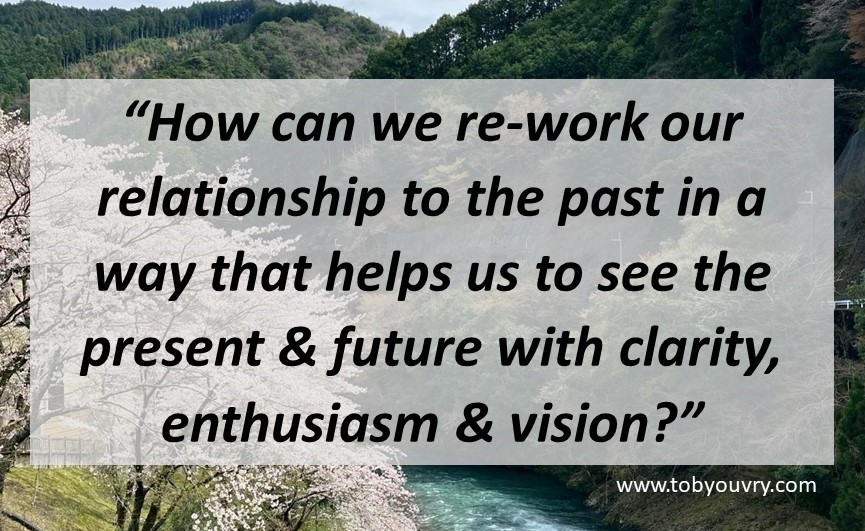
I am now offering it as a 1:1 coaching service, which can also be facilitated in a group coaching context. You can read about the coaching & training by following the link above. Essentially the question it seeks to answer is “How can we re-work our relationship to the past in a way that helps us to see the present & future with clarity, enthusiasm & vision?”
I have also created this ‘Therapeutic mindfulness reading page’ which is an anthology of all the articles that I wrote during that time. You can find these summarized below, with links to each article.
The recordings of the original course are also available as an online course, if you are interested in that then just drop an email to info@tobyouvry.com
“The purpose of therapeutic mindfulness is to go back to previous stages in our development in order to reconnect to feelings, emotions, body sensations & memories that we have repressed, denied, or lost touch with. The healthy re-integration of these experiences sets the scene for a renewed sense of wellbeing within our present life, & for safely engaging in higher, deeper levels of personal growth.”
“You might think about your inner mood as being like the weather. If you are playing a game of tennis in a sunny, lightly breezy day, its completely different from playing it on a rainy, very windy day. We can usually shift ourself at least partially toward a better mood if we try, and this then affects everything for the better”
“Past-focused mindfulness involves delving consciously into past memory & narratives, releasing pent-up energy, and then gently reworking these stories to create a more optimistic and energized outlook“
“The ‘teenage self’ is one of several aspects of our inner-self or psyche that, if we take the time to connect to, we can find ourselves being enriched. For example, if I am well connected to my inner teenager, then I can draw upon his innate curiosity, ambition and appetite for life in a way that other middle-aged folk who lack a vital connection to their inner teenager cannot!”
“Suppression can be used positively and strategically to enhance our effectiveness and wellbeing in life, whereas repression almost always results in long term inner turbulence and interference in our ability to see and work with our present life as it is”
“In a situation where your self-concept doesn’t believe you can meet & solve a challenge, you can do one of two things. You can give up, or you can change your idea of yourself, making it one that can work with what is presenting”
“As you grow & mature, if you repress your previous selves, they can become ‘allergies’. If part of you remains trapped within them, they become ‘addictions. Transcending & including means to grow beyond who you were, whilst still giving your previous self a seat at the table”
It can be good to really get clear about the basics of what you are trying to do in meditation, in a way that invites many deeper levels of understanding of those basics. The article below aims to offer some pointers for this…. In the spirit of presence,
Toby
The foundational pillars or ‘goal-posts’ of meditative presence
In my previous article on basic mediative presence, I defined meditation as: “Meditation is the state of being awake, not lost in thought and not falling asleep. It is a state of being present in the moment, and aware of the present”
This gives us a nice broad, ballpark within which we can start to practice. Here are two images to work with in meditation to help get comfortable in this space.
Sitting between the goal posts In this first image, imagine yourself sitting in the middle of a football goal mouth. Either side of you are the goal posts.
Going to the far side of the left goal posts means getting completely lost in thought
Going to the far side of the right goal post means falling asleep
All you are trying to do is keep your attention oriented around the body and breathing, stay in the centre of the goal mouth, and avoid ‘traveling’ to the far side of either post.
Notice that you can have thoughts arising, but not be lost in those thoughts. Just because there are thoughts does not mean that you have lost your meditative presence
Notice also that you can feel a bit sleepy, without falling asleep. You just need to notice the sleepiness and avoid totally dropping off!
It should feel like you are sitting in quite a forgiving, comfortable space that you can relax in. Even if you do get lost in thought, or fall asleep a little, is not a problem. As soon as you become aware of it, bring your attention back between the goal-posts, and re-establish your basic meditative presence.
Two trees or pillars An alternative to the goal-posts image is to imagine yourself between two pillars or trees. If you imagine yourself between two pillars, you could imagine yourself in your own ‘meditation temple’. Perhaps you are looking out into a beautiful landscape from the steps of the temple, between the two pillars. Or you can see and feel yourself between two trees, sitting in a harmonious landscape within nature. Both the pillar and tree option are equally good, you just choose the one that appeals the most to you, and that you feel most comfortable with. Like the goal posts image:
Going beyond the tree/pillar on the left represents getting lost in thought
Going beyond the tree/pillar on the right represents falling asleep
Your goal is simply to remain in the middle, avoiding either extreme, and cultivate your basic meditation state. If you are a visual person, you can build the image of the goalposts, pillars, or trees quite strongly, and use the image as an orientation point in addition to your body and breathing. Imagining yourself in a place that is beautiful or harmonious can really help to access a state of meditation more quickly for some people. If you are not a visual person, then you are mainly using the image as a metaphor or set of practice principles to guide you as you meditate. You would mainly simply stay with the body and breath, not worrying about building a picture so strongly. Try sitting between the goalposts or pillars for 5-10minutes initially, and then for 15-20minutes using it to help you build your basic meditation state more tangibly and stably.
Welcome to the simple, positive, creative & aware training page. In it you will learn how to practice this integral meditation combination effectively, & you can then use the meditation recordings & readings below to practice.
As I said in the original article on this meditation: “I outline four ways of paying attention that, if you get really good at will render you largely impervious to intimidation from any of the current challenges in your life.”
The Integral Meditation Training pages are a free resource, but if you feel you have benefitted, & would like to donate to the Integral Meditation training pages & project, you can do so via PayPal or if in Singapore you can do so directly by PayNow on +6596750279. Thanks!
When Chogyam Trungpa, the famous Tibetan Buddhist Master was asked “What is Dharma?” (Dharma means the teachings of the Buddha), he replied “Dharma means that everything is workable.” The other day I was texting a friend I hadn’t seen in a while. He asked “How is everything?” to which I replied “With acceptance, everything is workable.” This made me recall the Trungpa quote, then leading to a few thoughts about the principle of ‘Effortless effort’. You might think about Effortless effort as a way of accepting and working with the reality that you are presented with. It is a ‘state’ of being that then leads into a way of doing that works with whatever we are facing. ‘Effortless effort’ could also be described as ‘Doing though non-doing’, also known as ‘Wei wu wei’ in Chinese (translating into ‘effortless action’). It is a philosophy of life & way of meditating found explicitly in the Zen, Chan & Taoist schools of meditation. Implicitly it is found in most of the great wisdom traditions of the world. It indicates skilful and ergonomic ways of working with life that facilitate balance, resilience, creativity & wisdom.
The feeling of Effortless effort (E-E) in the body
One of the things that I really enjoy and appreciate about E-E is the sense of flow and energy efficiency that it brings. It makes difficult things feel manageable, and effort over a long period of time sustainable, even quietly joyful. The state of E-E can be described as a way of holding your body, as well as a state of mind. As a bodily state, here are some pointers:
The muscles are soft, with only enough tension in them to perform the presenting task. For example, if you are standing or sitting upright, the crown may be high and the body upright, but the centre of gravity is low in the belly, so that the chest and shoulders are not carrying their own weight. Hands and arms are loose, and the belly is not holding onto emotional stress.
The feeling of the inner self is one of comfort in the body, or ‘comfort in your own skin’. There is an absence of rush or panic, even, and particularly in the face of persistent stressors
The body feels at home in its environment. There is a sense that the world is a friendly place, where you are things are workable. As a sensation in the body, there is a feeling of trust in process, a sense of quiet alertness and relaxed attention
An everyday reflection
This morning I had a coaching appointment cancelled at short notice. So, I thought it would be nice to take my daughter to pre-school. I took her, but forgot to bring her nap-time bedding. I had planned to work on this article before going to work, but now I had no time, because I had to go back to the school. Pausing, relaxing, and working on the principle that ‘everything is workable’, I transferred the article from my computer to my phone, and use the extra time on public transport to continue to edit my article. Through-out the process, I simply focused on staying calm, feeling flexible and accepting. Having come up with a simple battle-plan, I relaxed into it’s execution. I consciously worked on being smooth and ergonomic, working with the situation rather than fighting it. This is a very simple example, but hopefully it gives you a feeling for how to start working with E-E in everyday situations. If you can practice daily actions with E-E, then you will burn up a lot less energy, and arrive at the evening feeling less fatigued, with your mood more positively disposed. A final point, if you get good at E-E during the day, when you sit down to meditate, you will find that you are already near a state of meditation, and that moving into formal meditation feels more like slipping into a warm bath; a natural, easy transition from doing to being!
Shamanic meditation, often described as ‘Shamanic journeying’ occurs mainly in the dream state, which is to say the psychic and subtle levels of mind. You might think of shamanic meditation as a type of ‘conscious dreaming’ done whilst meditating…read full article
“The time to make progress in your meditation practice is always ‘now’, so if by an act of choice and imagination you can see each day as an ‘active-retreat’, then this is really going to accelerate your growth”
Dear Integral Meditators,
This week’s article explores the potential of each day of your life to develop your active-meditation practice, by seeing it as a retreat! Also, if you want to really help kick start this, the Integral Meditation Two Day Retreat on the weekend of the 28/29th October is a fantastic way to do it!
Also excited to announce the new Integral Life Practice Sessions, starting on Saturday 11th November, 9am-12noon, do click to see the format.
In the spirit of life-as-meditation,
Toby
Your daily life as a meditation retreat
Don’t wait for a retreat to do meditation It is great to be able to do a meditation retreat, and the experience can be genuinely transformative. But for most of us, the vast majority of our time is spent with work, family and the everyday challenges and joys of daily life. The time to make progress in your meditation practice is always ‘now’, so if by an act of choice and imagination you can start seeing each day as a type of ‘retreat-in-the-world’, then this is really going to accelerate your capacity to grow as a meditator.
What you need to make your daily activities a meditation? All very well to say ‘My daily life is a retreat,’ but how can we develop the capacity to use daily activities as forms of ‘active meditation’? Below is a list of qualities that we can bring to the table:
Intention & enthusiasm (urgency) We begin the process with intention; “I am going to see today and its challenges as a form of active meditation, to facilitate my inner growth, to benefit my circle of family, friends and colleagues, and to make a benevolent impact on the world.” From this intention, we then generate a degree of curiosity, enthusiasm, and determination. It all starts from the choice to live on purpose!
Creating your basic meditation space The basic goal of any meditator is to be ‘primarily present, secondarily thinking.’ This means a successful day retreat would be spent being just a little more present, and a little less lost in thought. To do this the basic mantra is: Not lost in thought, not falling asleep, anchored in the present, and aware of my focus point in the present. The ‘focus point’ in terms of your day retreat, is simply the next task or activity at hand, that is your meditation object.
Mindfulness & alertness To stay ‘primarily present’, you need to remember that that is what you are trying to do (mindfulness), and alert when you loose track of it (alertness). Mindfulness and alertness are the tools that you employ to make any activity a ‘meditation.’
Ergonomic, focused flow Mindful activity relies upon a state of body-mind that is balanced between focused and relaxed. If you try to hard to focus, you’ll get tense and tired quickly. If you are too relaxed, you’ll get distracted easily and succumb to inertia. As you do your activities, experiment with what it feels like to do it with this balanced, ergonomic state of ‘flow.’
Alternating focused & field awareness As you go through your day, there will be times when you are paying attention single-pointedly to one task, and then ‘panning back’ to take in the big-picture of the day. ‘Single-pointedness’ and ‘field awareness’ are two basic types of meditation practice. We can use this skilful alternation between the two to navigate our day in a meditative manner.
Review time Some time at the end of the day, or when lying down before sleep can then be used to assess what went well in your ‘retreat.’ What activities were really good ‘meditations’, and what were the ones where you ‘got lost’? What can you try tomorrow to do a bit better? What lessons have you learned? With your review time, you can use one day to make the day after an incremental improvement.
As the Navy Seal motto goes: “When faced with a challenge, we sink to the level of our training. Train hard!” With skill we can train hard, with gentle consistency and make every day a ‘meditation retreat’!