Categories
Awareness and insight Inner vision Meditation and Art Meditation and Psychology

Reflecting on the Relationship Between Art and Meditation

Here are three areas and life lessons that meditating and making art both teach:

Close Observation

Most of us think we know what the world looks like, but if we examine this assumption we learn it is not as true as we thought. For example if you try and draw a tree you discover that your idea of what a tree looks like and the way in which it actually exists physically in space are very different, and that in order to get to the “real” tree and draw it accurately you have to let go of your idea of the tree and look closely and clearly with your eyes.
In a similar way we may think that we know ourselves well, we think we know who we are. However, when we start meditating, which is partly the discipline of witnessing and observing our mind and self, we discover that the person we think we are and the person that we actually behave like are actually very different. Meditation teaches us the bitter-sweet art of seeing who we REALLY are and trying to bring our self-image and behavior into an authentic and genuine communion.
Both making art and meditation have made me find simple objects and activities very interesting and fulfilling as there is always endless detail and nuance to observe and enjoy. Last Friday I took a bit of time off and went to sit down in East Coast Park and just look at the sea, listen to the wind in the trees and observe the play of the afternoon sunlight across the landscape. I can’t imagine a much more fulfilling time.

How to See Through Difficult Times

If you have ever tried to create a piece of art work you will know that often (though not always) there is a time when everything about the picture seems horrible, ugly and awful, and where the critical voice in your mind is telling you that you may as well give up and trash the whole thing, and that you also may as well give up art too. After a while as an artist you come to expect this ‘phase’ in your work to complete a piece, and you know that the main thing to do is “keep calm and carry on”, steadily working through this phase. You learn that it is part of a natural cycle, and when it happens it just indicates that you are at a certain stage of the creative process. You don’t panic, after a while it can even be enjoyable in a funny way.
Similarly as a meditator you learn that sometimes your mind just goes through dark phases. Sometimes you know the reason, sometimes not, but either way you come to understand through sitting with these dark phases in meditation that they come and go. They are just a part of the processes of life, like the weather; sometimes sunny, sometimes thunderclouds. Either way there is no need to panic, just be present with it and allow it to work itself through your system in a non-harmful way.

Understanding How Beauty is Both Spontaneously Ever Present, and at the Same Time has to be Worked at and Re-created all the Time

As an artist you learn through observing things from multiple angles and points of view that everything has its own type of beauty. As a result, wherever you look you can appreciate something about what you see. At the same time actually creating a  beautiful and authentic piece of art work is a very demanding endeavor requiring a lot of effort physically, mentally and spiritually of the artist. In this way beauty for the artist is something that s/he can always see in what s/he observes, but at the same time the creation of beauty is always effortful and challenging.
Really with meditation practice it works the same way, after meditating for some time you get to a stage where even if there is pain and confusion in your mind, there is also an ever present stillness and beauty that is available to you at all times, you just have to remember it. However, in another sense the daily process of thinking positive, acting out of integrity, creating harmonious relationships often seem to take just as much work and effort as they always did!
This seems to be the paradox of both outer and inner beauty; they are ever present and yet they demand constant effort to create and recreate. However, being in touch with the ever present aspect of inner and outer beauty (which are really states of being) helps us to keep even-minded amidst the struggles and strains of trying to effort-fully create a beautiful inner and outer life for ourselves and others.

© Toby Ouvry 2011, you are welcome to use or share this article, but please cite Toby as the source and include reference to his website www.tobyouvry.com

Categories
A Mind of Ease Awareness and insight Meditation and Psychology Meditation techniques

Going Beyond the “Do This” and “Do That” Mentality

My daughter has just turned six, and one of the things that I have noticed about our relationship recently is that it has been possible for me to start changing my relationship to her from a lot of “do this” and “do that” instructions to a much more process based “Why don’t you try this?” or “What will happen if you think about it this way?”. Her gradual increase in age and maturity, combined with my own gradual maturing as a parent has allowed our relationship to evolve from being somewhat dictatorial to much more co-creative.

How we often use the “do this / do that” mentality with regard to the way we treat ourselves
One of the things that has struck me when thinking about the changes in my relationship to my daughter is how often we get caught up in a “do this” and “do that” relationship to ourself. “Instead of  approaching situations and challenges in our life with an open, flexible and enquiring mind, often we will simply react in a pre-programmed way, based around our past experience. Internally we order ourselves around with no real sensitivity to what is actually happening and this kills our ability to respond authentically and creatively.
For example I may find myself mentally punishing myself for not having made more effective use of my time during the day. The conversation goes something like:
“You should not have got sidetracked by this, you should not have wasted time doing that, you don’t deserve to relax this evening because you have not achieved what you wanted…” the instructions and judgments go on and on…

What we can replace the Do this/do that mentality with
One of the things that we are trying to create through a meditation practice is enough self-awareness  to be able to respond to our immediate circumstances as they are, without projecting judgments or old values onto them. What we are trying to do is replace the automatic “do this” and “do that” voice of our judgments and past mental programs with questions like:
“What is this situation showing me or offering to me?”
“What are the real emotions behind what is being said here?”
“What is the most creative thing I can do in this situation?”
“What is my most authentic response to what is happening here?
By bringing questions such as these to the forefront of our mind in our daily life we can start to over ride the automatic “do this” and “do that” orders coming from our subconscious mind and start to live a life that involves more freedom, more authenticity and more happiness.

Awareness exercise:
The art of going beyond our “do this” and “do that” mentality lies in replacing these inner orders with a question that stimulates our enquiring mind and creativity. The next time you can hear and feel your old judgments barking orders at you as you try and cope with a life challenge, consciously place this question in the centre of your awareness:
“What is this situation helping me to see and learn?”
Try and stay with this question for a few minutes and observe the creative ideas that start to emerge from the inner space that the question allows.

PS: Heads up on the new series of meditation classes starting at the beginning of September 2011 “Meditations for Creating a Mind of Ease, Appreciation and Positive Intention”. Follow link for details!
© Toby Ouvry 2011, you are welcome to use or share this article, but please cite Toby as the source and include reference to his website www.tobyouvry.com

Categories
Awareness and insight Integral Awareness Tree of Yoga

Meditating On The Tree Of Yoga – Coming Back to the Body

Later this year I will be beginning a series of classes with meditations upon the “Tree of Yoga” as a focus point, so in my articles over the next few weeks I will be focusing upon themes relating to this. In this article I explain some basic working definitions of yoga from a meditative perspective, and how we can begin working with these ideas in a practical fashion.

Three Levels of the Meaning of Yoga That can be Distinguished
One of the main meanings of the Sanskrit word ‘Yoga’ is ‘Union’. From this we can see that the many different practices of yoga aim fundamentally at achieving a state of union.We can distinguish three types or stages of union in the path of yoga:

  1. Accomplishing the union of the mind and body
  2. Accomplishing the union of the body-mind with the environment
  3. Accomplishing the union of the self with the Cosmos

So, here we can see the three basic stages; the first stage focuses on unifying or synchronizing the body and mind into a singular, harmonized unit. The second stage focuses on expanding our self sense beyond the body mind so that our self-sense includes greater aspects of our internal and external environment. The third stage involves releasing all boundaries between our personal sense of self and the Cosmos, thus achieving the ultimate union of self and cosmos into the primal or Universal Self. This final stage, the recognition, embodiment and articulation of the Universal or True Self is really the endgame of all yoga’s whether you are talking about hatha yoga, bhakti yoga, raja yoga or any of the other forms of yoga. For the remainder of the article we will be focusing on the first level of union in the path of yoga.

A Closer Look at Stage 1: The Two Stages of Unifying the Body-Mind

Oftentimes the start of many peoples IDEA of the spiritual path involves an attempt to “go beyond the limitations of and attachments to the body and its appetites”. The body is seen as the obstacle to inner growth, continually getting in the way of our spiritual aspirations, and “detachment” from the body is where a lot of people place their efforts.
However, in reality, and this is a really key understanding, most people are already detached from the body in the sense of being mentally disconnected to it! So, the first goal for almost 100% of us is to reconnect our mind to our body as they exist in the present moment, here and now.

How did we disconnect from the body in the first place?

Our body-mind disconnection takes place in two stages:

  1. The separation of the ego from the body.

As we grow up our self-sense develops in stages. As young children we identify with our body, as teenagers we identify with our emotions. By the time we get to young adulthood almost all of us identify ‘self’ as being our mind, and the relationship to our ‘self’ to the body is like a rider to a horse; the mind or ego is like the rider, and the body is like the horse. Thus our mind and body have now become experientially separate; ‘I’, or my ego possesses my body which is a separate object. This is the first separation or disconnect of mind from body

  1. Stage 2: The Mind/Ego Divides Against Itself – The Separation of Persona from Shadow

So, our ego is now separated from our body, unfortunately it gets worse. Having now identified our ‘self’ as our ego, our ego then splits into what in psychological terms is called the ‘persona’ and the ‘shadow’.

What are the Persona and Shadow?
The Persona– The persona is that part of the contents of our mind and ego that is acceptable to our self-image. The persona is the conscious perception of who we think we are, that part of the contents of our consciousness that we allow ourself to see.
The Shadow – The shadow is the parts of our mind and ego that is not acceptable to our self image. The shadow is all the parts of our mind and ego that we refuse to consciously acknowledge and so as a result gets repressed or ‘pushed down’ into our unconscious mind. You can find more on the shadow self in my previous article on the shadow: Six Tips for Releasing the shadow Self. Another word for the shadow would be the repressed unconscious.

Bringing this all together
So, from this we can see that in order to re-unify our body-mind into a synchronized whole we need to go through two stages:

  • Unify our mind by healing the divide between our persona and shadow, thus creating a healthy functional ego.
  • Unify our body and ego by bringing our awareness and attention back into the body and the present moment.

There are a lot of practices that are specifically designed to help facilitate these two stages. For example traditional psychotherapy (eg: Freudian and Transactional Analysis) aim at creating a healthy ego through unifying the shadow and persona. Hatha yoga, Qi gong and Tai-Qi are all helpful methods for the second stage of unifying the mind-body. There are also psychological therapies that aim at unifying the body-mind such as gestalt therapy and aspects of the humanistic psychology approach of Carl Rogers.

The Centaur
The Centaur is a mythic beast that is half human and half horse. Centaur or centauric is sometimes used as a name for the state of consciousness where the body-mind are unified. The centaur is not a human riding a horse, the centaur is both the human and the horse as a single entity, no division.
The centauric state of consciousness is a state of being where our body intelligence and mental intelligence are always working in harmony. When we accomplish this union our body-mind union becomes more than the sum of its parts, we start to be capable of achieving things that ordinary people would consider ‘impossible’ or ‘beyond them’. Much of the Human Potential Movement is aimed at accomplishing the centauric state, the unity of the body-mind.
The centauric state of a unified body-mind acts as the stable basis upon which we can then go onto explore higher and more expanded levels of consciousness and being. If we try and ‘expand’ our consciousness too extensively and quickly before stabilizing our centaur we will quite rapidly find ourself struggling with the unhealed elements of our ego, persona and shadow.

Awareness Practices to Start Unifying the Body-Mind: Meditating on the Body as a “Consciousness Sponge”.

So, I’ve covered quite a lot of ground above, and what I want to do is finish with a really simple two stage practice to help you begin integrating your body-mind. It can be done as a short 1-5minute practice, but just as appropriately and easily it can be done as a 15-30 minute form.

Stage 1: Noticing Resistance.
Simply sit quietly and notice the resistance that your mind has to entering fully into the present moment and into your body. Notice how it is always jumping away from present moment awareness of the body, diving into the past and forward to the future. Take your observation of this resistance as your object of awareness for the first part of the meditation. Don’t try and overcome it, just notice it.

Stage 2: Your body as a Sponge
In the second stage imagine that your physical body is like a dry sponge and your mind and consciousness is like water. Feel all the thoughts and feelings in your mind being gradually absorbed into your body as it sits in the present moment, just like water being absorbed by a dry sponge. Feel your mind fully inside the skin of your body, fully present in the here and now, in communion with your body. For the remainder of the meditation explore this feeling of a unified body-mind as deeply and fully as you can, rest your awareness on it and in it as fully as possible.

© Toby Ouvry 2011, you are welcome to use or share this article, but please cite Toby as the source and include reference to his website www.tobyouvry.com

Categories
Awareness and insight Inner vision Primal Spirituality

Meditating on the Four Seasons and Four Stages of Our Life

I’ve been back in the UK now for a few days, enjoying the particular ambience of the English summer time, all the birds in the garden are looking extremely plump and well fed, the flowers are all in bloom and the dragon flies are flying around the pond, showing off their beautiful green and red colourings.

One of the major “diagrams” or maps of the spiritual path as explained in the western tradition is the Wheel of Life, which essentially consists of a circle with four points on it. These four points correspond to the following basic energies and directions:

North: Winter, night time and the earth element
East: Spring, morning and the air element
South: Summer, noonday and the fire element
West: Autumn, evening and the water element.

In addition the four seasons on the wheel spring, summer, autumn and winter also correspond to the four stages of a human (or any other creature’s) life, namely childhood, youth (young adult), mature adult (parental) and old age.  From this we can start to see that our own life moves in a natural cycle that is very much like the four seasons of the year, and also the four stages of a twenty four hour cycle; morning (childhood), noon (young adult), afternoon (maturity) and night (old age).
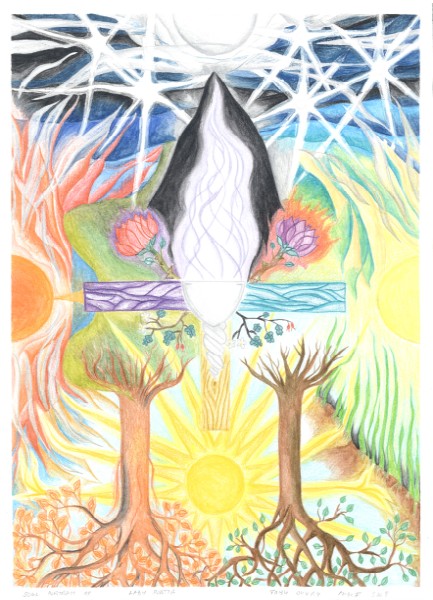
In the picture that I have posted with this article you can see these correspondences depicted in an artwork that I have created:

  • A pathway in the north (top of picture) leads to a winter landscape
  • To the right hand side is a pathway opening to a spring landscape
  • At the bottom is a gateway opening to a summer landscape
  • On the left hand side there is a pathway leading to an autumn landscape.

Meditation on breathing with the four seasons and stages of life
From the above we can see that our life, like the nature of which we are a part moves in cycles. We can begin to develop a subjective feel for this by meditating in the following manner:

  • As you begin to inhale feel the awakening of new life in your body-mind, like the energy of spring and childhood within you.
  • As you progress through the second half of the inhalation, feel the awakening of the energy of summer and the prime of your youthful-self awakening within you.
  • As you pause briefly at the top of your breath feel your body-mind  to be full of vital energy and life-force, like a landscape in mid-summer.
  • As you begin exhaling feel yourself connecting to the energy of autumn and maturity.
  • As you move into the second half of your exhalation, feel yourself connecting to the season of winter, and to the wisdom of old age.
  • As your breath ceases at the bottom of your exhalation, meditate briefly on death, and the end of the brief life cycle of your last breath. Note how it is from this ‘death’ that a cycle of new life emerges with the beginning of the next new breath.
  • Continue this cycle of breathing for as many breaths as feels comfortable, and end with a period of silence, stillness and deep calm.

This is a nice meditation to do outdoors in direct contact with nature and the seasons themselves. Also, contemplation of the ‘Four Seasons’ artwork that I have done can also be a helpful tool for getting a feel for how the four seasons and stages of our life flow together in a circle, one after the other, and how we can create this cycle of energy within ourselves with each in-breath and out-breath.

© Toby Ouvry 2011, you are welcome to use or share this article, but please cite Toby as the source and include reference to his website www.tobyouvry.com

Categories
Awareness and insight Enlightened love and loving Meditation techniques Motivation and scope

Meditating on Detached-Compassion and Divine Playfulness

The first of the five enlightened powers that I outline in my meditation technique “The Five enlightened Powers” is the power of embodiment. This involves, quoting from my previous article on the subject:

Remembering that you are, in essence a spark of Universal spirit experiencing (temporarily) a physically embodied life on Earth as a human. Whatever situation you find yourself in, grounding your awareness in your true identity and not getting caught up in your small or egoic identity is the power of embodiment. Wherever you are, remember WHO you are!”

A question that we may then ask ourselves is “So then what is it actually like to experience ourself as such a spark of Universal Spirit? What qualities and emotions would we experience?” In this article I intend to highlight two specific qualities and perspectives that we can seek to bring into our daily life that will enable us to function more authentically as a divine spark amidst the push and pull of our daily lives. These two qualities are detached-compassion, and divine playfulness.

Detached-compassion

Detachment and compassion are qualities that often we think of as being separate because they appear to exclude each other.  We think that when you are detached you are disconnected from others, and so cannot feel deep compassion for them. Likewise if we are truly being compassionate we cannot be detached because that would mean disconnecting from our feeling nature, which is where our compassion is located.

However, viewed from the perspective of our spiritual being, it is perfectly possible to bring deep compassion together with a sense of detached, witnessing observation. This is because from the perspective of spirit:

  • We can be detached from any situation because we are always viewing things from the “big picture” perspective; nothing is truly personal in the egotistic sense of the word.
  • At the same time we feel totally close and intimate with all living beings because we realize that on the essence level we all share the same common identity. Ultimately we are all one being viewing the world from billions of pairs of different eyes!

So, from the perspective of our spiritual being we experience our life as impersonally-personal, as deeply involved and at the same time not involved, as passionate at the same time as being totally even minded.

The main take away from this is that if you practice bringing detached compassion together simultaneously in life situations, gradually improving your ability to do so, then you will consistently increase your experience of what it is like to be a spiritual being embodied in a physical body.

Divine Playfulness

One of the fundamental qualities of spirit is playfulness and a corresponding sense of humor. From its perspective the whole process of creating and evolving a universe is done as a type of game, a way of creatively expressing itself and its potential.

Consequently, if you want to increase the level of spirit in your daily life then entering into your daily tasks in the spirit of divine playfulness is a great practice to have.

Most of the time we tend to get a little too serious about things and as a result allow our life to become unnecessarily stressful and unhappy. Thinking about the challenges in your day as playful games and puzzles set you by the universe and your own spiritual being in order to help you evolve and grow is a technique that both relieves stress and enhances the deeply felt spiritual nature of your human experience.

One to Five Minute Meditation to integrate Playfulness and Detached Compassion into Your Daily Life

Step 1: Mentally select a particular life situation/challenge  that you wish to work on in the meditation. One of the characteristics of meditating with the Five Enlightened Powers technique is that you are always trying to work directly with a practical “real time” situation in your life. It should never be allowed to become totally abstract.

Step 2: Recollect your understanding of detached compassion. Open your heart to the feelings that you are experiencing and the other people that are involved AT THE SAME TIME AS mentally taking a step back and seeing what is happening from the big picture perspective. Experiment and try to feel both empathic compassion and witnessing observance SIMULTANEOUSLY. Breathe with this combined feeling experience for a while.

Step 3: Introduce playful humor to your perspective of the challenge. Think of the challenge as a game that you as a spiritual being are being set by the Universe to stretch and improve yourself as a human being. Stay with this perspective and the experiences it gives rise to for as long as you wish.

If you do this brief exercise a few times over the next week or so you will find that compassionate detachment and divine playfulness will become a real experience for you in your daily life that can help you to gain an authentic experience of what it is like to be a spiritual being appearing as a physical body!

© Toby Ouvry 2011, you are welcome to use or share this article, but you must seek Toby’s permission first. Contact info@tobyouvry.com

Categories
Awareness and insight Enlightened love and loving Meditation and Psychology Motivation and scope Presence and being present Shadow meditation

The Role of Courage in Meditation

Two Types of Courage

In order to build a successful and authentic meditation practice you need courage, and the two types of courage that I want to highlight today are the courage to initiate, and the courage to persist. You need the courage to initiate to get through all the excuses and distractions that are in the way of you starting or restarting your meditation practice, and just ‘put your bum on the seat’ so to speak. You then need the courage of persistence, which is really a steady type of willpower, to simply keep going on a regular basis week in week out, so that your practice has a chance to bear fruit. Without these two types of courage, the inner clarity, wellbeing and centeredness that is within the grasp of anyone who persists in meditation will remain out of your reach.

Two Types of Meditation: Sitting With the Silence and Sitting With the Noise

When many people approach me for the first time to talk about meditation, the most common reason for them wanting to start meditating is that they want to find some headspace, some inner silence that they can relax with. They then tell me that they simply cannot stop their mind chattering, and so they find it “impossible” to actually start a meditation practice. What we need to realize (and this is really important) is that before we can enjoy “sitting with silence” we first need to enjoy the process of “sitting with the noise”, that noise being the inner noise of our mind incessantly chattering with itself!

The way to learn how to sit in silence is first to get comfortable sitting with the noise of your mind. Over time and out of your daily or regular practice of sitting with the noise of your mind you will gradually start to notice an inner silence emerging, at first only occasionally in brief flashes, but the gradually emerging more and more fully as time goes by.

The Story of Tom

Back in the 90’s, when I was a Buddhist monk teaching meditation in the north of England I had a man in his 70’s come to my meditation class called Tom. Tom was an ex coal miner. He was in constant discomfort due to rheumatism, and his wife was a mental and physical invalid (Parkinson’s disease I think) to whom Tom was the sole care giver. He arrived at my class for the first time in deep despair regarding the loss of his wife, of his own physical fitness and of many of the other good things in his life that had previously made it enjoyable. He made a courageous choice to sit down for 20minutes at the beginning of each day to meditate, a choice to which he stuck to. He used to describe his meditation to me, saying that usually for the first 5-10 minutes all of the anger, despair and sadness would well up within him about his life and about how unfair it all was. Then, at some point in the middle of his meditation, patches of silence would start to appear, and the noise in his mind would quieten. Usually, for the last few minutes of his meditation he said, he would find a state of deep peace, and those few minutes at the end of his meditation were enough to get him through the rest of the day.

Tom’s story is a simple story of courage and persistence in meditation. His description of his own meditation experience shows the truth of how very often before we experience peace in meditation we first have to sit with the “storm” so to speak. The way to meditate in silence is first to get comfortable with sitting with the noise!

Practical Work: Get Comfortable Sitting With The Noise

Pick an amount of time that you can commit to every day, from 3-20minutes. Resolve each day during that time to generate courage and self-compassion, and then simply “sit, breathe and be” with the noise inside your mind. Forget about immediately making your mind silent, just focus on sitting breathing and being with what is there, pleasant or unpleasant, happy or sad.

If you do this consistently each day the inner silence will emerge in its own time. If you make this a lifetime practice the inner silence will grow organically within your life a tree. A tree grows too slowly to spot the changes from day to day, but from month to month, year to year it grows from a fragile seedling to a mighty tree.

Long Term Results

The final thing that I want to mention about meditating on inner noise and inner silence is that eventually, after you have been meditating for quite some time you will discover that you are equally happy to experience inner noise or inner silence, you realize that they are really just two sides of the same coin and not so different in reality.

This can be difficult to grasp conceptually without experience, but an analogy may help: In the same way that a bright, sunny day and a thunderstorm are both “weather”, so a loud noisy mind and a silent one are just “mind”. If you are sitting in a strong house looking out of your window, a storm and a sunny day can both be interesting and enjoyable to experience. Similarly once we have grounded our awareness in the centre of our being through meditation, both noise and silence are equally enjoyable 😉

© Toby Ouvry 2011, you are welcome to use or share this article, but please cite Toby as the source and include reference to his website www.tobyouvry.com

Categories
Awareness and insight Inner vision Primal Spirituality

Meditating with Animals and Starlight – Shamanic Journeying

Meditating with animals and animal spirits is one of the main practices found in ancient shamanic traditions worldwide. The ancient shamans were really the pioneers of the first meditation techniques and these techniques (which are mainly the technique of “inner world journeying”) are deeply embedded within the psyche of human beings, including you and me. The result of this is that most people who actually try shamanic meditation techniques actually find that they are able to gain some success quite quickly. Michael Harner, one of the pioneers of modern proto-shamanism reports that fully 85% of people participating in his shamanic journeying workshops are able to gain tangible results and experiences from their first attempts at journeying meditation.

As mentioned above, the main meditation “technique” found in shamanism is the “inner world journey” where contact with animal and ancestral spirits is sought for the purposes of gaining guidance, wisdom and healing. When meditating with animals and animal guides the sequence of the meditations would tend to go something like this:

  1. The shaman (or you and I if we are choosing to meditate in this way) goes on a journey, either within his imagination, or actually physically into a landscape to meet his or her animal guide
  2. Once the specific animal has been contacted, the shaman requests to be taught or shown the wisdom or healing method that the animal has to impart to him.  There then follows a communion between human and animal, trust is hopefully gained and the relationship proceeds. It should be noted that the animal chooses the shaman, not vice-versa. If you are met by an ant or a rat when you wanted a lion you cannot do a trade in! Experience will show you that in reality the animal that comes is invariably the best one for you and for the job at hand!
  3. A series of meditations can then be embarked upon where the mediator then goes on journeys and receives teachings, techniques and insights from the animal. Initially the meditator travels WITH the animal, but over time s/he may feel as if he is merging with the animal’s body and actually BECOMING the animal for periods of time.
  4. Over time a stable working relationship is established with the animal spirit which is mutually enriching for both parties, and the wisdom and abilities of the animal are imparted to the meditator.

What “abilities” and wisdom do you get from an animal guide?

The way in which animal guides impart wisdom is non-intellectual, experiential and mainly done through images. To take an example, if your guide is a spider, and in meditation you experience what it is like to have eight sensitive legs picking up information from all directions around you then this will give you a heightened awareness of your inner sense of touch which you can apply to appropriate life situations and challenges.

Starlight meditation with a pigeon

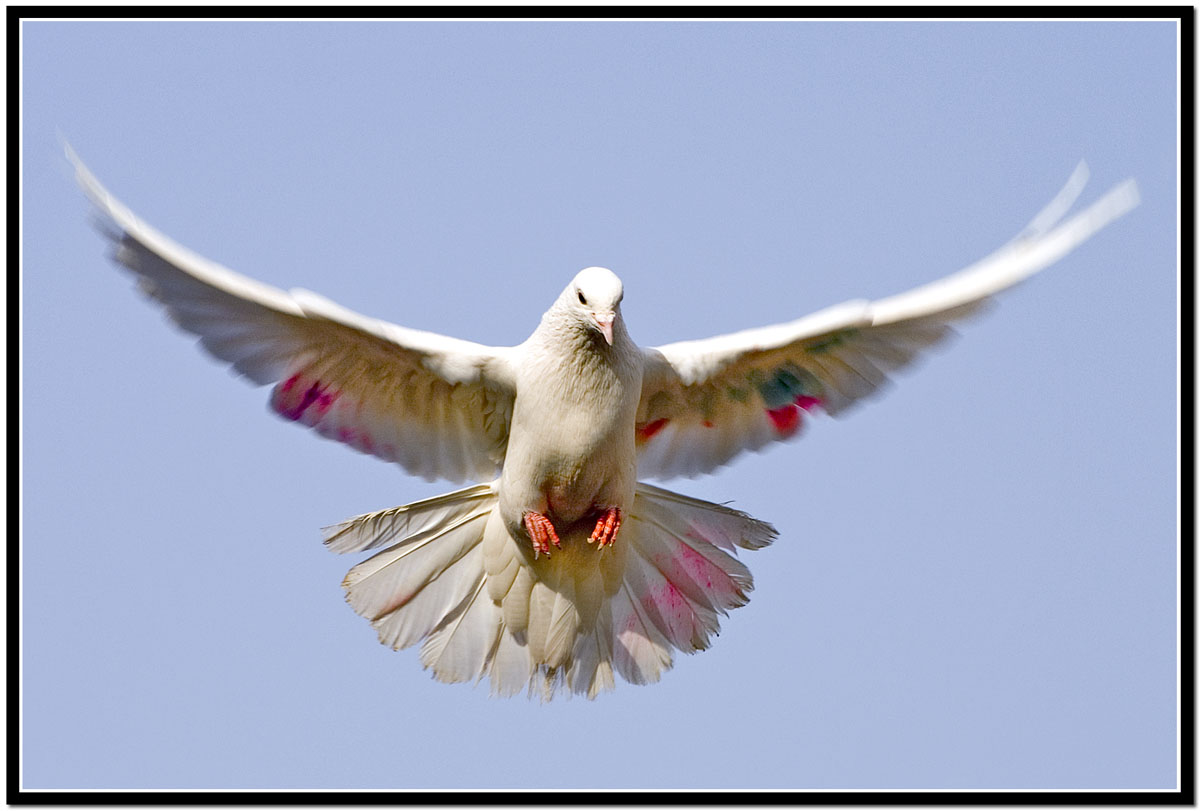
One animal that I have developed a relationship with since the beginning of 2010 is the pink necked green pigeon a number of which hang out in the park near my office. My animal journeying-type meditations are mostly spontaneous these days, done whilst napping or just sitting having a quiet moment. Animal journeying really just becomes an integral part of life once you have been doing it a while. So anyway, here is the last journey that I experienced with the above mentioned green pigeon, maybe a week or two ago:

I am having a ten minute meditation break in my office. My mind becomes quiet and tranquil. Quite suddenly I feel myself to be sitting in the next door park, staring up at a tree, where the green pigeon is sitting looking at me. After an initial contact we fly up into the sky going high above the cloudline.

With the clouds below us and the blue sky above, I become aware of rays of starlight flowing down from the heavens, bathing our bodies in white light. The rest of the meditation is then spent simply enjoying the starlight, absorbing it and being it. We then fly back down to the park, the vision breaks apart and I am sitting in my office meditating. I say thankyou to the green pigeon and get on with my day!

For many people the idea of meditating in this way may seem a bit far-fetched. However there is HUGE value for urbanized humans to do this type of meditation, as it re-connects us to a truly living relationship with nature and animals. The other thing that we discover is that it is actually quite easy, it is just a matter of re-awakening our visualization and imaginative skills, and pointing them in the right direction.

© Toby Ouvry 2011, you are welcome to use or reproduce this article, but you must seek Toby’s permission forst. Contact info@tobyouvry.com

Categories
Awareness and insight Integral Awareness Meditation and Psychology Presence and being present Shadow meditation Uncategorized

The Self-Healing and Self Evolving Power of the Mind and Six Tips For Releasing the Shadow Self

Whenever we engage in meditation or any other activity that promotes greater self awareness, we automatically begin to activate two innate capacities within our mind: Its capacity for self-healing and its capacity for self-evolving.

The minds capacity for self-healing is basically means that, whenever we move into a meditative state, the process of being aware of our mind, whether it I in a state of bliss or pain (or somewhere in between) has a beneficial healing effect upon our mind. Awareness heals.

The minds capacity for self-evolving means that the process of sitting and being alert and aware in meditation brings to the surface of our mind all the latent higher qualities and talents that we might not be aware of or, may even be afraid of.

Meditation makes you more aware of your creative gifts and talents and will over time create an energy in you that actually DEMANDS that you start expressing these talents in your life.

From this we can see that, as well as bringing you greater peace of mind, meditation can also be quite challenging in the sense that:

  • You become more aware of all that is damaged and that needs healing within you
  • You start having a lot of creative urges that start to PULL you toward higher and greater achievement in your life.

If you are not prepared for these side effects they can actually be a bit shocking, and you might even feel that you may be doing something wrong. Actually as often as not it is just your minds capacity for auto-healing and auto-evolving kicking in!

So, although the minds capacity for self-healing and self-evolving  are good things they also challenge us, bringing us face to face with the two aspects of our shadow self:

  • The DARK part of our shadow self; the damaged part of self which we have disowned and rejected, and
  • The LIGHT part of our shadow self; that latent greatness and talent within us that is as yet unknown and unexpressed.

With this in mind here are six tips for starting to get friendly with your shadow self. They are the basic elements of what I call a “Six point shadow reclamation process” that I use with coaching clients, and teach in Integral meditation Asia classes and workshops.

Step 1:

See it – Pay close attention to both strong positive and negative emotions that get triggered in you by people, events, places  or things. Be alert to the meaning that there is in the fact that your mind has been triggered in this way.

Step 2:

Feel it – Rather than immediately repressing or pushing away the strong emotions, thoughts or images that get triggered in your mind, get used to feeling into them, holding them within your conscious awareness

Step 3:

Communicate with it – Once you have some experience of steps 1&2, you can then try inwardly communicating with the person or thing that is triggering the shadow emotion. For example if a person fills you with revulsion, try visualizing them in front of you and asking “what is it about you that is creating such strong feelings of dislike?” – see what answer comes back. (Please note you are not actually communicating with the physical person, but trying to connect to that part of yourself that has been triggered!)

Step 4:

BE it – Practice mentally imagining that you have become the person that you fear or admire. Become that angry person that you run away from all the time, imagine yourself AS that great public speaker that fills you with so much admiration.

Step 5:

Own it – Practice taking responsibility for your shadow self and emotions, the light and the dark:

-“Yes I really am angry and hurt deep down, it is not always the other person that is angry”

– “It’s my job to make the most of this talent, no one else is going to do it for me!”

Step 6:

Transcend and transform it – This is the final step, and needs to be done at the END of the other 5 steps. A BIG mistake people make is to try and transcend their shadow self too soon, before they have properly seen it, felt it, communicated with it, been it and owned it.

To transcend and transform the shadow self simply means to recognize it is NOT your true or ultimate self, but nevertheless it has a potential place and function within your everyday personality of ego self. For example:

  • Your previous fear of anger and projection of it onto others can be transformed into the ability to be powerful and polite with difficult people
  • Your previous admiration of another person’s public speaking skills is transformed into your ownership of that talent within yourself, and the development of your own talent as a passionate and persuasive speaker.

If you simply think about the above six points, and start to try them out in your daily life, I think you will find that you can start to get a feel for this process.

Here’s to the maximization of our minds capacity for self-healing and self-evolving!

© Toby Ouvry 2011, you are welcome to use or share this article, but please cite Toby as the source and include reference to his website www.tobyouvry.com


Categories
Awareness and insight Enlightened love and loving Inner vision Integral Awareness Presence and being present

Re-Awakening To Your Bliss

When was the last time you enjoyed bliss? By bliss I mean not just an isolated experience of pleasure in either your physical, mental or spiritual bodies, but an experience of pleasure that touched them all three levels of your being  and brought them naturally back into alignment and harmony with each other?

Perhaps when you read the paragraph above the experience of bliss seems a little bit abstract, something difficult to attain, something that happens to us only occasionally and even then caused by something outside of ourselves, something that “happens” to us, rather than something we ourselves create?.

In my opinion and experience the experience of bliss is a lot simpler and more accessible than that. As  human beings and as living creatures, we are all NATURALLY full of blissful energy. Energy is what we are, and in its natural state, our sensory, mental and spiritual energy is deeply blissful and pleasant.

So, if this is the case, why does experiencing bliss seem like such a difficult experience for us? Well, put very simply, most of us live too much of our life “in our head” or in an abstract mental state divorced from the depth and pleasure of our own natural energy. Get out of your head and step back into your moment to moment direct experience of life and bliss starts to return.

Two ways to begin re-connecting to your bliss:

1) Remembering and experience of bliss.

You can try this one right now. Recall a past experience of genuine bliss. Spend a minute or so remembering it and re-creating it in your mind, until you can feel a bit of that blissful energy in your body and soul. Now let go of the memory, and simply focus of the sensation of bliss in your body-mind. There it is, still there even though you have let go of the memory. This exercise helps show you that bliss is a state of being that is present within you right now, it is not something that you have to go out and purchase, or fight hard to obtain.

2) Taking moments in your day to touch bliss

Try and do five short activities (of one minute maximum) every day that are specifically focused on generating bliss. For example I can look up from my keyboard now and just observe the sky and the cloud formations, as I really drink in the richness of that visual experience, I can feel a natural gentle bliss beginning to flow through my being, it is not just an intellectual appreciation, it is a feeling that I can feel relaxing me and expanding into my physical, mental and spiritual being. So there you go, one minute of bliss!

Later I might give my partner or child a hug, and really focus on the experience of bliss that rises from the physical, mental and spiritual touching of two human beings. Again, another minute of natural, easy bliss.

If you like you can make a list of things that make you feel blissful and then just make sure you touch one or other of these activities a few times each day.

Life should be blissful. The interesting thing about true bliss (not to be confused with craving and attachment) is that it makes us less selfish, more giving, more sane and more happy. As it turns out the most important thing to do if you want to re-awaken your bliss is to REMEMBER it, as it is always there!


A final warning: Most people these days do seem to have forgotten their bliss, and are tied up in complicated mental knots. Resolve firmly not to be like them;-)

Thanks for reading, and here is to a blissful week ahead!

Toby

© Toby Ouvry 2011. You are welcome to use this article, but you must seek Toby’s permission first. Contact info@tobyouvry.com

PS: If you enjoyed this article and would like to find out how you can use the latest meditation technologies to enhance your bliss and joy, then click here: Digital Euphoria

Categories
Awareness and insight Integral Awareness Meditation and Psychology Presence and being present

Article: Meditating on Your Body as a Landscape, and the Beauty of Ageing

Hi Everyone,

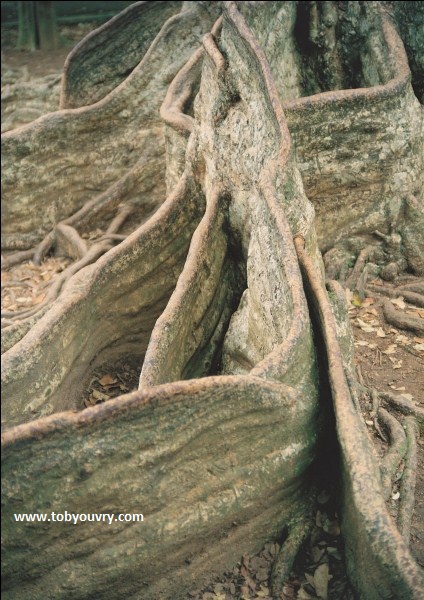
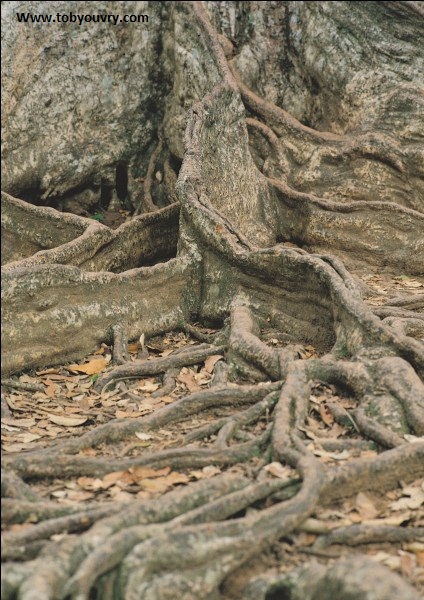
When we see natural objects in a landscape, such as trees, rocks, cliffs, mountains, lakes and so forth, very often we judge them to be beautiful. For example when we see the way in which a trees branches and bark has twisted and morphed over time we think of this as a tree with character, a tree with a deep sense of spirit. Likewise an old but well maintained house is very easy to love and appreciate.
So, if we think of old objects and aspects of landscape as having character and beauty as they age, what about our own bodies and their signs of ageing? To appreciate the beauty of our own ageing process requires the ability to, at least temporarily, step outside of the intense way in which we have been culturally programmed to value youthful looks only, and instead look at the way in which time changes our features as being something natural, something to be embraced, and finally as something that in many ways actually enhances the character and DEEP beauty of our looks.

To start to work experientially with this idea, you might like to try the following simple meditation:
– Sit or stand in front of a mirror. Close your eyes and relax for a few breaths, as you do so think to yourself that, when you open your eyes you are going to see your face (and your body if you can see it) as a landscape.
– When you open your eyes, try for a while simply to stare at your face without thinking or analysing too much, just try and see and accept it as it is. It can be a good idea to smile gently in acceptance of yourself and what you see.
– Then, thinking of your face as a landscape, reflect on the story behind the  lines that you can see on your face (if you are still young, imagine the lines that will be there!), how each crease and bump has arisen from countless times when you have smiled or laughed, countless times when you may have experienced pain or even cried. Think of the lines on your face as beautiful in the sense that they describe the depth and character that you have created within yourself in the years that you have lived in your body. Think of the lines as describing the knowledge and wisdom that you have within your heart. Reflect that, as time goes by and these lines deepen on your face, as long as you are trying to live your best life, the deepening lines will represent the flowering of a deeper human beauty within you.
Continue this mindful exploration for as long as you like, finish when you are ready.

So, of course we don’t want to grow physically “old before our time” so to speak and I really think that daily meditation and Qi gong are one of the very best methods for staying physically and mentally young for as long as possible (Note, also free, all they require is a little gentle discipline!). However, middle and old age come to us all, and we are at a tremendous advantage in terms of personal happiness if we can embrace them openly, value them, and consciously override the fear and resistance that mass consciousness encourages us to develop toward ageing process.

Thanks for reading,

Yours in the spirit of the journey,

Toby

© Toby Ouvry 2011, you are welcome to use this article, but you must seek Toby’s permission first. Contact info@tobyouvry.com