Categories
Meditation and Psychology Meditation techniques Uncategorized

Four Tips for Meditating at Home and Beware of Second Hand Statues!

This week’s article focuses on tips for meditating at home. There is a great article that I read this week by Maria Kapaln (Author of “The Guru Question”) called “10 Spiritually Transmitted Diseases” I really do encourage you to have a look through it. There really is a lot of nonsense masquerading as spirituality these days, and this article gives some really clear pointers for developing your own discernment and ability to clearly see the difference between genuine spirituality and either ego-manifesting-as-spirituality, or just plain confusion.

Enjoy the article below!

Yours in the spirit of the ongoing journey,

Toby

Four Tips for Meditating at Home and Beware of Second Hand Statues!

Of course we all enjoy the support and interactive atmosphere of a meditation class and the occasional retreat, but the fact remains that if our meditation practice is ever going to truly transform our consciousness, then establishing a daily practice is really what we need to focus on. With this in mind here are four ideas regarding how to support your home meditation practice.

1) Just get your bum on the seat!

As we go about our daily activities we get used to the neutral momentum of “doing stuff”. This means that when it comes to the time we have designated for meditation our mind tells us there is “just one more thing” that we need to do before we meditate. Before we know it is late, and we have to go to work, or we are too tired to focus effectively and the day’s meditation opportunity goes begging. The only solution to this is to discipline yourself to STOP, SIT down and BEGIN! You’ll start to feel better as soon as you do!

2) Get your family to support you.

Your family, flatmate, friends are all going to benefit from a happier, more focused and aware you right? So let them know that you have/are trying to develop a meditation practice, and have set aside a particular time each day to do so. Explain that it is going to be of benefit to them as well as you, and ask them to support you and remind you when the time comes for you to say “excuse me for 20 minutes!” We are social animals and getting others to help and support you really helps.

3) Don’t try and do too much in the meditation session itself

Many of us are already struggling with information overload in our life, and so trying to do a meditation form that is overly complex and/or where we have too many expectations can be counterproductive. Make your meditation time spacious; don’t give yourself too many different things to do. On my website I have plenty of meditation techniques that I explain, but it really can be as simple as focusing on two things: Sitting still and practicing “non-doing” for ten minutes!

4) Set up places in your home where you can sit down and meditate comfortably.

I have set up in the living room, two of the bedrooms and the roof balcony small arrangements of candles, crystals and other objects that, when I sit in front of them immediately helps put me in the mood and mindset for meditation. If one room is occupied by other members of my family, I simply go to the space that is unoccupied. Having physical places that you associate with meditation and relaxation in your home really helps you to settle into a regular dally habit!

Watch out for second hand statues!

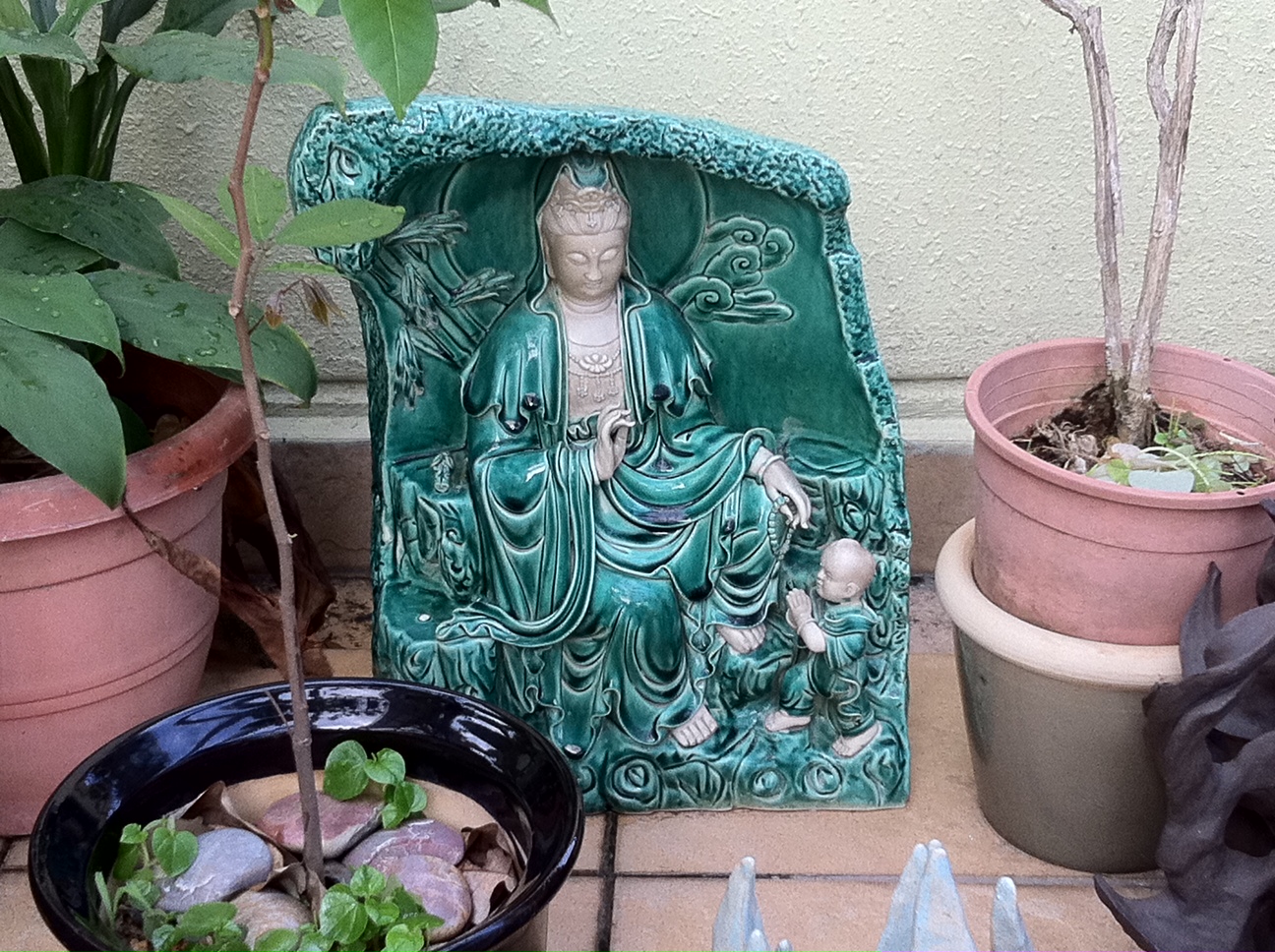
A final point I want to end with is that, if you are considering putting antiques or otherwise second hand statues or crystals in your meditation space take care. Particularly with second hand religious statues they can come to you “ready energized” in the wrong way by its previous owners. I was reminded strongly of this when I recently acquired a very finely crafted ceramic Quan Yin statue. It looked great, but I placed it in the meditation “shrine” in my bedroom and promptly got woken up that first night feeling extremely energetically uncomfortable, and after tossing and turning for a while was gifted some nasty dreams before waking up in the morning. The entire disturbance was coming from the dissonant energy that the statue had been energized with in its past.

So, what to do? Don’t worry; there is no need to throw such statues away! I have placed mine amongst the pot plants in my garden (see picture above) , where it will remain for six weeks or so and where all the negative elemental energy (for elemental energy think “physicallized mental energy”) can dissipate and be released from the statue to be absorbed and transformed by the natural elemental energy of nature. Once our Quan Yin has been “neutralized” then we will be able to place her wherever we want with no disturbing side effects!


Categories
Integral Awareness Meditation and Psychology Meditation techniques Presence and being present

Thoughts As Affirmations: Three Questions To Help Make Your Thoughts Your Allies

“It’s repetition of affirmations that leads to belief, and once that belief becomes a deep conviction, things begin to happen – Muhammad Ali”

The practice of affirmations – positively worded statements about your life repeated to yourself verbally or mentally or written down – has been given a lot of credence in recent years and appears in various forms of therapy. For example; cognitive psychology, hypnosis, neuro-linguistic programming, creative visualization and some forms of meditation.

From the perspective of transforming our experience through affirmations, one of the most important things to realize is that each thought that we think and word that we say is an affirmation, positive or negative, that re-enforces a belief that we have about our experience and reality. So, from this point of view, the most important aspect of mastering affirmations is being more aware of everything that you think and say, and being as careful as possible to energize only those thoughts and beliefs within you that are helpful and beneficial.

For example if I have injured my body in some way, and mentally I start to complain to myself about how unjust it is that I am injured and how the Universe always seems to be against me, then those thoughts are affirming a negative perspective on the situation. As a result, if I don’t check my thoughts and make appropriate adjustments, then my experience of that injury is going to be a negative one.
If on the other hand I notice that my mind has started complaining, and I ask myself “Is this way of thinking really serving me and helping me to have the best experience of the circumstances?” My answer will most probably be “no!” If I then make the effort to find a new perspective and way of thinking about my situation, then it will become an affirmation that I can use to directly change my experience. For example if I have an injury I may choose to see the situation as a chance to rest my body and allow it to recharge its energies.
Mindfulness of our thoughts is a big part of daily meditation practice. As meditators we understand that each thought is affirming something positive or negative about our experience, and our job is to focus on and energize the thoughts and beliefs that are most helpful, benevolent, and evolutionary to ourself and the other people involved in the situation.

Asking Yourself Three Questions – A Practical Exercise For Turning Your Thoughts Into Positive Affirmations

Step 1: Select a particular life situation to work on that is happening to you at this time, and where you sense that your mind is affirming negative beliefs and thoughts that are hindering your ability to deal with the situation.
If you can it is good to do this exercise in a notebook where you can actually write down your questions and answers as the written word is a more powerful affirmation than an affirmation that is simply thought or verbalized. BUT it is still worth doing as a mental exercise if you really don’t have a pen and paper available!

Step 2: Ask yourself three questions. Write down each question and your reply to it in turn:

  1. What are the negative thoughts and affirmations that I am holding with regard to this situation?
  2. What are the thoughts and affirmations that I can hold in this situation that will enable me to gain a better experience, and that will enable me to respond in the most creative and life-affirming way?
  3. What is the kindest and most compassionate (to both myself and the others involved in the situation) mental approach and perspective that I can affirm in this situation?

Step 3: Practice affirming your answers to these three questions.

  • Your answer to the first question shows you what thoughts and beliefs you want to avoid affirming and energizing.
  • Your answers to the second and third question are the thoughts, perspectives and beliefs that you need to affirm. Whenever you think about your life situation, immediately bring your mind back to your answers to these three questions and affirm accordingly!

© Toby Ouvry 2011, you are welcome to use or share this article, but please cite Toby as the source and include reference to his website www.tobyouvry.com

Categories
Integral Awareness Meditation and Psychology Meditation techniques

Taking Control of Your Happiness and Mental Wellness Through Lifestyle Therapy

As witnessed in a recent article in the “American Psychologist Journal” by transpersonal psychologist Roger Walsh there are eight “lifestyle therapies” that have been proven by scientific research to have a positive effect on our mental wellness. The slightly scary thing is that, in the same article Walsh observes that currently less than 10% of mental healthcare professionals (in America) are actually recommending these lifestyle therapies to clients, and are relying all too heavily on the prescription of psychiatric  drugs for mental health problems such as depression. These lifestyle therapies are FREE, have no unpleasant side effects, and the list of them below offers a “go to” set of strategies that you can employ for your own mental wellness, and also recommend to friends and family experiencing mental stress and unhappiness.

Here is the list:

1. Exercise – Psychotherapy has been shown to be positively effective for approximately two thirds of people experiencing mental problems, with the same success rate for psychiatric intervention (ie: drugs). What is the activity that has been shown to have an almost 100% success rate on improving mental health? No, not electric shock treatment, EXERCISE! Enough said, find a sport or exercise form that you enjoy and engage in it regularly! We have so many options these days, weights ping pong, brisk walking, belly dancing, do something.
Another thing that the benefits of exercise highlight is that an excessively sedentary lifestyle gets you down.

2. Nutrition and Supplements – Ok, huge area, two things that research has shown to have the most positive effect on mental health: Avoiding excessive calorie intake and eating a diet with multi-coloured fruits and vegetables. The supplement that has been shown to be most effective for mental wellness is fish oil. I’m a vegetarian, but this is what the research shows so I’m putting it in. Anyway, the basic thing is that “You are what you eat” is an expression that holds true mentally as well as physically!

3. Time in Nature – Nature has been a source of healing and inspiration for humans for Milena. How much time have you spent in nature recently? If the answer is not much then there is a very good chance your lack of exposure to it and your over exposure to artificial environments is contributing to your mental stress. What has been obvious to generations of humans has now been proven beyond doubt by the science. Go hug a tree, dance barefoot on the lawn  and swim naked in the sea. Or y’know at least go for a regular walk in the park…

4. Relationships and the Acquisition of Friends – Feeling mentally out of balance can often cause us to recede into our shells and shun contact with people. Cultivating good friends and supportive relationships is fundamental to most people’s inner balance and mental health. Learning to leverage positively on your relationships in an appropriate way is a mental wellness life-skill not to be neglected!

5. Recreation and Enjoyable Activities – Yes, having fun regularly is good for your mental health and happiness, now proven by science, so go have some!

6. Relaxation and Stress Management – Activities include meditation, Qi Gong, Tai Qi, Yoga, progressive muscle relaxation techniques, visualization and hypnotherapy. Currently under utilized by many, but gradually becoming main stream.

7. Religious and Spiritual Involvement – Big area with a lot to consider, but basically some form of spiritual community and support for your inner wellbeing has been shown to have very positive effects on mental health. If you are like me and have no local church or temple that really resonates deeply, at least you can make the effort to keep active contact with people of a spiritually like mind virtually and when possible in person.

8. Contribution and Service – Giving happiness to others has a definite and undoubted effect on the sense of meaning, inner fulfillment and happiness of the person giving.

A Special Shout Out For Meditation!
Here is a quote from Roger Walsh directly from the above mentioned article: “In addition to its benefits for relaxation and stress management, meditation may also enhance measures of psychological capacities, health, and maturity in both patients and nonpatients (Walsh & Shapiro, 2006). Particularly important to health care professionals are findings that meditation can enhance valued caregiver qualities such as empathy, sensitivity, emotional stability, and psychological maturity while reducing distress and burnout (Shapiro & Carlson, 2009). On the cognitive side, studies suggest that meditation can enhance some measures of cognition and may reduce age-related cognitive losses and corresponding brain shrinkage (Pagnoni & Cekic, 2007; Xiong & Doraiswamy, 2009).”

A final point from me here, most of the research on meditation to date have been short term studies on relative beginners. I feel pretty certain that when the results of longer term research is done on more advanced practitioners there will be many more remarkable additional benefits to meditation that will come to light!

Starting to Make Practical Use of the Above List:

As mentioned, each of these eight “lifestyle therapies” now has a large body of scientific research behind it indicating that it is of real and tangible benefit to mental health and well being. Again for a fuller breakdown of the actual research please refer to the article by Roger Walsh.
For Yourself:
Go through the above list and with each of the lifestyle therapies simply ask yourself “How well am I leveraging on this activity at the moment?” In the areas that you feel you have been neglecting, write down a couple of things that you can do over the next week or so to start re-integrating them into your life in an effective way.
For Other People:
When you have a friend or family member under mental duress, the above list is a useful one to bear in mind, as you will almost always be able to suggest one or more of them as a way of helping them to deal with their challenge more effectively. The good thing about this list is that (with the exception of number 7) it is totally non-denominational and complex-philosophy free. From your teenage daughter or son, to your partner to your Mum or Dad, this list is going to be easy for them to understand and implement!

© Toby Ouvry 2011, you are welcome to use or share this article, but please cite Toby as the source and include reference to his website www.tobyouvry.com

Categories
Enlightened love and loving Integral Awareness Meditation techniques spiritual intelligence

Tapping Into Your Invisible Sources of Love and Support, A Contemporary Interpretation of the Process of Prayer

One of the great illusions that we often battle with is the feeling of being isolated and alone. This feeling of loneliness and isolation can exact a heavy toll upon our psyche. There are three approaches that we can take to this challenge:

  1. Get more comfortable with being alone
  2. Reach out to other people and build more of a sense of external community
  3. 3. Tap into sources of invisible love and support that surround us all the time

This article looks at the third option, which in many ways can be understood as tapping into the power of prayer. The meaning of prayer as I am referring to it here is as follows:

“Prayer is a way of invoking and requesting support from the invisible sources of love that surround us at all times” .When I say “invoking” here this can be done in both an active and a passive way. To pray actively means to make a specific request to any invisible source of support. Prayer can also be done in a more passive way simply by becoming aware of the invisible source of support and focusing on consciously receiving supportive energy from that source.

So, what are these invisible sources of loving and supporting energy? Here is a list of examples:

From Yourself – We can prayers and requests to the higher dimensional aspects of ourself that we can term in many ways, for example our Higher Self, our Divine Spark or our Buddha Nature. Since these higher aspects of consciousness are literally a part of who we are, it is safe to assume that they are always wishing us success and happiness, and are sending us that support all the time. Through the practice of prayer we can leverage on this invisible support much more.

From those who love and like you, and from your Ancestors – We are energetically and mentally connected to friends and family all the time, and there is potentially a constant stream of positive energy and support that we can be receiving from them even if they live in a far away land. Moreover there is also an ongoing stream of invisible love, support and wisdom that flows through our life at all times in the form of our ancestral group as a whole.

From the “Power of the Common Good” – This level of support is really about remembering that there is within the group mind of humanity a common intention to benefit, do good and support. Easy to forget amidst the mass of seeming negativity and chaos, but it is nonetheless there for us to tap at will!

From the Wise – Those Saints Saints, Sages and Great Souls, the great and the good, past and present who are filled with love, wisdom and compassion, and are at the cutting edge of human evolutionary consciousness.

From the Earth and from Nature – Sit in a park surrounded by trees for a while and any problem or pain that you have will reduce. I’m reading the Ramayana with my daughter at the moment, where all the characters pray for support from rivers, tress and mountains. It is a bit of a forgotten art in modern society that we could well do with remembering and practicing more!

From Spirit or Source – By this I mean the formless creative energy that creates and sustains all of the above, call it God or what you will…

A One Minute Prayer/Meditation Method for Tapping into Your Invisible Support Network

Pick one of the above invisible sources of love and support and focus on it mentally. You can then either:

  • Offer a specifically worded prayer requesting support for a particular area in your life, or
  • Just recognize this invisible source of love and acknowledge its readiness to support you.

Having made your prayer or recognized this source of invisible love, feel it surrounding you and supporting you, breathe with this feeling of receiving love and support for a few breaths, share your burden and release your worries.

A slightly longer Prayer/Meditation Method for Tapping into Your Invisible Support Network

Take the time to go through the above list of sources of love and support. Having offered your prayer for support, spend a few moments breathing with and feeling the support of each of these sources in turn. Take the time to recognize and feel the support of each of them. Feel the love you are receiving increasing with each source that you focus on. End by focusing on a feeling of having released your worries and burdens, and of being NOT ALONE!

© Toby Ouvry 2011, you are welcome to use or share this article, but please cite Toby as the source and include reference to his website www.tobyouvry.com

Categories
Awareness and insight Enlightened love and loving Meditation techniques Motivation and scope

Meditating on Detached-Compassion and Divine Playfulness

The first of the five enlightened powers that I outline in my meditation technique “The Five enlightened Powers” is the power of embodiment. This involves, quoting from my previous article on the subject:

Remembering that you are, in essence a spark of Universal spirit experiencing (temporarily) a physically embodied life on Earth as a human. Whatever situation you find yourself in, grounding your awareness in your true identity and not getting caught up in your small or egoic identity is the power of embodiment. Wherever you are, remember WHO you are!”

A question that we may then ask ourselves is “So then what is it actually like to experience ourself as such a spark of Universal Spirit? What qualities and emotions would we experience?” In this article I intend to highlight two specific qualities and perspectives that we can seek to bring into our daily life that will enable us to function more authentically as a divine spark amidst the push and pull of our daily lives. These two qualities are detached-compassion, and divine playfulness.

Detached-compassion

Detachment and compassion are qualities that often we think of as being separate because they appear to exclude each other.  We think that when you are detached you are disconnected from others, and so cannot feel deep compassion for them. Likewise if we are truly being compassionate we cannot be detached because that would mean disconnecting from our feeling nature, which is where our compassion is located.

However, viewed from the perspective of our spiritual being, it is perfectly possible to bring deep compassion together with a sense of detached, witnessing observation. This is because from the perspective of spirit:

  • We can be detached from any situation because we are always viewing things from the “big picture” perspective; nothing is truly personal in the egotistic sense of the word.
  • At the same time we feel totally close and intimate with all living beings because we realize that on the essence level we all share the same common identity. Ultimately we are all one being viewing the world from billions of pairs of different eyes!

So, from the perspective of our spiritual being we experience our life as impersonally-personal, as deeply involved and at the same time not involved, as passionate at the same time as being totally even minded.

The main take away from this is that if you practice bringing detached compassion together simultaneously in life situations, gradually improving your ability to do so, then you will consistently increase your experience of what it is like to be a spiritual being embodied in a physical body.

Divine Playfulness

One of the fundamental qualities of spirit is playfulness and a corresponding sense of humor. From its perspective the whole process of creating and evolving a universe is done as a type of game, a way of creatively expressing itself and its potential.

Consequently, if you want to increase the level of spirit in your daily life then entering into your daily tasks in the spirit of divine playfulness is a great practice to have.

Most of the time we tend to get a little too serious about things and as a result allow our life to become unnecessarily stressful and unhappy. Thinking about the challenges in your day as playful games and puzzles set you by the universe and your own spiritual being in order to help you evolve and grow is a technique that both relieves stress and enhances the deeply felt spiritual nature of your human experience.

One to Five Minute Meditation to integrate Playfulness and Detached Compassion into Your Daily Life

Step 1: Mentally select a particular life situation/challenge  that you wish to work on in the meditation. One of the characteristics of meditating with the Five Enlightened Powers technique is that you are always trying to work directly with a practical “real time” situation in your life. It should never be allowed to become totally abstract.

Step 2: Recollect your understanding of detached compassion. Open your heart to the feelings that you are experiencing and the other people that are involved AT THE SAME TIME AS mentally taking a step back and seeing what is happening from the big picture perspective. Experiment and try to feel both empathic compassion and witnessing observance SIMULTANEOUSLY. Breathe with this combined feeling experience for a while.

Step 3: Introduce playful humor to your perspective of the challenge. Think of the challenge as a game that you as a spiritual being are being set by the Universe to stretch and improve yourself as a human being. Stay with this perspective and the experiences it gives rise to for as long as you wish.

If you do this brief exercise a few times over the next week or so you will find that compassionate detachment and divine playfulness will become a real experience for you in your daily life that can help you to gain an authentic experience of what it is like to be a spiritual being appearing as a physical body!

© Toby Ouvry 2011, you are welcome to use or share this article, but you must seek Toby’s permission first. Contact info@tobyouvry.com

Categories
Awareness and insight Inner vision Meditation techniques

A Personal Reflection on How Meditation Develops Your Inner Vision and Ability to Work With Energy

Hi Everyone,

Back in 2001 when I left my life as a Buddhist Monk part of the reason was that I wanted to return to a life as an actively working artist expressing his inspiration in paintings and sculpture. As I had meditated during the 1990’s I had touched the inner formless spaces that you find in deep meditation practice, but I had also found that, from these deep formless spaces a lot of inner visions started to emerge quite spontaneously, and that they often really demanded to be expressed.

Since then I have developed a method of combining my meditation and artistic practice where I will meditate on a particular topic or subject for a while in order to receive visual and sensual impressions of its inner nature, and then I will create an art piece based around what I have seen.

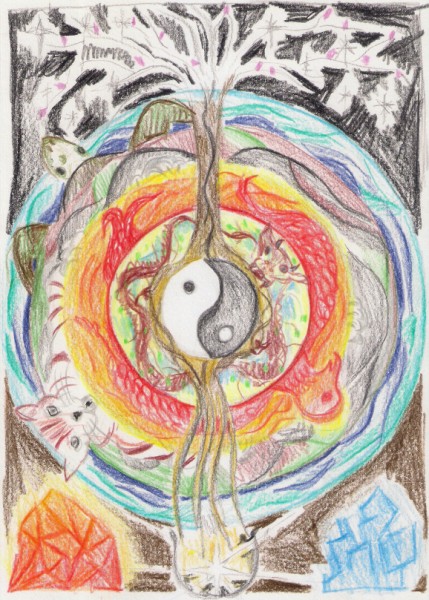
In order to give an example of this, at the top of this article you can see a working sketch that I have done for an artwork that embodies the energy of The Tao, Yin-Yang and the five Chinese elements of earth, wood, metal and fire. Here is a brief description of the inner landscape from which this image arose. You can do it yourself if you like, the basic images are simple, and there is plenty of room for creative imagination and to really make the inner landscape your own:

The Asian Tree and the Yin-Yang courtyard.

Before meditating set your intention to travel, within the reality of your creative imagination, to an inner landscape that embodies the spiritual energy of the Tao, Yin-Yang and five elements.

Spend a short while relaxing, focusing on your breathing and stilling your sense of time, space and energy.

After a while you sense yourself within what you intuitively sense is an Asian landscape, in front of you is your “Asian tree”, a tree embodying that embodies the energy of Asian spirituality and that you have a particular inner connection to. Spend a while seeing, feeling and sensing the landscape and the tree; the texture of the bark, the colour of the leaves, the time of day and so forth…

To one side of you in your landscape you see an ancient courtyard. Upon its old wooden doors is inscribed a yin yang symbol.

Passing through the doors to the interior of the courtyard you sense yourself entering into a state of deep peace. The roof of the courtyard is open to the sky. In the centre of the courtyard is a yin-yang symbol made of living light. The light part of the symbol is fed by a stream of bright white star light that comes down from the sky. The dark part of the symbol is fed by a stream of dark light rising from the depths of the earth. Within the courtyard are many beautiful ancient objects, such as bonsai trees, crystals and gemstones. In particular there are sculptures of four creatures:

  • A dragon, embodying the energy of the wood element, of spring, air and morning
  • A phoenix embodying the energy of the fire element, of summer and the noonday sun
  • A tiger embodying the energy of the metal element, of autumn and evening
  • A turtle embodying the energy of the water element, of winter and of night time.

Each of these statues, although static seems to be alive and radiates its elemental energy in the form of colour. These colours gather around the central yin-yang symbol, flowing around it in an ever changing flow of radiant elemental light.

Deep within the earth beneath the yin-yang symbol is a cauldron, which embodies the earth element and is the source from which the other four elements arise.

Simply sit and relax in this beautiful peaceful space, and as you do so feel the yin-yang and elemental balance within your body mind come back into balance. As your body-mind comes into balance, feel your inner being becoming still and spacious like a deep lake.

Thanks for reading,

Yours in the spirit of the rich landscape of the imagination,

Toby

PS: You can see more of my artwork in the most recent post on my Soul Portrait site:

Slideshow of Soul Portraits From the First Three Months of 2011

PPS: If you are not familiar with the 5 elements and want a bit more information, you can find more in my past article on my Qi gong blog:

Meditating on the Five Chinese Elements as a Method Achieving Harmony and Balance Through Dependent Relationship.

Similarly, you can also find a previous Yin-Yang meditation there:

The Meaning of the Term “The Great Mother” and its Relationship to Yin and Yang

Categories
Awareness and insight Integral Awareness Meditation and Psychology Meditation techniques Presence and being present

Meditation for Tapping Into The Natural Creativity of Your Mind

Hi Everyone,

Do you consider yourself to be naturally creative? The following meditation is a simple technique for tapping into awareness of the natural creative quality of the space within our mind, and learning to direct and harness it in a positive way in our life.

Sit down and take a few deep breaths, relax your body-mind as you breathe out, feeling tension leave you on your outward breath.

Now start to become aware of the space within your mind, over a period of time, try and make the inner space within your mind as big as possible, imagine it becoming as big as the sky, or as big as the whole Universe.

Now look at this space in your mind. Initially it seems lifeless, just an empty open space, quite pleasant and peaceful, but not much else. However, if you start to look a little more closely at this space, it is this inner space itself from which all the thoughts, images and feelings within your mind are emerging. If you watch closely in this way you start to see that the “empty” space of your mind is actually a continuously creative source of energy, thinking, images and feeling within you.

Once you have observed this, focus once more upon the inner space within your mind, this time recognizing that this space is a creative, living source of energy, ideas and life force for you. How does it feel to experience directly your own natural inner creative potential? Our creative power can seem like such an elusive beast, yet actually here It is, under our nose all the time within the inner space or formless nature of our consciousness!

Most of the time we don’t use the creative energy of our inner space very well, because as soon as it arises we unconsciously direct it towards old, familiar patterns of thinking and feeling, so the thoughts in our mind don’t feel very creative or inspired at all. Indeed it can feel like our thinking and feeling energy are a burden, a stuck record in our mind that always remains the same whatever we try and do to change it.

Meditating on developing a more lucid and heightened awareness of the creative nature of the space within our mind encourages us to start making use of it in a more flexible, useful fashion, allowing us to respond to the challenges of our life in a more spontaneous and liberated manner. If we do not take responsibility for making good use of the creative energy within our mind, then we can find ourselves oppressed by this creative energy, as again and again it flows into thought patterns that are unhealthy and create feelings of stress, anxiety, fear and unhappiness.

Here’s to enjoying the creative inner space within all of our minds!

Thanks for reading and have a great week!

Toby

PS: This weeks meditation class topic:

You are multi-talented! Meditating on multiple-intelligences as a way of finding inner wholeness

PPS: Related articles that might be of interest to you:

Nurturing your natural intelligence and natural dignity

Finding your deep creativity (in three easy steps)

Categories
Awareness and insight Enlightened service Integral Awareness Meditation techniques Motivation and scope

Meditating On The Five Levels of Positive Intention, And Learning How To Use Group Consciousness to Support And Enhance Your Own Personal Intention

Here are five levels of positive intention that we can hold, and that we can use as conscious motivators for our meditation and awareness practice, or indeed as full objects of meditation in themselves:

1. The intention to practice non-harmfulness toward ourself and others

2. The intention to heal, nurture our body-mind, and develop it to its fullest potential

3. The intention to contribute in the most meaningful and positive way to our circle of influence, meaning our family, friends, work colleagues and anyone else whom we have a direct, immediate and personal relationship with.

4. The intention to be of active benefit to all of humanity without discrimination

5. The intention to be of active co-operation and benefit to all living beings on the planet, including all members of the plant, animal and mineral kingdoms, as well as all the other classes of living being that there may be.

As you can see, these five levels increase the scope of our intention incrementally. We start with the intention to stop harming ourselves and others (if you can’t help, at least don’t harm), and end with a truly kosmocentric intention to be of benefit to all living beings without exception. This last intention is the most evolved and expansive of all the five, and is really what might be called the loving, fearless and compassionate intention of the Bodhisattva, to borrow the Buddhist expression.

A final note is that each of these intentions is valid and has its own place in our consciousness. For example, just because we may be aiming for the fifth level of intention, we can still hold intentions two and three; to nurture ourself and our circle of influence in a perfectly valid and complementary way.

You might also like to compare and contrast these five levels of positive intention with “The Five Levels of Intention For Effecting Personal Transformation” that I wrote about in a previous article.

Connecting our own five levels of motivation to the corresponding intentions within group consciousness.

It can be very useful to realize that there exists within the group mind of the Planet the collective energy of all these positive intentions. We can learn to leverage on this already existing positive group intention by connecting to it with awareness.

Here is a simple, guided meditation that takes level one, the intention to practice non-harmfulness as an example. Once you understand how to do it with one level of intention, you can easily learn how to do it with the others.

– Sitting comfortably, become aware of the different levels of intention in your mind right now, both “positive” and “negative”.

– Focusing on yourself and your own body-mind, place within you awareness the intention to practice non-harmfulness toward yourself; to stop the self abuse, self hatred, self destructive habits and so on, even if it is just for these few minutes. Sit with this intention for a minute, just holding it gently in your awareness

– Now be aware that you are part of group consciousness that we shall call the planetary mind, or planetary consciousness. This is the collective intelligence of all the living creatures in the world. Be aware that there already exists within the group mind a strong intention to practice non-harmfulness. This energy comes from all the living beings of past, present and future that have held this intention, from the great saints and yogis, to the tiniest animals.

– Feel your mind connecting to this group intention, and feel its energy flowing into your body-mind. If you like for a minute or so you can feel yourself breathing the intention in on the inhalation, and relaxing your awareness deeply into that intention as you breathe out.

Finnish when you are ready. As with all the meditation exercises on this blog this one on intention can be done as a one minute awareness form, or as a more extended meditation according to your time schedule and needs.

© Toby Ouvry 2011. You are welcome to use this article, but you must seek Toby’s permission first! Contact info@tobyouvry.com

Categories
Awareness and insight Integral Awareness Meditation techniques Presence and being present

A Simple Sketch Of Three Simple Creative Meditation Awareness Forms: Appreciation Of the Pleasure Of Simple Awareness, Taking a Third Person Perspective On Your Life, and Finding Your Inner Light

Here are three simple meditation forms that you can do anytime, either as a short 1-5 minute practice in a spare moment, or as a longer meditations when you have more time.

1. Developing appreciation of simple awareness.

One of the main things that we learn to appreciate when we take up a meditation practice is to appreciate how pleasurable the simple act of awareness can be.

Take a minute now and just allow your mind to rest on an object. It could be the sounds as they come and go from moment to moment, or the play of the light across the landscape or cityscape as you look out of the window. Just allow your awareness to rest on that single point of focus for as long as you want. As you do so, feel your mind and body moving into a state of rest and regeneration. Feel how pleasant the simple experience of relaxed, open awareness is.

2. Observing yourself in the third person

We habitually view our daily life and the events that happen in it in a first person, subjective manner. This awareness exercise offers another perspective on our life that we can work on integrating.

Sitting down, imagine that, rather than seeing life through the eyes of your physical body, imagine that you are outside your body, maybe two or three meters away, and observing yourself as you go about your day. Recall the events of the last 24 hours, and mentally see yourself engaging in your activities. As you observe yourself, you may find that feelings and emotions come up. If so that is fine, just allow them to. The thing that you want to try and avoid as you are watching yourself is to start analyzing it or making judgements about what you are seeing. Simply be an objective observer of yourself and try and experience as fully as possible what it is like to be free from an obsessive first person experience of your life.

3. Finding your inner light by relaxing into the darkness of your mind.

Relax your mind as much as possible, as if you are falling asleep. Allow your awareness to be enveloped by the deep, silky darkness that is normally experienced as you start to drift into unconscious slumber. The key here is to ALMOST fall asleep, but NOT to actually fall asleep! Keep a part of your mind alert and awake as the main part of your mind and body relaxes deeply.

Think of the darkness that you experience as you are relaxing in this way as being like the darkness that a baby experiences in the mother’s womb, or like the darkness of deep night when we are all asleep. Rest in this darkness as fully as you can without losing that small element of alertness and awakeness!

After a while imagine that you sense within the darkness a point of light. A little bit like the first rays of sun as it is still beneath the horizon at dawn. Focus on this point of light and allow it to become gradually stronger and more pervasive, like the rays of the sun spilling across the horizon as it rises. Gradually, without trying too hard, let the inner light within your mind begin to fill the darkness until your mind feels bright and radiant like a morning sun.

The key with this exercise is to relax as fully into the darkness before you attempt to find the light, and not to try too hard to find the light. If you relax fully and deeply into the darkness, the light will actually start to emerge in its own time. However you can stimulate it a little bit by imagining the point of light emerging from the darkness as described above.

© Toby Ouvry 2011, you are welcome to use this article, but you must seek Toby’s permission first! Contact info@tobyouvry.com

Categories
Awareness and insight Inner vision Meditation techniques Presence and being present

When You Are Less Distracted, Your Mind Goes Deeper Into Things

We have just cut off our cable TV contract, and so we have no telly at home right now. I have to say I am really enjoying it. It is not that I am vehemently against TV, but the relative silence and absence of easy distraction in the evening has really contributed positively to the quality of my mind.

For example, I have just finished eating my dinner and doing the washing up. Everyone else has gone to bed. I pick up a pink quartz crystal that has been sitting on our coffee table, the evening is so still and my mind is so clear that I feel as if I can feel everything about the crystal; the energy inside it, the texture of its surface on the pads of my fingers. Holding the crystal is a deeply simple, pleasurable and rewarding experience.

In addition to finding time for meditation, it is also worth regularly cutting down on your distractions. Doing so enables you to experience and look into the simple things in your life with depth, clarity and genuine pleasure.

© Toby Ouvry 2011. You are welcome to use this article, but you must seek Toby’s permission first. Contact info@tobyouvry.com