“Meditation is developing our capacity to generate happiness within & project it outward, rather than needing outer circumstances to align before we can be happy”
Dear Integral Meditators,
This week’s article explains a fundamental paradigm for how meditation works that I use often in my workshops and sessions. Once you ‘get it’ its easy to stay motivated in your meditation practice!
Heads up for this Saturday’s Saturday 13th December, 9am-12.30pm – Psychic & Psychological Self-defence half day workshop, & also I have just posted the new class series’ for January:
Tues 13th, Weds 14th January, & then weekly – Beginners mind, resilient body – a 10-week integral meditation course
Starts Saturday 17th January, 5.30-6.15pm, & then weekly – Beginners mind, resilient body deep-dive: An 11 -session practice series
In the spirit of ‘life is good and…’,
Toby
Article: From ‘life is a problem and…’ to ‘life is good and…’
One definition of meditation that I learned from my Tibetan Buddhist days is this one:
“Meditation means to focus our attention on an object (or in a state) that, when we dwell on it, causes our mind to become positive, calm and/or happy.”
The task of a meditator from this point of view is to discover as many ‘positive’ states, ways of thinking, ways of non-thinking, emotions, temperaments, dispositions and so on as they can. A meditator then tries to keep her attention oriented around one or other of these positive objects or states during the day. The net effect of this is that they spend most of their life in a condition of happiness, even in the face of substantial obstacles. To be a meditator is empowering in this sense, because we are developing our capacity to generate happiness within ourselves and project it outward, rather than needing outer circumstances to align before we can be happy.
From life is a problem to life is good
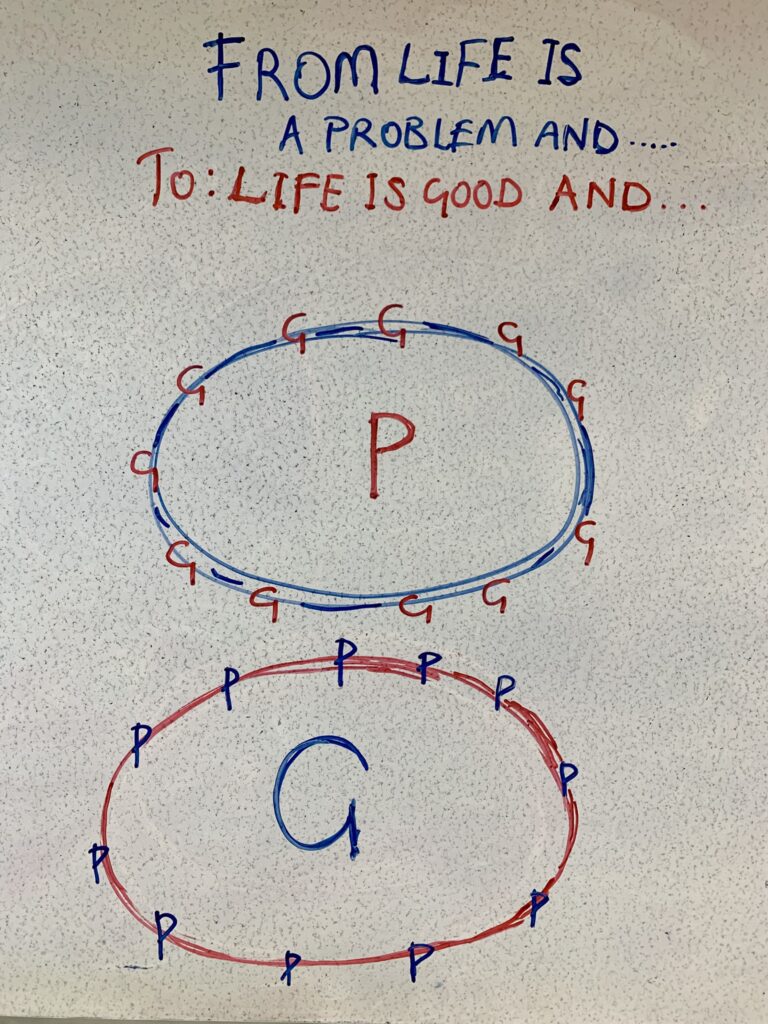
One simple paradigm I often use to illustrate the basic task and practice of a meditator is the one that you can see in the picture. Both oval shapes represent a person’s field of awareness.
Life is a problem and… The upper circle represents the everyday persons awareness field. In it you can see in the center there is a ‘P’ which stands for problem. On the edge of the circle, you can see several small ‘g’s, which represent the good things in our life. Unless we are careful, this is a place where we can spend a lot of our day and life; with our problems front and center of our awareness, and the good things in our life a secondary, background element of experience. With this perceptual dynamic or habit in place we literally experience our life as mostly a problem, as it is our problems that appear front and center of our awareness. This position can feel very defensive; our problems dominate, and the good things lack power due to their peripheral position.
What we are trying to do as meditators is ‘flip’ this so that our perceptual state goes from ‘life is a problem and…’ to:
Life is good and… the lower circle you can see has a ‘G’ for good things in the center, with the ‘p’ for problems pushed out to the periphery. Here you are simply keeping the good things in your life front and center of your awareness as you go through the day. You can understand ‘good things’ to represent a broad category here, that you are then making specific to your particular life experience. Because we keep the good things front and center, the power of our problems to dominate our awareness reduces as they are pushed out to the periphery.
An important thing to note here is that the change is perceptual, nothing external needs to change for us to do this. The difference between someone with the ‘P’ mostly front and center of awareness, and someone with a ‘G’ is the habit and discipline of focusing awareness in a particular way. You could have two people with almost identical life-circumstances, but a completely different experience simply due to their habit of focus. When we push the ‘p’s out to the periphery, we are not denying our problems, or the need to deal with them effectively. We are just placing them in a particular context, the ‘G’s, in a way that puts them in perspective and makes them feel much more manageable
A simple practicum: Set aside a fixed amount of time, say 5-10mins. Watch your awareness. Notice the ‘P’s often taking center-stage. Practice placing your ‘G’s front and center instead, pushing the ‘p’s benevolently to the periphery. Notice how your experience changes, and enjoy.
Related article: Meditation – Life as a positive mindfulness game
© Toby Ouvry 2025, you are welcome to use or share this article, but please cite Toby as the source and include reference to his website www.tobyouvry.com
Upcoming classes & workshops
Ongoing on Tuesday’s & Wednesday’s (live & online), 7.30-8.30pm – Weekly integral meditation classes
Starts Tuesday 11th & 12th November, 7.30-8.30pm – Going beyond your limitations, tapping into your hidden strengths – Meditating with your bright shadow, a 6-week course
Starts Saturday 15th November, 5.30-6.15pm SG time – Bright shadow meditation Deep-dive – A 5 session practice series
Saturday 13th December, 9am-12.30pm – Psychic & Psychological Self-defence half day workshop
Tues 13th, Weds 14th January, & then weekly – Beginners mind, resilient body – a 10-week integral meditation course
Starts Saturday 17th January, 5.30-6.15pm, & then weekly – Beginners mind, resilient body deep-dive: An 11 -session practice series
Follow Toby on: LinkedIn, YouTube, Instagram
Integral Meditation Asia
Online Courses * 1:1 Coaching * Books * Live Workshops * Corporate Mindfulness Training *Life-Coaching * Meditation Technology