Categories
Awareness and insight Concentration creative imagery Integral Meditation meditation and creativity Meditation techniques Mindful Breathing Mindful Resilience Mindfulness Presence and being present

Stabilizing your pyramid of consciousness

Dear  Integral Meditators,

What is the simplest, stabl-est and most basic way to stabilize your mind and attention? The article below explores one answer to this in a practical way.

In the stability,

Toby

Stabilizing your pyramid of
consciousness

Within your field of awareness, you have three basic areas; your senses, your feelings and your thoughts. Of these, which do you imagine is the most stable and reliable? Which of these three moves slowest and is the most predictable? If you watch for a while, you will see clearly from experience that the answer to this is your senses. The mind and emotions can move and change very quickly and unpredictably. Your physical awareness and senses however are much slower moving. For example, if you bring your attention to the sensation of your physical body over a one minute period, you’ll see that it remains fairly constant, even as your mind moves here and there, and your moods shift.

Anchoring your attention to your senses
In mindfulness terms then, if you want to establish basic stability in this moment, the obvious place to go is to your physical body and senses. You can use them as an anchor for your attention. If you think about your attention as like a boat, and your thoughts and feelings as being like the waves, wind and other moving conditions around the boat. Your body and senses then become like the anchor that keeps the boat in one place. You don’t even need to try too hard still your mind and feelings. Just keep coming back to the anchor of your body, and you’ll find this gives you the basic ‘weight’ and stability for a sense of calm to start to come into your mind.

The weight of your body
I find it particularly useful to focus on the weight and solidity of my body. In particular the sensation of the weight where my body is on contact with the floor or surface where it is sitting or standing. So, if you are standing, that would be the soles of your feet, or if you are sitting it’s the back of your legs and butt that is on contact with the seat. If you like you can focus on the weight of your body as you inhale and then feel the tension in your upper body flowing down into the floor through that contact point as you exhale.

Your pyramid of consciousness 
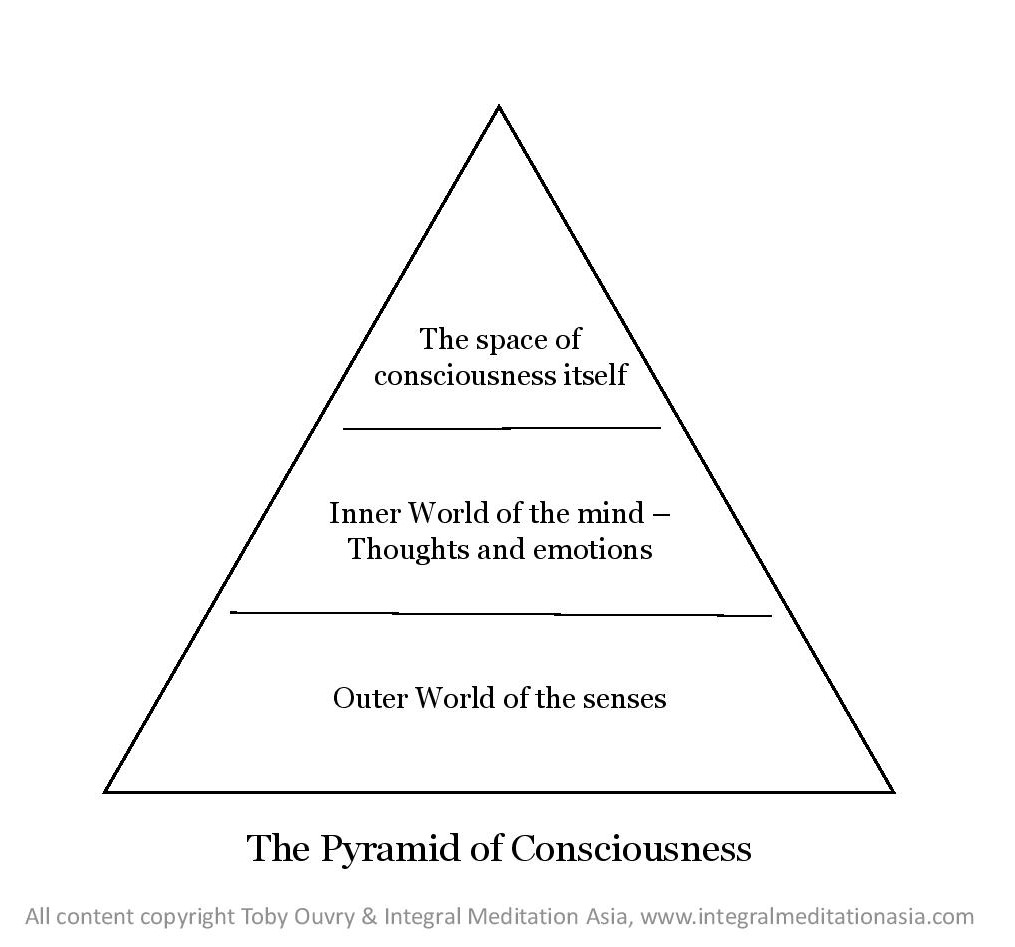
If you think about your consciousness as being like pyramid, with your senses as the broad base, your mind and emotions as the mid-section, and consciousness itself as the top tip (see the article diagram). In this exercise, we are focusing upon stabilizing the ‘base’ of our pyramid by paying attention to the weight of the body. If the base is stable, then everything above it is going to feel basically strong and stable, even when your under pressure.
You don’t need perfect concentration!
Even if as you are focusing on the weight of your body you are only able to concentrate 10-20% of your attention on it, then that is still 10-20% more stability and centre than you have when your lost in your thoughts and feelings. What’s more, if you lose focus on the weight of the body, its very easy to find again, as it is such a simple, obvious sensation. When you have a sensory ‘anchor’ for your consciousness, then even if you ‘get lost’ its easy to find centre again!

This week you might like to spend a few minutes each day ‘stabilizing the pyramid of your consciousness’ by paying attention to the weight of your body.

© Toby Ouvry 2018, you are welcome to use or share this article, but please cite Toby as the source and include reference to his website www.tobyouvry.com

Upcoming Courses at Integral Meditation AsiaOngoing on Wednesday’s, 7.30-8.30pm – Wednesday Meditation Classes at Basic Essence with Toby

Ongoing on Tuesday evenings, 7.30-8.30pm – Tuesday Meditation Classes at One Heart with Toby (East coast)

Monday 6.15-7.15 & Wednesday 12.15-1.15 – Integral Meditation classes at Space2B on Stanley Street

Saturday mornings 9-10.15am 1st,15th, 22nd, 29th December – Qi Gong workout and meditation class

Saturdays December 15th & 22nd – Mindfulness group coaching sessions with Toby

Tues & Weds Dec 18/19th, 7.30-8.30pm – Winter Solstice balancing & renewing meditation


Integral Meditation Asia

Online Courses 1:1 Coaching * Books * Live Workshops * Corporate Mindfulness Training *Life-Coaching *  Meditation Technology

Categories
Awareness and insight Gods and Goddesses Insight Meditation Integral Meditation Meditating on the Self Meditation and Psychology Meditation techniques Mindful Self-Leadership Presence and being present Uncategorized

Dimensions of mindful perception and understanding (Plus new astrological monthly meditations)

Dear  Integral Meditators,

This week’s article looks at how to improve your perception and understanding through mindfulness. If you enjoy the article, then do consider coming along to the new monthly astrological class next week, which will be on the subject of ‘Sagittarius – I perceive and understand! It is available as a recording for those not in Singapore who may wish to participate.
Full details of this week’s sessions on Compassion, Qi gong and beginners meditation can be found here.

In the spirit of clear perception,

Toby


Dimensions of mindful perception and understanding

It’s easy to assume that the way things appear to you is literally objectively true. When someone at work is irritating you, when you are in love with someone, when things feel smooth and relaxed, or anxious and stressful, we can quickly jump to the conclusion that it’s about the situation, and not the state of mind that we are bringing to the experience.
Much of mindfulness is about attention to the moment. If you start to watch what is going on in the moment, you might start to notice that two things are going on simultaneously:

  • The experience itself and
  • The things that your mind is projecting onto the situation.

For most of us these two things; the experience, and our mental projection of the experience are completely mixed up, which can lead to a very muddy perception and understanding of what is going on!

Clarifying perception by isolating the experience – So, the first thing to do is simply notice the objective facts of the experience as far as you can understand them; ‘First this happened, then I said that, then she said this, then I felt that….’ Try and take a ‘birds eye’ or ‘fly on the wall’ view of what you are experiencing, where you are, as far as possible a detached observer.

Getting to know the projection – After isolating the experience itself, you can then start to notice the way you are projecting your own inner material onto the situation. To help with this you might like to consider four interrelated sources:
From your emotional state and mood – If you’re feeling depressed and low, then it’s going to be very easy for a situation to feel hopeless. We all know the experience of some days our feeling not bothered by setbacks, simply because were in a good mood. If your aware of your moods and emotions, you’ll start to see how they impact your perception and understanding of what’s going on.
From your cognitive framework and beliefs – Without realizing it and out of familiarity, we project out beliefs about the world onto what’s happening, onto ourselves and other people. If we believe anyone with a certain type of car is a snob or a yob, then when someone turns up in such a car, that mental label with be almost effortlessly applied to them. Notice how this works for you.
From your history – Someone can appear very attractive to us (or unattractive!) on a romantic level because they remind us of a parent. If I had a hard time with teachers at school, then anyone in a ‘authority figure’ role in my adult life can trigger all sorts of uncomfortable projections. If you observe situations and your response to them, you’ll start to notice how your experience is continuously coloured by your story.
Environmental factors – If I’m in a hot, cramped lift, that can very easily make me irritated with someone I share the space with. When I am feeling well rested and in a physically open and calm space, it’s easier to feel benevolent and generous. Different environmental factors can play a huge part in our experience of ‘this moment’.

Drawing conclusions and understandings
So then, in order to develop a clearer perception and understanding of what is going on ‘in this moment’ here are five questions to consider:
What is literally being experienced here?
What is my emotional state and mood?
How are my beliefs and habitual thought structures working here?
What part of my history is being stimulated by this situation?
Are there any environmental factors that are contributing to the experience?

Related article: Dualistic appearance – what you see and what you think you see

© Toby Ouvry 2018, you are welcome to use or share this article, but please cite Toby as the source and include reference to his website www.tobyouvry.com


POWER NAP – STEALING FLOW
Power Napping for increased energy, focus, and creativity
The daily practice of napping with the Power Nap track is deceptively simple, but it has the power to profoundly transform your life and your work.

Get 10% off this product simply by using this coupon code at checkout: INTEGRALASIA


Upcoming Courses at Integral Meditation AsiaOngoing on Wednesday’s, 7.30-8.30pm – Wednesday Meditation Classes at Basic Essence with Toby

Ongoing on Tuesday evenings, 7.30-8.30pm – Tuesday Meditation Classes at One Heart with Toby (East coast)

Monday 6.15-7.15 & Wednesday 12.15-1.15 – Integral Meditation classes at Space2B on Stanley Street

Saturday mornings 9-10.15am 1st,15th, 22nd, 29th December – Qi Gong workout and meditation class

Tues & Weds, 4th, 5th December – Monthly Astrological meditation – on ‘Sagittarius – I perceive/understand’

Saturdays November 17th & 24th, 4.30-6pm – Mindfulness group coaching sessions with Toby

Saturday 24th November 9.30am-12.30pm – Finding simplicity in the complexity – Meditation from the perspective of Zen

DECEMBER
Saturday 1st December 11am-12.30pm
 –  Get Your Meditation Practice Started Now – The Shortest and Most Time Effective Meditation Workshop Ever

Saturday 8th December, 9.30am-12.30pm – Psychic & Psychological Self-defence half day workshop

Saturday 15th December, 1-4pm – Integral meditation practice: Optimize your inner calm, strength and energy


Integral Meditation Asia

Online Courses 1:1 Coaching * Books * Live Workshops * Corporate Mindfulness Training *Life-Coaching *  Meditation Technology

Categories
Awareness and insight creative imagery Insight Meditation Integral Awareness Integral Meditation Meditating on the Self Meditation and Psychology Meditation techniques mind body connection Mindfulness Presence and being present Stress Transformation

Making your body your castle (And watch Toby’s Mindfulness TedX Talk!)

Dear  Integral Meditators,

This weeks article gives some simple mindful suggestions for bringing real stability to your life, literally, and even when under pressure!
Also, I recently discovered that a TedX talk I gave on mindfulness is up on the web. Its a pretty decent 15min primer on the vision of engaged and integral mindfulness, do have a view!

In the spirit of castle-like awareness!

Toby


1:1 Coaching offer until the end of August
On a personal level, if you are looking to meet the rest of the year with a renewed strategy for developing your work-life balance, and for dealing with your stress more effectively, until the end of August I am offering a 15% price reduction in myHandle stress and have peace of mind 1:1 coaching sessions.


Making your body your castle

Your body and your senses are your most basic, simple and stable objects of mindful awareness. They are basic and simple because they are non-conceptual, solid experiences that we encounter when we observe the physical dimension of our present moment awareness. When your mind is focused on your body and senses quite naturally it starts to feel more stable, because our body is generally much less changeable, quick and unpredictable than our thoughts and emotions.

Your body and senses are the easiest objects to train in mindfulness to begin with. This is because they are obvious and easy to find, even if we are not familiar with mindfulness practice. Everyone can become aware and focus on their body, or the sounds around them without too much trouble. Because of this they are an obvious place to begin building mindful concentration and focus. Once you are familiar with focusing on the body and senses, you can then go onto focus on thoughts, feelings and mental images as objects of mindfulness with much greater ease and success.

Solid mastery of mindfulness of the body and senses will give you tremendous stability under mental and emotional pressure. This is because they give your mind a stable anchor in the moment. Rather than feeling like you are drowning in an uncontrollable mass of thoughts and feelings, you will gradually start to feel more and more comfortable under pressure, because your attention to your body gives you a deeper sense of presence in the moment that enables calm.

Make your body like your castle 
There is an old saying that goes something like “An Englishman’s home is his (or her) castle”. The gist of this is that our physical home is a refuge where we can retreat from the world, gather our strength, heal our wounds and feel safe. If we have a physical space to retreat to it is of great value to us in terms of our peace and wellbeing. I often think about my own body as being like my ‘castle’ as I go around my day facing various challenges. As long as a part of my attention is centered in my body I have a place where I can feel strong, relaxed and solid, even if there are difficult emotions, uncertainties or negative thoughts going on.
If you like you can bear this image in mind as you cultivate your own mindful attention of your body and senses. Practice making them ‘castle-like’; solid, immense and stable amidst the whirlwind of your emotions, thoughts and activities. If you are a visually minded person, when you are sitting in meditation you might even like to imagine yourself in your very own castle, safe and calm within its strong walls. You can them bring that feeling into your body in the present moment and cultivate that feeling of physical strength and solidity.

Enhancing your bodily comfort and wellbeing
As you cultivate your awareness in this way, you will also start to notice tension, fatigue or discomfort in the body. As a result, you will naturally start to let go of that tension and look after your body better. So not only will you find more mental stability, but you will also enhance your wellbeing on a physical level!

© Toby Ouvry 2018, you are welcome to use or share this article, but please cite Toby as the source and include reference to his website www.tobyouvry.com


Upcoming Courses at Integral Meditation AsiaOngoing on Wednesday’s, 7.30-8.30pm – Wednesday Meditation Classes at Basic Essence with Toby

Ongoing on Tuesday evenings, 7.30-8.30pm – Tuesday Meditation Classes at One Heart with Toby (East coast)

Begins 14/15th September – Effortless effort – Insight meditation for self-healing and transformation – a five week course

Monday 6.15-7.15 & Wednesday 12.15-1.15 – Integral Meditation classes at Space2B on Stanley Street

Saturday 8th September & 29th September 9-10.15am – Qi Gong workout and meditation class
Tues 18th & Weds 18th September, 7.30-8.30pm – Autumn equinox balancing & renewing meditation

Saturday 22nd September, 10.30am-5pm – Shamanic Mandala Meditation and Art Workshop

Saturday 29th September, 2-5pm – OneHeart Open Day ‘Activating your journey of healing and empowerment’.


Integral Meditation Asia

Online Courses 1:1 Coaching * Books * Live Workshops * Corporate Mindfulness Training *Life-Coaching *  Meditation Technology

Categories
Awareness and insight Insight Meditation Integral Meditation meditation and creativity Meditation and Psychology Meditation techniques Mindful Confidence Mindful Resilience Mindful Self-Leadership Mindfulness

Simple, or aware, or positive, or creative

“There is much inner stability that comes just from observing and being curious. There is a world of difference between ‘My life is a disaster’ and ‘how interesting that part of my mind should be thinking that my life is a disaster!’ Awareness gives us choice.”

Dear Integral Meditators,

In this weeks article I outline four ways of paying attention that, if you get really good at will render you largely impervious to intimidation from any of the current challenges in your life. Enjoy!

In the spirit of attention,

Toby

PS: You can now train in this meditation using my recordings on the Simple, positive, creative & aware training page


Simple, or aware, or positive, or creative

What are we fundamentally trying to do with our attention in mindfulness practice? One way of thinking about this question is to divide our daily attention into four ‘types’ Under each type listed below I detail an introduction to what it is and how to go about cultivating it. In each section there is also a link to a full article on each topic.

Simple – This type of mindful attention involves making our attention simple, grounded, uncomplicated by directing it toward our body and senses. You can take any of your senses, your breathing or feelings within your body as your object of attention here. By keeping your attention anchored to your sensory experience, you make your mind simpler, stronger and more relaxed. Without deliberately making our mind simple every day it’s all too easy to live in a permanently complex, stressful, anxious and worried mental world, that feels intimidating and not much fun. Also, when you think less, you also tend to think better!

Aware – This second type of mindful attention seeks only to pay attention and be aware. It observes and notes what is happening in our mind with impartiality, not trying to change fix, judge or alter. There is a lot of basic inner stability that comes just from observing and being curious. There is a world of difference for example between ‘My life is a disaster’ and ‘how interesting that part of my mind should be thinking that my life is a disaster!’ Awareness gives us choice and flexibility of mind. It also makes it more likely that we will then go onto make better decisions based around what we have become aware of.

Positive – This third type of attention means deliberately paying attention to what good there is in our life, or a situation; what there is to appreciate, feel grateful for, or that is to our advantage. It seeks out reasons to feel happy, glad, optimistic, peaceful, enthusiastic, even if we seem to be surrounded by problems and challenges. Developing our daily skill at this type of attention value adds tremendously to our pleasure and wellbeing. It also increases the chances of us being more effective and energized in the face of problems.

Creative – Finally, the creative mode of attention is where we think and analyze in a focused way in order to find solutions to problems. It is completely different from ruminating, over-analyzing or negative worrying. It simply observes the presenting issue with curiosity (fear or anxiety may be present, but we do not allow them to dominate) and seeks to come up with creative ideas as to how a solution could be found, or a step forward can be taken. The creative mode of thinking is not focused exclusively on the positive. It seeks to know obstacles and problems objectively and realistically and seeks ways to find resolution. This way of paying attention is also creative in the face of non-problems. It seeks to innovate, improvise and enjoy whatever circumstances we find ourselves in!

A suggested practicum: For five minutes, focus on making your mind simple by focusing on your body and senses. Then spend five minutes letting your attention roam, and greeting whatever comes up with awareness, or positivity, or creativity. It can be whichever you prefer, but it must be one. You can repeat this cycle as many times as you like in any sitting. Get used to paying sustained mindful attention to your life in these four ways and notice what starts to change!

Related article: Two fundamental mindfulness and meditation questions

© Toby Ouvry 2018, you are welcome to use or share this article, but please cite Toby as the source and include reference to his website www.tobyouvry.com


Integral Meditation Asia

Online Courses 1:1 Coaching * Books * Live Workshops * Corporate Mindfulness Training *Life-Coaching *  Meditation Technology

Categories
Awareness and insight Integral Meditation meditation and creativity Meditation and Psychology Meditation techniques Mindful Resilience Mindful Self-Leadership Mindfulness Presence and being present

Two fundamental mindfulness and meditation questions

Dear  Integral Meditators,

What are important questions that you can use to greatly improve your meditation and mindfulness practice, whatever level you are at? The article below offers two…


Two fundamental mindfulness and meditation questions

One fundamental mindfulness question that you can ask yourself is “What is the way in which I am paying attention to my experience in this moment?” Regarding meditation, a central one is Which positive object of attention is going to be most useful to me in this situation, right now?

“What is the way in which I am paying attention to my experience in this moment?”
Let’s look at the mindfulness question first. Mindfulness means being aware of what you are doing in the moment, and how you are paying attention to what you are doing. If you ask yourself how you are paying attention to what is happening to you, then you’ll start to notice the way in which your attention is influencing how you experience what you are going through. You can then ask yourself the question “is the way in which I am paying attention here helping me or hindering me to be both happy and effective?” If you can see that your current way of paying attention is working to produce a good result, then you can stay with it. If it isn’t, then you can try making a mindful adjustment that will make an improvement.
For example, if I am in a meeting, and I am feeling impatient because it has gone overtime, I might notice that the impatience is making me both unhappy in the moment, and less effective at bringing the meeting to a successful conclusion. So, I might then decide to make the adjustment of accepting that the meeting is late, and re-focus my attention on patiently getting the best outcome by listening to the other parties, and communicating well.
It is by making many such incremental adjustments each day that mindfulness can really improve out quality of life and make us more effective at what we are doing.

“Which positive object of attention is going to be most useful to me in this situation, right now?”
A meditator is (amongst other things) someone who is concerned with focusing their attention mindfully around a positive object as they go through their daily life. A ‘positive object’ is one that, when we focus upon it helps our mind to feel calmer, more joyful/loving, more confident, grounded, centered and so on. A positive object influences our state of mind for the good when we focus upon it. There are as many different positive objects as there are positive states of mind. The skill as a meditator lies in focusing on the right positive object. For example:

  • If I am experiencing fear, I might take courage, or the recognition of my immediate physical safety as my object of meditation in the moment
  • If my mind is very busy or distracted, then I might practice attention to my body and senses as my positive object, to settle my mind.
  • If I have just received an experience of good fortune, then I can take appreciation of that good fortune as my object of mindful attention.

The skill of the meditator in this context is selecting the right positive object to effectively meet and enjoy the challenge that s/he is going through in the moment. Since life is always changing, the particular positive object will also change as our day/week/month progresses, so we need to keep aware and making adjustments. We can do this by asking ourself this second question.

So, if you can bear in mind these two questions and ask yourself them regularly, then both your mindfulness and meditation practice are going to become more effective. Enjoy!

© Toby Ouvry 2018, you are welcome to use or share this article, but please cite Toby as the source and include reference to his website www.tobyouvry.com


Upcoming Courses at Integral Meditation AsiaOngoing on Wednesday’s, 7.30-8.30pm – Wednesday Meditation Classes at Basic Essence with Toby

Ongoing on Tuesday evenings, 7.30-8.30pm – Tuesday Meditation Classes at One Heart with Toby (East coast)

Begins 14/15th September – Effortless effort – Insight meditation for self-healing and transformation – a five week course

Monday 6.15-7.15 & Wednesday 12.15-1.15 – Integral Meditation classes at Space2B on Stanley Street

Saturday 11th August, 9-10.15am – Qi Gong workout and meditation class

Saturday 18th August, 9.30-1pm – Meditations for Developing the Language of Your Shadow Self Workshop


Integral Meditation Asia

Online Courses 1:1 Coaching * Books * Live Workshops * Corporate Mindfulness Training *Life-Coaching *  Meditation Technology

Categories
Awareness and insight Insight Meditation Integral Meditation Life-fullness Meditation techniques mind body connection Mindful Confidence Presence and being present

The healing power of awareness; Four insight meditation techniques

Dear  Integral Meditators,

This weeks article is on insight meditation, and on the natural healing power of our mind, when we allow it. Its a slightly longer article than usual, with four short techniques you can try out!
You can also find below the details of the next series of meditation classes at Integral Meditation Asia beginning mid August, on Insight meditation.

In the spirit of insight and allowing,

Toby


The healing power of awareness; the topography of insight meditation

I want to begin this article by paraphrasing Roger Walsh in a conversation that he had with Ken Wilber. Basically, he said that one of the amazing things about our minds is that, if we let it, our mind has this incredible power to:

  1. Self-heal – that is to heal its inner divisions and move toward wholeness
  2. Self-actualize – that is start to move naturally toward a more enlightened or awakened state of self-awareness, and to
  3. Self-transcend – that is to move naturally toward the next, deeper level of consciousness immediately beyond its present state of growth.

All of this can happen by our simply ‘allowing it’. The way in which we ‘allow it’ is by regularly cultivating a state of relaxed, lucid awareness in our day to day routine. The innate power of this awareness creates a powerful healing and stimulating effect upon our mental, emotional and physical wellbeing. The problem for many of us is that we perceive our relationship to our mind as a perpetual battle, where the thing that seems to be standing in the way of our inner healing and growth is the mind itself. It is not natural for us to seek resolution to our inner problems through conscious relaxation!
One very ergonomic form of meditation that we can use in order to start making friends with our mind and access its powers of self-healing is insight meditation. The main activity in insight meditation is to identify and observe the different levels of our mind. Because of this, insight meditation is sometimes called “choice-less awareness”. Whatever comes up, we just watch without getting involved.

Four levels of observing – A basic map or topography of insight meditation awareness
There are four basic levels of mind that insight meditation helps us to cultivate awareness of. These might be called the gross, subtle, very subtle and non-dual. What I want to do is to outline them and offer simple meditation practices that we can do on each of these levels. This way you can get a practical flavour of what insight meditation involves, and start trying it out for yourself.

Level 1: Gross awareness – This is awareness of our physical body, senses and environment.
Sample insight meditation exercise for this level: Be aware of everything that you hear for a period of time. Note all the different layers of sound that your ear awareness is picking up. As I am sitting now I can hear some distant cars, the fan on the table next to me, the typing as my fingers work on the type-pad, I can hear the sound of my breathing in my inner ears. Just sit back, relax and enjoy the layers of sound flowing into your moment to moment awareness. You can practice an equivalent insight exercise for any of your other senses.

Level 2: Subtle awareness – This level observes the flow of thoughts, feelings and images that flow through our mind on a moment to moment basis. On this level there is a range of subtlety, from the everyday thoughts of our waking mind to the more subtle experiences of the dreams and of dreaming. Basically, this is the realm of thoughts.
Sample insight meditation exercise for this level: Sit down and observe the flow of thoughts, feelings and images through your awareness. Imagine that you are like a person sitting by the side the river of your mind, observing the constant ebb and flow of mental images and feelings that passes by you.

Level 3: Very subtle awareness – This level observes the inner space of our consciousness itself, which is formless, space-like , and lies behind our mental and sensory consciousness. If you imagine your thoughts and feelings are like clouds, then your consciousness is like the sky that contains those clouds.
Sample insight meditation exercise for this level: Continue to watch your mind, become aware of the spaces between your thoughts. Allow your awareness to sink deeper and deeper into these spaces. Let the cloud-like forms of your thoughts and feelings gently dissolve away as you observe the sky-like space of your consciousness.

Level 4: Non-dual awareness – This level is where the sense of yourself the observer of your consciousness (as in level 3 above) dissolves away, and you are left with a unified (non-dual) experience of awareness, just a single experience of consciousness with no conceptual idea of observer and observed.
Sample exercise: The way to approach this experience is through the level 3 exercise. The more you practice it, very gradually, over time you will feel yourself moving toward this non-dual state.

So, my basic point in this article is that if you allow your mind to relax consciously and attentively, then you are going to activate its natural capacity for self-healing and growth. If you want a particular in-depth method to develop your minds self-healing mechanism, then insight meditation is one such tool.

© Toby Ouvry 2018, you are welcome to use or share this article, but please cite Toby as the source and include reference to his website www.tobyouvry.com


Upcoming Courses at Integral Meditation AsiaOngoing on Wednesday’s, 7.30-8.30pm – Wednesday Meditation Classes at Basic Essence with Toby

Ongoing on Tuesday evenings, 7.30-8.30pm – Tuesday Meditation Classes at One Heart with Toby (East coast)

Begins 14/15th September – Effortless effort – Insight meditation for self-healing and transformation – a five week course

Rest of August program coming soon!


Integral Meditation Asia

Online Courses 1:1 Coaching * Books * Live Workshops * Corporate Mindfulness Training *Life-Coaching *  Meditation Technology

Categories
Awareness and insight Integral Meditation Life-fullness Meditating on the Self meditation and creativity Mindful Resilience Mindfulness Presence and being present Primal Spirituality

Four functional purposes of moving into stillness

Dear Integral Meditators,

Why bother continuing to cultivate stillness and reduced thinking through meditation? The article below considers four compelling reasons to keep you motivated!

In the spirit of stillness,

Toby

Live in Singapore this week: At this Tuesday & Wednesday‘s meditation class we will be focusing on self awareness though meditation, all welcome!
If your looking to give your meditation practice a shot in the arm, or know someone whose been looking for a place to get started with meditation, then this Saturday we have the Get Your Meditation Practice Started Now – The Shortest and Most Time Effective Meditation Workshop Ever at the One Heart center.


Four functional purposes of moving into stillness

Why bother continuing to cultivate stillness and reduced thinking through meditation? It’s useful to have some concrete reasons other than ‘it feels good’, although this is not a bad reason in and of itself! Knowing the four reasons below helps us to persist with our practice, and be able to clearly see the benefits as they start to arise.

1. Our quality of thinking improves – By cultivating stillness we reduce the amount of thoughts in our mind. As the quantity of thoughts reduces, the quality of thoughts tends to increase. Because our mind feels less rushed, we activate our natural intelligenceand tend to think more positively, more reflectively, and more rationally.

We become much more resilient to stress – Imagine holding a bottle of water in front of you without putting it down. For 5minutes no problem, 10minutes your feeling it, 30minutes you are uncomfortable, one hour you might be in pain. If, however you were able to put the bottle of water down for 30seconds once every 5minutes, then you could actually hold that bottle of water out in front of you almost indefinitely, with minimal discomfort. It’s the same with our mental and emotional stress; it is not that the burden in itself overwhelmingly heavy, but because we never put it down it tires us out and feels unbearable. Stilling the mind and putting down our stressful thoughts is like putting down the bottle of water. It enables us to keep on bearing the weight of our stress FAR more easily by regularly putting it down!

We activate out intuitive and unconscious processing capabilities – When you temporarily reduce your everyday mind and thinking by moving towards stillness, you activate the natural unconscious and intuitive processing faculties of your mind. This enables your mind to sift through information, move towards balance and come up with creative ideas without you having to try hard at all. You learn to rest your mind and let it work by itself to come up with useful insights and information that we can use in our life.

We access the deeper self – Behind the everyday thinking mind there is the experience of consciousness itself; that which observes and is aware of the movements of our mind. This ‘observer’ is what I mean by the ‘deeper self’. It remains unchanged and constant even as our thoughts and experiences continually change. By dropping into stillness, we access this deeper, observing self. We can begin to identify with it, and use it as a point of stability, constancy and calm even as the events of our life twist and turn with fortune. Carl Jung called this deeper level of consciousness simply ‘the Self’, with our everyday thoughts, habits and patterns of action being ‘the ego’. In moments of crisis when the ego ‘falls apart’, people sometimes become aware of ‘the Self’.  Dropping into stillness gives us regular access to ‘the Self’, and the support it can offer us.

So there you go, four reasons to keep cultivating stillness! You can find a simple technique for cultivating stillness in my recent article So how do you still your mind?

© Toby Ouvry 2018, you are welcome to use or share this article, but please cite Toby as the source and include reference to his website www.tobyouvry.com


Upcoming Courses at Integral Meditation Asia

Ongoing on Wednesday’s, 7.30-8.30pm – Wednesday Meditation Classes at Basic Essence with Toby

Ongoing on Tuesday evenings, 7.30-8.30pm – Tuesday Meditation Classes at One Heart with Toby (East coast)

Saturday 7th April, 4-5.30pm – Get Your Meditation Practice Started Now – The Shortest and Most Time Effective Meditation Workshop Ever

Tuesday & Wednesday’s in March/April – Inner Peace, Inner Power – An Introduction to Integral & Engaged Meditation Practice

Saturday 14th April 9.30am-12.30pm – Integral meditation & mindful walking deep dive half day retreat

Saturday 28th April, 9.30am-1pm – Finding Freedom From What Holds You Back in Life: Practical meditations & techniques for working with your shadow-self

Sunday 20th May, 10am-5pm – How to do Soul Portraits Workshop


Integral Meditation Asia

Online Courses 1:1 Coaching * Books * Live Workshops * Corporate Mindfulness Training *Life-Coaching *  Meditation Technology

Categories
Awareness and insight Integral Meditation Meditation techniques Mindfulness Presence and being present spiritual intelligence

So how do you still your mind?

Dear Toby Ouvry,

You may have heard that meditating means to still the mind, but how do you actually do that, and what are the benefits? The article below considers these questions, and offers a simple practice you can do anytime!

At this Tuesday & Wednesday‘s meditation class we will be doing a class on stilling the mind, so do come along if you are available!

Underneath the article you can find the schedule of classes and workshops for April…

In the spirit of stillness,

Toby


Meditation Means to Still the Mind (Positive Amnesia)

We constantly try to solve our inner problems and find inner peace by using their mind to ”think” our way out, and it is certainly true that we can find many solutions to our problems using our mind.
However, it is also true that peace of mind is available to you at any time simply by stopping thinking and relaxing into a state of non-thinking stillness. If you can stop yourself thinking, then peace and inner well-being will arise naturally and easily from your consciousness. This is because peace, wholeness, and stability are the nature of your consciousness when there are no thoughts getting in the way.
So of course simply stopping thinking and resting in stillness will not solve all your problems. However, it will enable you to enjoy inner peace regularly, and this peace then gives you the perspective that you need in order to face your life challenges with much greater stability and sanity.

So, stilling the mind, is an essential skill that we are trying to develop in meditation. In many meditation schools such as Zen, moving into a state of stillness and non-thinking is emphasized as a major goal right from the beginning, it is THE training. The technique I explain below is a simple, uncomplicated way of moving into stillness that you can use anytime you want.

Stillness through non- thought: Amnesia or becoming a Simpleton.
This meditation technique involves an act of imagination, where you either imagine:

  • That you have suddenly been afflicted with amnesia and can remember nothing, not even your name
  • Or that you have become a complete simpleton. You have become so simple-minded or ”stupid” that you can no longer even string a sentence together!

Sitting quietly, just maintain the recognition of your amnesia or simpleton-ness. When thoughts, memories or images arise, remember that you have amnesia, or that you are too ‘stupid’ to hold the stream of thought together in your mind.
Practicing in this way, let your mind gradually become more and more relaxed, with less and less thought arising. From this absence of thought will come a sense of stillness. When you get good at this, you will be able to let your mind rest in a state of no-thought for longer and longer periods of time. This will give you a tangible experience each day of inner peace, and allow your body-mind mind to relax deeply.

Question: Won’t meditating on no-mind in this way actually make me more stupid, less intelligent and more forgetful??
Answer: Quite simply, no. We are using our imagination here to create a condition of stillness and no-thought. This then allows our mind to really have a good rest and recuperate its energy, which in turn results in an increase in our awareness, clarity and intelligence. It should also result in an improvement in mental factors such as memory.

Once you become used to practising amnesia or being a simpleton, you will discover that you can use it in many different situations in your daily life. For example, if you find that as you walk down the street your mind is commenting in a negative way on all the passers-by, you can simply ”switch it off” and ride out your difficult mood in relative inner silence, without making it any worse than it needs to be.

© Toby Ouvry 2018, you are welcome to use or share this article, but please cite Toby as the source and include reference to his website www.tobyouvry.com


Upcoming Courses at Integral Meditation Asia

Ongoing on Wednesday’s, 7.30-8.30pm – Wednesday Meditation Classes at Basic Essence with Toby

Ongoing on Tuesday evenings, 7.30-8.30pm – Tuesday Meditation Classes at One Heart with Toby (East coast)

Tuesday & Wednesday’s in March/April – Inner Peace, Inner Power – An Introduction to Integral & Engaged Meditation Practice
Saturday 14th April 9.30am-12.30pm – Integral meditation & mindful walking deep dive half day retreat

Saturday 28th April, 9.30am-1pm – Finding Freedom From What Holds You Back in Life: Practical meditations & techniques for working with your shadow-self

Saturday May 26th, 9.30am-12.30pm – Zen Walking Meditation Workshop

Sunday 20th May, 10am-5pm – How to do Soul Portraits Workshop


Integral Meditation Asia

Online Courses 1:1 Coaching * Books * Live Workshops * Corporate Mindfulness Training *Life-Coaching *  Meditation Technology

Categories
Awareness and insight Integral Awareness Integral Meditation meditation and creativity Meditation and Psychology Meditation techniques Mindful Confidence Mindful Resilience Mindful Self-Leadership Mindfulness

The Fundamental Game of Mindfulness – Three Stages

Dear Integral Meditators,

You will never be able to entirely control what happens in your life. In fact, sometimes you may feel that you are not in control of your life at all. However, you do have control of the way in which you pay attention to what you experience. Engaged mindfulness is all about taking benevolent control how you pay attention to the experience in the moment.
The article below explores how, in three stages…

In the spirit of engaged mindfulness,

Toby


The Fundamental Game of Mindfulness – Three Stages

You will never be able to entirely control what happens in your life. In fact, sometimes you may feel that you are not in control of your life at all. However, you do have control of the way in which you pay attention to what you experience. Engaged mindfulness is all about taking benevolent control how you pay attention to the experience in the moment. It involves three stages:

  1. Firstly, noticing how you are paying attention to an event, and the way in which that attention is affecting your experience.
  2. It then involves asking the question “How can I adjust the way I am paying attention in such a way that I am being both more effective, and deriving greater happiness and/or wellbeing from what is going on?” This question can be shortened to “What is the best way to pay attention here?”
  3. Finally, it involves making an adjustment to your attention, based on your answer to stage 2. Once you have made the adjustment, you then practice holding that ‘attentional position’, using it to optimize your experience.

An example:
Recently I have been doing quite a lot of voice recording for a mindfulness app. The process of doing the recording involves receiving quite a lot of (mostly well intentioned) criticism from people about my voice, my tone, the energy level and ‘entertaining-ness’ of the narration. When receiving this criticism, I notice that my mind could very easily start focusing on this criticism in an overly personal way, and feeling negative or discouraged. So then I ask myself the question “What is the best way to guide my attention in this experience?” upon reflection I came up with a three pronged approach:

  1. I need to receive the criticism in a detached manner
  2. I need to be interested and curious about how the criticism can help me to become a better voice narrator and mindfulness teacher. Seeing the value of the criticism to me personally helps me receive it positively, even when part of my mind resists.
  3. I can choose to focus on my successes and the positive feedback that I am getting for my efforts. This way any criticism always comes in the context of the things that are going well and the progress that I am making.

So then having answered the question in these three ways, the ‘game of mindfulness’ that I then start to play is holding these three perspectives. As I go about my narration work with my colleagues, detachment, curiosity and what is going well become the ‘mindful ways’ that I make the most of my experience in the present moment. In this way my mindfulness practice helps me to both enjoy/derive pleasure from my experience, and to be as good at it as I can be.
This week, you might like to apply this three-stage mindfulness game to your own experiences, personal or professional. Simply choose your experience and then:

  • Notice the way your mind is paying attention to it, is it helping or hindering?
  • Ask the question “What is the best way to pay attention here”
  • After you have answered the question, focus on training your attention to hold these mindful positions, so that you derive maximum value from your experience.

Enjoy the game!

© Toby Ouvry 2018, you are welcome to use or share this article, but please cite Toby as the source and include reference to his website www.tobyouvry.com


Upcoming Courses at Integral Meditation Asia

Ongoing on Wednesday’s, 7.30-8.30pm – Wednesday Meditation Classes at Basic Essence with Toby

Ongoing on Tuesday evenings, 7.30-8.30pm – Tuesday Meditation Classes at One Heart with Toby (East coast)

Saturday February 3rd, 9.15am-12.15pm – Integral meditation & mindful walking deep dive half day retreat

February classes coming soon!


Integral Meditation Asia

Online Courses 1:1 Coaching * Books * Live Workshops * Corporate Mindfulness Training *Life-Coaching *  Meditation Technology

Categories
Awareness and insight creative imagery Inner vision Integral Awareness Integral Meditation Life-fullness meditation and creativity Meditation and Psychology Meditation techniques mindful dreaming Presence and being present Primal Spirituality

The web of time & the intuitive present

Dear Integral Meditators,

We normally think about time as being in a straight line, running from past to present to future. but what it it were more like a web? The article below investigates how we can begin to meditate on the web of time, and the intuitive present that is its gateway.

In the spirit of intuition,

Toby


The web of time & the intuitive present

According to our concrete, logical, linear mind, time unfolds in a sequence, from past to present to future. Time looks like a straight line.
If you look at the way in which we experience time from moment to moment, you can start to see that we experience time in other ways too. From the point of view of our intuitive, or non-linear mind time can be more like a web, with the present moment in time like being in the center of that web. In each moment we are receiving images, ideas, impressions, feelings and so on from these intuitive dimensions of our being and time.

You might think of your intuitive mind as the non-logical, non-rational part of your mind that includes areas such as the subconscious, the creative and imaginative, as well as the higher, trans-rational mind, our ancestral consciousness and dream states. These parts of our mind do not experience time ‘in a straight line’. The past and the future, things that have happened, things that have not happened all appear in a seemingly jumbled up, but often meaningful sequence.

Some of the information we receive in this way can be quite random and not very useful. However, some of it can be very worthwhile and valuable. Indeed, some of it can be more valuable than the information we receive from our logical mind, as our intuitive mind is connected to sources of information that are beyond the reach of our everyday sequential thinking and thoughts.

Sitting in the web of time as the ‘spider of the intuitive present’


Imagine you are sitting in the ‘web of intuitive time’, with threads all around you connecting you to different parts of time and areas of your consciousness. Imagine you are the ‘spider of the intuitive present’, sitting in the middle of your web, waiting, watching and observing. You are very still, feeling the vibrations coming along the threads around you, receiving different impressions, images and information from your intuitive mind. You simply watch, observe and sift through the information distinguishing that which is worthwhile and interesting from that which is probably not useful.
You can do this as a meditation form in and of itself anytime to attune yourself to the web of time and the intuitive, or non-linear present moment.

A personal example: The Buddha & his coat of many colours


A lot of the information I tend to receive from the intuitive present tends to be in the form of images. For example, a few months ago, I started seeing in my meditations a fat, Buddha like figure (a Maitreya figure for those of you who may know him as the popular Chinese laughing Buddha), wearing a coat of many coloured cloths and colours. He was sitting on a pile of gold coins, and seemed to be radiating abundance and wellbeing. Observing and experiencing this I had a feeling that my business was going to take a turn for the better (financially) over the coming months. Sure enough all sorts of business opportunities started coming in. It isn’t that I would not have had the business if I had not seen the image, but the image was an intuitive guide for me to the landscape of my business for the subsequent few months, which was very useful, and complementary to my ‘hard-nosed’, linear and rational methods of planning my work and income!

© Toby Ouvry 2017, you are welcome to use or share this article, but please cite Toby as the source and include reference to his website www.tobyouvry.com


Upcoming Courses at Integral Meditation Asia

Ongoing on Wednesday’s, 7.30-8.30pm – Wednesday Meditation Classes at Basic Essence with Toby

Ongoing on Tuesday evenings, 7.30-8.30pm – Tuesday Meditation Classes at One Heart with Toby (East coast)

Starting Tues/Wed September 5th/6th – September & October Five Class Meditation Series: Cultivating Deep Experience of the Present Moment

September 19th/20th: Autumn Equinox balancing & renewing meditation

Saturday September 16th, 10am-5pm –  Shamanic mandala meditation & art workshop

Saturday September 30th, 10am-4.30pm – One Heart Open Day!


Integral Meditation Asia

Online Courses 1:1 Coaching * Books * Live Workshops * Corporate Mindfulness Training *Life-Coaching *  Meditation Technology