Categories
A Mind of Ease Concentration Enlightened Flow Inner vision Insight Meditation Integral Awareness Integral Meditation Meditation techniques mind body connection Presence and being present Primal Spirituality spiritual intelligence Zen Meditation

Prajna – Seeing things from all angles & none

“Prajna is awareness that does not break reality into opposites. When you are feeling broken-apart by the world, it is a place you can return to, finding wholeness instantly”

Dear Integral Meditators, 

The meditation processes I describe below are part of the ongoing theme of Non-Duality practice that I have been writing about the last few weeks. The beauty of them is that they are simple at the same time as profound. Have a go at developing your prajna!

If you enjoy the article, we will be meditating on this topic in both the  Tues/Weds class  and the Saturday deep-dive sessions. I invite you to join us either live, online or via the recording!

In the spirit of prajna, 

Toby


Prajna – Seeing things from all angles & none
 
Dualistic or conceptual reality
 
From the point of view of the Madhyamika Buddhist meditation school, confusion and suffering derives at its root from what is called dualistic-appearance. Dualistic appearance is basically what happens when we conceptualize. Conceptual thinking and feeling does two things:

  • When we see an object or person (or belief etc…) we then throw our idea of the object on top of the object itself, so now there are two things appearing to us, not just one. This is one reason why it is called dualistic appearance.
  • Secondly, we see the world in terms of opposites, polarities, or dualities, for example good and bad, higher, and lower, better or worse, nirvana (freedom) and samsara (bondage).

Dualistic appearance sees the object together with our idea of the object, and then we conceptualize the object in terms of its opposites.
For example, let us say you or I meet a female primary school teacher. The first instant you see her, you will see her ‘as she is’. In the next moment your mind will start throwing concepts on her based upon things like:

  • Your experience of primary school
  • Your assessment of teachers
  • Whether she is your child’s teacher or not

You will start making assessments in terms of opposites:

  • She’s a better/worse teacher than my primary school teacher
  • She is polite/rude
  • She is admirable/contemptible
  • She is superior/inferior to me

Of course, using these dualities well is essential for navigating the world effectively. But it is also this same duality that prevents us from seeing the world as it is, from seeing reality from an Ultimate or Absolute point of view, and that creates all sorts of sufferings and problems for us.
 
Seeing dualistic appearance / Pranja – Dropping dualistic appearance
 
In our own self-enquiry, we can start to look for and see the processes of our own dualistic appearance. We can watch how we ‘throw’ our ideas onto people and things, and box them into polarities. This is a very interesting and powerful practice in itself. We can then practice dropping our ideas about what we are seeing, and try to encounter things as they are, in a singular, non-dual manner. One way to do this is to practice the ‘mirror mind’ method that I outline in a precious article. You imagine that your awareness is a mirror, simply reflecting back what it sees without adding or subtracting to it. This non-dual way of viewing the world is called prajna, or wisdom.
 
 
Seeing things from all angles and none
 
Another complementary technique to mirror mind that you can use is explained by Ken Wilber in his article on ‘Five Reasons You Are Not Enlightened’. I’m just going to quote it directly below, as it is very clear:
“One little exercise I use to get into a state of pure awareness without any conceptual operation is to: Ask yourself how do you feel physically? So, you start to get a sense of how that is. How do you feel emotionally? How do you feel morally? How do you feel mentally? Now how do you feel from all those angles at once?
As soon as you hear that question, there is a silence in the mind, a quiet, there’s no immediate answer that comes up. And that is because you have an awareness that is not conceptualizing and not feeling. It’s just pure, unqualifiable awareness. And that is an example of prajna, or being in pure awareness without concepts. And so, remaining in that state sooner or later allows you to have a realization of Ultimate Reality, where emptiness and form are not two. Where samsara and nirvana are not two. Because it is an awareness that does not break reality into opposites. And so this type of awareness is the fundamental practice of the Madhyamika, and in many cases Mahayana schools of Buddhism”.
 
Related readingMirror mind meditation
Dualistic Appearance – What you see, and what you think you see


© Toby Ouvry 2025, you are welcome to use or share this article, but please cite Toby as the source and include reference to his website www.tobyouvry.co


Follow Toby onLinkedInYouTubeInstagram

Integral Meditation Asia

Online Courses 1:1 Coaching * Books * Live Workshops * Corporate Mindfulness Training *Life-Coaching *  Meditation Technology

Categories
Concentration Energy Meditation Enlightened Flow Inner vision Integral Meditation Life-fullness Meditation and Psychology Meditation techniques Mindful Breathing Mindful Self-Leadership Presence and being present Primal Spirituality spiritual intelligence Zen Meditation

Dancing between time & eternity

“The Eternal Present a place (or non-place) we can take a holiday, returning to time & our life refreshed,
enthused & ready to go”

Dear Integral Meditators, 

This week’s article looks at time mastery from a meditative perspective. If you enjoy it it will be a focus point of this week’s meditation classes on Tuesday & Wednesday. 
The Eternal Present will also be a point of deeper focus of the upcoming Tues & Weds Freedom & Fullness – A practical introduction to non-dual meditation practice classes, as well as the companion deep-dive non-dual meditation sessions beginning on Saturday 15th February, 5.30pm SG time.

In the spirit of Presence, 

Toby


Dancing between time & eternity
 
Looked at from a certain point of view, we are points of energy moving in time and space. That may see a little abstract, but really it is quite simple, mastery of human life involves mastery of our time, our energy and our movement, physical, mental, emotional spiritual. In this article I want to focus on time mastery, outlining four mindful positions that can be used progressively and then in a circular, mutually re-enforcing manner. Here they are.
 
Position 1 – Positivity in time. This first position entails becoming present enough to be aware of the stream of thoughts and experiences flowing through your body-mind and, even though you might still be a bit distracted, steering your attention towards the positive. For example, as I am sitting here now watching my attention, I can notice that;

  • my sore back is feeling much better today than yesterday
  • I’m looking forward to doing some gentle exercise tonight
  • I’m enjoying the process of writing
  • I’m slept well last night

So, the idea here is that, as I stay generally present and self-aware, I keep my attention primarily centred around objects that give rise to resilient, positive thoughts and feelings.
 
Position 2 – The present moment in time. In this second position I’m interested in trying to identify THIS present moment in time, as it moves through time, and staying with it. Using my breathing as an orientation point:

  • As I breathe in, I am focused and aware of this present moment in time
  • As I breathe out, I relax into the PMIT, noticing what is there

Practising in this way we build proficiency at being more present and in the now-moment in time, not lost in thought, not falling asleep. This builds temporary peace of mind, trains in undistracted concentration and builds relaxed focus that is useful both in meditation and daily life.
 
Position 3 – The eternal present. As I relax into the present moment in time, I start to notice that there is a watcher, or a witness within myself that is simply awareness, a formless consciousness. This witness-self always remains the same; an always open expanse of pure, free awareness. If I turn my attention away from the objects of consciousness, the things that come and go in time, and instead gently rest in the freedom of consciousness itself I start to drop into the Eternal Present. This is the present moment beyond time. It is not moving from moment to moment, it is the always already here and now. It is the space that contains all time(!) By practising position three, we drop out if time into the formless timeless Present. This is great for a radical deepening and expanding of our consciousness in meditation, but it is also fantastic for giving our everyday mind a complete break from all its worries and concerns in time. It’s a place we can rest and take a holiday, returning to time and our life refreshed, enthused, creative and ready to go!
 
Position 4 – Integration of the three positions. The three positions above summarized are:

  • Different degrees of distracted in time, but being present enough to keep your attention sufficiently focused on the positive to build resilience and perspective
  • Increasing proficiency at being in the present-moment-in-time, both in and out of meditation
  • Dropping into the Eternal Present to enjoy the radical freedom and bliss of it, then returning to time and life refreshed and enthused

Position 4 then is practising them together, in meditation and informally in daily life, so that most of our time we are in one or other of these conditions, dancing in and out of time lightly, creatively and playfully.
 
Related readingEternal life (& where to find it)
The Eternal Present and the Four Types of Time
 

© Toby Ouvry 2025, you are welcome to use or share this article, but please cite Toby as the source and include reference to his website www.tobyouvry.co


All upcoming classes & workshops
 

Ongoing on Tuesday’s & Wednesday’s (live & online), 7.30-8.30pm – Weekly integral meditation classes

Final session this week! 7.30-8.30pm – The Wisdom of Awakening Series – Meditation for leaping into reality

Saturday February 8th, 15th, 22nd, 10-11.40am – Mindful Life-skills for Teenagers – a three module course

Starts Tues 11th, Weds 12th February, 7.30-8.30 pm – Freedom & Fullness – A practical introduction to non-dual meditation practice

Begins Saturday 15th February – Freedom & Fullness deep-dive non-dual meditation sessions

Tues 18th, Weds 19th March, 7.30-8.30pm – Spring Equinox balancing and renewing meditation


Follow Toby onLinkedInYouTubeInstagram

Integral Meditation Asia

Online Courses 1:1 Coaching * Books * Live Workshops * Corporate Mindfulness Training *Life-Coaching *  Meditation Technology

Categories
creative imagery Enlightened Flow Essential Spirituality Inner vision Integral Awareness Integral Meditation Meditating on the Self meditation and creativity Meditation and Psychology Meditation techniques mind body connection Mindful Resilience One Minute Mindfulness Presence and being present Zen Meditation

Awakening, not over-thinking

“Growth is achieved by degrees. Enlightenment is instantaneous”

Dear Integral Meditators,

This week’s article looks at the practice of waking-up, which is something that we can practice ‘leaping’ into anytime, anywhere. If you like the article, you are invited to come along to this week’s Tuesday & Wednesday meditation class, where we will be taking this subject as our object of meditation.

In the spirit of awakening, 

Toby


Awakening, not over-thinking
 
Enlightenment – Waking up to the freedom of awareness
There is a precept in soto zen that goes something like “One must not wait for awakening.” What this means is that you can touch the freedom of the present moment simply by letting go of your pre-occupations and awakening to exactly where you are. You might think of this enlightenment or awakening as having three levels. You start at level one, which even a beginner can do in a rudimentary way, and as you build confidence you work onto levels two and three.
 
Level one involves simply being fully present to an experience. It could be physical/sensory, it could be thought, or even the more subtle experience of awareness itself. You might think of it as a non-resistance to what is, an acceptance that facilitates an awakening to life in the moment.
 
Level two involves noticing that there is an observer within you, a witness that is present to whatever is there. This witness is the ‘I Am’ within you. With a bit of practice, you can not only awaken to objects of awareness in the present, but also that which is aware of the objects in the present, which is the witness, or your enlightened nature itself.
 
Level three involves insight into the not oneness and not two-ness of the object of awareness (level one) with that which witnesses the object of awareness (level two)’

  • If the witnessing awareness is like the ocean, the object of awareness is like a wave
  • If the witnessing awareness is like the sun, the object of awareness is like a light-ray from the sun

This non-one, not-two experience moves us toward a non-dual or unitive awakening in the moment.
The above three practices are methods of awakening, or ‘Waking up’, and you really just have to commit to doing it again and again, awakening to this moment of your life as best you can and ‘improving’ through practice.
 
Awakening, not over-thinking – a practical reflection
 
Over the Christmas period I travelled back to see my family, and spent almost the entire time sick with a bad flu. One of the main ways in which I worked with this in terms of enlightenment and awakening was simply practicing the three levels above:

  1. Being present to the experience as it was
  2. Being aware of my witness
  3. Resting the not-one, not-two-ness of positions one and two

This enabled me to:

  • not over-think about the ‘bad luck’ or difficulty of my situation
  • simply accept it as I found it.

As a result, I was able to minimize my pain, make the experience into a form of meditation, and endure it with a degree of patience.
Of course, I did spend some time thinking and reflecting on my experience, but (almost)) always in the context of finding mental perspectives that are useful and helpful, rather than ruminating.
 
I’ll end with a short story from Anthony De Mello entitled “Rebirth” that illustrates nicely some important ideas around awakening related to this article.
 
REBIRTH
“Make a clean break with your past and you will be enlightened,” said the ‘Master.
“I am doing that by degrees.”
“Growth is achieved by degrees. Enlightenment is instantaneous.”
Later he said, “Take the leap! You cannot cross a chasm in little jumps.”


© Toby Ouvry 2025, you are welcome to use or share this article, but please cite Toby as the source and include reference to his website www.tobyouvry.com


Meditation classes & workshops in January 2025 with Toby:

Ongoing on Tuesday’s & Wednesday’s (live & online), 7.30-8.30pm 
– Weekly integral meditation classes

From Tues 7th/Weds 8th January, 7.30-8.30pm – The Wisdom of Awakening Series – Meditation for leaping into reality

Saturday 18th January 9am-12.30pm – Meditations for Developing the Language of Your Shadow Self Workshop

Saturday, 25th January9.30-11.30am – Deep-dive breathing meditation masterclass

Saturday, 25th January, 5-6pm – Engaged mindfulness & meditation class – ‘Honesty, release and redirection – three levels of non-judgment’


Follow Toby onLinkedInYouTubeInstagram

Integral Meditation Asia

Online Courses 1:1 Coaching * Books * Live Workshops * Corporate Mindfulness Training *Life-Coaching *  Meditation Technology

Categories
A Mind of Ease creative imagery Enlightened Flow Inner vision Insight Meditation Integral Meditation Life-fullness meditation and creativity Meditation and Psychology Mindfulness Presence and being present

Witnessing the witness article

“Looking outward, the sun of our awareness illuminates our world, looking in on itself, it notices the watcher of the world”

Dear Integral Meditators,

October has a full routine of classes, retreats & workshopsto enjoy, both live & online, starting with the  Mindful Self-Confidence workshop this Saturday 5th, & the Cultivating your Nirvana, or inner freedom mini retreat on the morning of the 12th.
You can find full details of all sessions beneath this weeks article on ‘Witnessing the witness’.

In the spirit of meditation in action,  

Toby


Witnessing the witness – The sun turning in on itself
 
The witness self – your inner sun

One way to center yourself in the present is to focus on a single object in the present moment, such as your body, your breathing, a thought, an image and so on. A second major way to center yourself is to center your attention around the observer within you, and its process of observation. This practice is called witnessing. All you need to do is center in your position as the witnessing observer within your field of awareness.
When you witness, it is important to get the balance right between transcending and including. What I mean by this is the balance of two qualities:

  • Transcending means you observe in a detached manner, treating your observed content as an object
  • Including meaning that you observe your objects inclusively, touching them with care and warmth

In a previous article I compare witnessing to the Sun;

  • The sun shines its life-giving warmth upon us generously
  • At the same time it’s light and warmth are completely impersonal and detached

So, when you witness, good technique transcends and includes the observed object, like the sun shines it’s light on us.

Things to witness

One of the great things about witnessing is exactly the way it turns subjects of consciousness into objects of consciousness. It is much easier to work with and master an object of consciousness compared to something that you are deeply identified with. So, what I like to do regularly is to take as my object of witnessing awareness the things that are bothering or triggering me that day. For example:

  • If I’m feeling anxious about something such as a meeting
  • If I’m feeling the need to be right with someone, and the past conversation keeps replaying
  • If I’m feeling grumpy or distressed about physical pain
  • If I’m feeling sad

…or attached to something/someone, and sometimes if I am feeling good about something, and I can tell I’m really identified with that feeling.

What you do is take your experience as the object of sun-like witnessing, and make it into an object of consciousness rather than a subject of consciousness. At a certain point you will feel the subjective power of that experience fading. It is still there, maybe even still feeling strong, but it is an object, rather than a subject of consciousness. This changes the experience, making it much easier to adapt to and work with.

The sun turning in on itself

Another core practice that you can build once you get used to witnessing, is witnessing the witness. If you were to imagine the light of the sun, which normally shines outwards, turns and shines inwards, this is the essential movement of witnessing the witness. This is a different form of witnessing because:

  • Witnessing consciousness itself has no form, it is just formless, timeless awareness. So there is nothing to ‘see’
  • Secondly, the witness is the absolute subject of consciousness. As such it cannot know itself in the same way as looking at an object from the outside. When you witness the witness, you simply notice the feeling of being the witness, and take that sense of formless timeless ‘being’ as your object of meditation

If you imagine the sun as your basic image for witnessing, and then imagine the sun turning it’s light and shining in on itself, this is a useful analogy and image for meditation to use to gradually access direct experience of the ‘witnessing the witness’ practice.

Structuring your witnessing practice

If I do a 20-minute witnessing meditation for example, quite often I will split the time;

  • 5minutes witnessing an object
  • 5minutes witnessing the witness
  • x2

Putting them together creates a powerful one-two punch for the practice!

Related article: Witnessing like the sun

Witnessing – Being that which is not

Bodies within bodies – Witnessing with your energy bodies

Bare attention – Your inner bird-watcher
 
© Toby Ouvry 2024, you are welcome to use or share this article, but please cite Toby as the source and include reference to his website www.tobyouvry.com


Upcoming meditation sessions & workshops with Toby 

Ongoing on Tuesday’s & Wednesday’s (live & online), 7.30-8.30pm – Weekly integral meditation classes

Ongoing, Tuesday/Wednesday evening’s, 7.30-8.30pm – Meditating with the power of intention – An eleven module course

Saturday 5th October, 9.30am-12.30pm – Developing Your Self-Confidence Through Mindfulness Workshop

Saturday 12th October, 9-11.30amIntegral meditation deep dive mini-retreat – Cultivating your Nirvana, or inner freedom

Saturday 26th October, 9.30am-12.30pmMeditation & Mindfulness for Creating a Mind of Ease, Relaxed Concentration and Positive Intention

Saturday October 26th, 5-6pm Singapore time Engaged mindfulness & meditation online class : What is self-awareness?

Tuesday 29th & Wednesday 30th Oct, 7.30-8.30 – Deepavali Meditation – Connecting to your inner light


Follow Toby on: LinkedIn, YouTube, Instagram

Integral Meditation Asia

Online Courses 1:1 Coaching * Books * Live Workshops * Corporate Mindfulness Training *Life-Coaching *  Meditation Technology

Categories
A Mind of Ease Awareness and insight Enlightened Flow Inner vision Insight Meditation Integral Meditation Integrating Ego, Soul and Spirit Life-fullness Meditation techniques mind body connection Motivation and scope Presence and being present

Nirvana

“Drop into your Nirvana to regenerate, & re-establish your inner freedom when you want to”

Dear Integral Meditators, 

Nirvana may sound or feel like an abstraction, unrelated to your life & workplace experience, in the article below I try and make the idea of Nirvana accessible, & offer some ways to start making it experientially real for you…

Two sessions this week: 
Tues & Weds 17th & 18th September, 7.30-8.30pm – Autumn equinox balancing & renewing meditation
Sat September 21st, 5-6pm Singapore time – Engaged mindfulness & meditation online class : The dance of relaxation & alertness

You are invited!

In the spirit of Nirvana, 

Toby


Nirvana – Finding your Ground
 
Where is Nirvana?
 
If you sit quietly in meditation for a while, you will start to notice the presence of spaces and silences between all the sensory, mental and emotional movement. When you notice these spaces, you start to discover what is called “Causal” consciousness, or the formless, timeless consciousness that acts as the ‘ground’ or basis of our being and experience. Dropping deeper into this Causal consciousness, we start to notice that, when we relax into these spaces we touch a sense of freedom, a liberation from all of the discomfort and ‘spikiness’ of our everyday life.
Developing and growing our contact with this causal level of consciousness, the “Ground” of our being gives us the basis for what in original Buddhism is called Nirvana. Nirvana is a Sanskrit word that is part of a numbner of “Nir” words. “Nir” basically means “without,” “not,” “none”.

  • Nirvana means “A state without grasping or desire”
  • Nirvakalpa means “Without thought forms”
  • Nirguna means “Without qualities”
  • Nirodh means “Pure extinction, total cessation”

 
They all point to variations of a completely Empty, Formless, Unqualifiable reality that lies underneath our experience of inner and outer forms. So, to build our own Nirvana, we look to cultivate this state in meditation (and later integrate it into daily life), a state in which we are:

  • relaxed, free from grasping or desire
  • free from thinking (without thought forms)
  • free from moods, emotions, personality traits (without qualities)
  • resting in a state of radical, free emptiness (extinction, total cessation)

To cultivate this state is to cultivate your Nirvana, your inner freedom, your liberation, resting in the formless, timeless emptiness that is the ground of being.
Don’t worry, if you do this you won’t become a ‘nobody’ in the everyday world! But you will experience yourself differently, and you will be able to drop into your Nirvana to regenerate and re-establish your inner freedom when you want to, now that you have access to it.
 
Nirvana and the Witness
Within your Nirvana, your formless timeless freedom, you will notice there is a Witness, an observer self. It has no qualities than the capacity to watch, notice, to be conscious of. You can use your Witness to build your Nirvana, and you can use your Nirvana to build your Witness. Building your competency in both, you build two major dimensions of a qualified meditation practice. Here are a few ways to start this. You can begin these exercises in sitting meditation, but with time you will be increasingly able to do them informally in daily life:

  • Use your Witness self to observe your desires and passions. After a while then gently drop your passions and Witness Nirvana, the state of freedom from grasping or desire
  • Use your Witness self to observe your thoughts and thinking. After a while then gently drop your thinking and Witness Nirvakalpa, the state of freedom from thoughtforms
  • Use your Witness self to observe your personality traits, moods, and other qualities. After a while then gently drop your thinking and Witness Nirguna, the state of freedom from qualities, a “person-less person”
  • The above three exercises give you a sound basis for developing your “Nirodh” your state of “Pure extinction, total cessation”, your state of radical, free emptiness, which you can then use to notice and rest in your Witness, the formless, timeless observer self.

Resting in this Witness then radically improves your capacity to deepen your states of Nirvana, Nirguna, Nirvakalpa and Nirodh. Which is another way of saying you re becoming a Free man or Free woman, resting in your own Nirvana!
 
Related articlesEternal life (& where to find it)
The path of no-escape


Article & content © Toby Ouvry 2024, you are welcome to use or share this article, but please cite Toby as the source and include reference to his website www.tobyouvry.com


Saturday 28th September, 9.30am-12.30pm –Developing Your Self-Confidence Through Mindfulness Workshop

In a sentence: Learn how you can develop greater self confidence in express it in your life using specific mindfulness practices.

Overview: How many things in your life would you be doing differently if you were thinking and acting from a place of deep self confidence?

This is a 3hour workshop where you will be taught practices that are designed to make a tangible difference to your levels of everyday confidence and inner wellbeing…read full details


Follow Toby onLinkedInYouTubeInstagram

Integral Meditation Asia

Online Courses 1:1 Coaching * Books * Live Workshops * Corporate Mindfulness Training *Life-Coaching *  Meditation Technology

Categories
Awareness and insight Energy Meditation Enlightened Flow Inner vision Life-fullness Meditation techniques mind body connection Mindful Breathing Mindful Resilience Presence and being present Tree of Life

Anchoring & moving from center

“Breathe into the fullness of your attention and intention. Breathe out relax into the freedom of awareness. At the bottom of the breath rest in stillness”

Dear Toby, 

This week’s article focuses on centering as a theme, & outlines a practice that you can do to help you center effectively in a number of key ways…
If you enjoy the article, you can explore aspects of it at this weeks Tuesday or Wednesday class, live or online.
And heads up for anyone who may be interested in the Developing Your Self-Confidence Through Mindfulness Workshop on the 28th September.

In the spirit of centered-ness, 

Toby


Anchoring & moving from center
 
In this article I want to bring together a few techniques into a ‘Form’. A form basically means a practice that is quite simple, and can be done at the level of the person doing it, beginner or more advanced. The characteristic of a form is that it grows with the abilty of the practitioner, thus remaining relevant to us as we grow. The three domains we bring together in this form are:

  • Physical and energetic centering
  • The ‘holy trinity’ of integral mindfulness; intention, attention and awareness
  • Our foundational freedom, fullness, and stillness

 
Centering

Imagine a line of light coming down from the sky. Imagine it descending through the crown of your head, and down through the dead-center of your body, brain, neck, chest, abdomen hips. It then leaves through your perineum and descends into the earth moving through the center of the Earth’s core. Feel this line of light to be in the middle of the front and back, left and right halves of your body. As you breathe in, breathe your energy into this ‘vertical core’ of your body, as you breathe out, feel yourself relaxing from center, from the core to the periphery of your body.**
After few breaths, locate the mid-point of your vertical core between your crown and your perineum. This is the mid-point of your torso, the absolute physical centre. Imagine this as a point of light, somewhere between your heart-centre and solar-plexus. Breathe into this mid-point, gathering your energy & power there. Breathe out, relax from your mid-point. Feel the inner balance that this practice starts to give rise to.
 
Aligning your mindfulness with your center

Now imagine that the three foundations of mindfulness, your intention, attention and awareness (IAA) are all focused within your vertical core, and particularly your mid-point/center. If you like, imagine your mid-point becomes like a little sun, shining your intention, attention and awareness out from your centre in a balanced, powerful and harmonious manner. Initially you can keep this a general feeling around your IAA, but then if you like you can make it into a practice around a specific domain of your life, reflecting upon particular intentions, and ways of directing your attention and awareness in this situation. Just centring your IAA and then holding a situation in mind, seeing if from this balanced point of center can be a surprisingly powerful and useful practice.
 
Relaxing into freedom, fullness and stillness

As you breathe in, imagine the sun-like fullness of your balanced intention glowing brightly. As you breathe out, imagine it shining out into the freedom of your sky-like awareness. Enjoy this feeling of freedom and fullness. If you like. As you reach the end of your exhalation, pause briefly, and relax into the physical and mental stillness in that pause. So, then we have:

  • Breathing into the fullness of attention and intention
  • Breathing out relaxing into the freedom of awareness
  • At the bottom of the breath resting in stillness

There is a lot in this form, but I hope you can see that the basic elements are really quite simple. The felt benefits are fairly immediate, and as your practice deepens, so will your experience of the form!
 
**When people start to meditate, quite often they notice that they feel ‘lop-sided’ with one side of the body feeling full of energy and the opposite side feeling empty or without feeling. Centering practice can really help with the re-balancing of this.
 
Related readingLocating your deep centre
The holy trinity of mindfulness
Sky & sun, freedom & fullness

Article & content © Toby Ouvry 2024, you are welcome to use or share this article, but please cite Toby as the source and include reference to his website www.tobyouvry.com


Follow Toby onLinkedInYouTubeInstagram

Integral Meditation Asia

Online Courses 1:1 Coaching * Books * Live Workshops * Corporate Mindfulness Training *Life-Coaching *  Meditation Technology

Categories
Enlightened Flow Enlightened service Inner vision Insight Meditation Integrating Ego, Soul and Spirit Life-fullness Mindful Confidence Mindful Resilience Mindful Self-Leadership Motivation and scope

Trusting your inner guru

“In any path of mastery, the purpose of the outer guru is to reveal the inner guru.”

Dear Integral Meditators, 

This week’s article is a reflection on developing confidence in your own inner guidance. If you enjoy it, the theme will be quite a big part of this Tuesday & Wednesday’s Wesak Class  meditation.

Heads up for this weekend’s Awakening to benevolence & compassion mini-retreat on Saturday the 25th.

Finally, I have created a new series starting Tues /Weds 25th & 26th June – The Wisdom of Awakening Series:  Meditations for cultivating your inner guidance & guru, which obviously relates closely to the article, exploring this theme in depth…

In the spirit of your inner guru,

Toby


Trusting your inner guru
 
I spent the first ten years of my meditation practice training in the Tibetan Buddhist path. After four years I had become a monk. After four years as a monk I could feel that I was approaching the end of my tenure with that group and with my guru or teacher at that time. That summer I went back to the UK from Singapore to listen to teachings and meditate with the spiritual community, as had been my habit for several years. By far and away the most significant words I heard from my guru over those two week’s was “The purpose of the outer guru is to reveal the inner guru.” These words were like a mantra for me for the next nine months, by the end of which time I had decided to leave my life as a monk and go back into lay life, whilst continuing my path as a meditation teacher. The difference was that now I was just a meditation teacher, not from any group or tradition, just teaching and offering guidance as myself.
 
The purpose of quietening the mind

A side effect of meditation is to calm the mind, and therefore to experience less negative stress and more peace. If we are interested in meditation as a creative path of awakening, we can also see that quietening the superficial noise in the mind is also to put us in touch with the deeper voices, intuitions and impulses that are showing us the way along our path in life.
 
What outer gurus & guides have that we do not

An outer guru, in order to be one who has any qualification, has to be in touch with his or her inner signals. S/he must have established a stable link to the higher and deeper levels of her consciousness, where the guidance comes from. The function of the Guru, if they are worth their salt is to empower/enable their students to get in touch with their inner guidance so that, eventually, the student becomes independent of the master. If a master teaches students to become independent in this way, s/he may find that there is quite a high turnover rate in their classes. Or alternatively, students go and return to the master as their own (ie: The student’s) inner guidance inclines them.  By teaching independence, the master avoids the co-dependency that happens in many groups.
 
Courage as the first virtue & your inner sense of timing (when I left my life as a monk)

I can remember the exact moment that I new I would leave my life as a monk. It was in Los Angeles, at another spiritual gathering with my old Tibetan group. I came in slightly late for the final chanting session, and found myself sitting a few seats back from the main group in the room. As I sat there, I realized I simply was no longer with this group (a purely intuitive and energetic sensibility), and I knew I would be leaving. In the subsequent months, telling my guru I was leaving and setting out on my own was a time full of anxiety and courage in equal amounts. I knew that if I didn’t have the courage to move forward at this time, I would be going fundamentally against the grain of my inner guidance and guru. My inner guru was now the primary guide in my life, but really feeling fully confident in that would be a work in progress for a number of years subsequently!
 
A short story

I hope you’ve enjoyed my thoughts above; I’ll end with a short story from Anthony De Mello that speaks to this is a fun way:
 
AVOIDANCE
A tourist, looking at the portraits of former Masters in the temple said. “Are there any
Masters left on earth?”
“There is one.” said the guide. The tourist solicited an audience with the Master and
started with the question, “Where are the great Masters to be found today?”
“Traveller.” cried the Master.
“Sir!” the tourist answered reverently.
“Where are YOU?”

Article & content © Toby Ouvry 2024, you are welcome to use or share this article, but please cite Toby as the source and include reference to his website www.tobyouvry.com


Follow Toby onLinkedInYouTubeInstagram

Integral Meditation Asia

Online Courses 1:1 Coaching * Books * Live Workshops * Corporate Mindfulness Training *Life-Coaching *  Meditation Technology

Categories
A Mind of Ease Enlightened Flow Integral Awareness Integral Meditation Life-fullness Meditation techniques Mindful Resilience Mindful Self-Leadership Mindfulness Presence and being present

Mindful transitioning – Your life as meditation

“Effective mindfulness & meditation is not just about learning to hold particular states in a focused manner, equally importantly it is about the skill of making the transition from one state of mind to another smoothly and ergonomically”

Dear Integral Meditators, 

This week’s article looks at making transitions in our consciousness as a practice in itself. There is a huge benefit in getting good at this if you take the time to!

In the Tuesday & Wednesday Meditation class this week we will be meditating on our ‘other & we space’; the capacity to see things from another persons point of view, and also become sensitive to the space that lies between people in couples & groups! 

If you know anyone looking to get their meditation practice started, or if you want to get your own practice rebooted, then I recommend this Saturdays session:Get Your Meditation Practice Started Now – The Shortest and Most Time Effective Meditation Workshop Ever
And also this Saturday those of you interested in Mantra meditation & spiritual healing will enjoy the Medicine Buddha Healing meditation, 11am-12.15pm.
 
In the spirit of mindful transitioning,

Toby


Mindful transitioning
 
Effective mindfulness and meditation are not just about learning to hold particular states in a focused manner. It is also, and equally importantly about the skill of making the transition from one state of mind to another smoothly and ergonomically.
 
What is the best state of mind to be in?
During the day we do many different activities, each of these requires a different state of mindful attention. For example:

  • The optimal state of attention when at dinner with our partner or date is very different from the state of being focused on work at our workstation. One is more functional and quantitative, the other more open and qualitative
  • Being with children requires a different state of mind from being with adults
  • Singular focus on one task is very different from being in a meeting and ‘reading the room’ with our awareness

So, during the day, in order to be mindfully effective, we need to be able to transition from one state or awareness to another appropriately. If we get stuck rigidly in different states, then we are going to struggle to bring our best to the different things we do, perform to our potential and enjoy each activity. It’s a little bit like martial arts or sports; the movement between shots or punches or single-moment activities is as important as the shots themselves!
 
The basic transition & practice
The basic transition that I like to teach in formal meditation is the one from field awareness to single-pointedness. It looks a bit like this:

  • Field-awareness: For five minutes or so take the position of the observer in your field of awareness, and practice watching the totality of what you notice there. This is like moving a camera to the ‘wide-angle’ position of the lens, so that it takes in the whole of the landscape. Practice mindfulness around the ‘big picture’ in this way
  • Then transition to single-pointedness, focus on one thing within your field of awareness in as singular a manner as possible. Obvious examples would be the breathing, or the weight of the body, or the sounds you hear. This is like closing the aperture of your camera lens so that it zooms on just one thing in the landscape of your mind. Practice building that singularity of focus, editing everything else out for five minutes, before transitioning back to field-awareness

If you meditate for twenty minutes, then you would practice transitioning three times, as well as enjoying the benefits of the actual states themselves. If you brought the time down to changing every two minutes then you would really get better quickly at the transitions.
 
Bringing this into daily life
During the day, I transition from field awareness to single-pointedness many times, and the feeling of doing so combines both personal enjoyment as well as a sense of the day running smoothly and effectively.

  • This morning, I took my daughter to school on the bus. On the ride there I was practicing field awareness, keeping an eye on her and her friends, getting of at the right time etc..
  • On the bus back by myself I zoomed into single-pointedness and did a few energy-mantras in a short five minute meditation, transitioning to a ‘just one thing’ state of mind, which was refreshing.
  • At the beginning of the work day, I go into field awareness, looking at the totality of the day and all that needs to be done. Having assessed the order of the day, I then go into single-pointedness on the next task, in this case my weekly article, which I am twenty minutes into and now nearly finished!

To make my life a ‘working samadhi’ or life as meditation, I need to make the transitions described above smoothly, skilfully and appropriately. If I do that, then my life is literally mostly a meditation! When I arrive at my formal daily meditation and sit down, I’m already very close to meditation, so it’s easy and natural to drop into meditation from daily life. Trying the practice described above (field to single-pointedness) for a few minutes each day can really make a radical difference to your transitioning skill, I really recommend it.
 
Related readingIntegrating field-awareness & single pointedness
Working samadhi

Article & content © Toby Ouvry 2024, you are welcome to use or share this article, but please cite Toby as the source and include reference to his website www.tobyouvry.com


Follow Toby onLinkedInYouTubeInstagram

Integral Meditation Asia

Online Courses 1:1 Coaching * Books * Live Workshops * Corporate Mindfulness Training *Life-Coaching *  Meditation Technology
Categories
A Mind of Ease creative imagery Enlightened Flow Inner vision Insight Meditation Meditation and Psychology Meditation techniques Mindful Self-Leadership Presence and being present Zen Meditation

Resting under the tree of non-doing & unbeing

“Trees are not trying to be anyone or anything else. They rest within their own natural dignity, their sense of inner sufficiency and completeness. What if you could be like that too?

Dear Integral Meditators, 

This week’s article looks at the practice of non-doing as a way of moving into being, & then deeper into non-being. It’s a key to effortless effort in meditation & in life! If you enjoy it, then it will form a central part of this week’s Tuesday & Weds meditation class. So do feel free to pop in, either live or online!

A couple of new events up for February: Saturday 17th, 9am-12pm – Integral love & compassion meditation workshop, &  24th, 9-11.30am – Integral meditation deep dive mini-retreat.

Last but not least, I’ve posted an integral meditation training page for my Simple, positive, creative & aware practice. Click on the link to watch the video, listen to the guided meditations & read the related article! 
In the spirit of non-doing,
 
Toby


Resting under the tree of non-doing & unbeing
 
This is a simple meditation form to take you from doing, to non-doing/being, to unbeing. The image it uses is that of a tree. Beneath the guided meditation are three stories/quotes from which the meditation is partly inspired. Dropping into a space of non-doing and unbeing is a particular type of silence practice. If you practice it regularly you will find it an invaluable resource to relax, regenerate and come back to your life with new eyes and new inner strength.
 
Meditation: Resting under the tree of non-doing
 
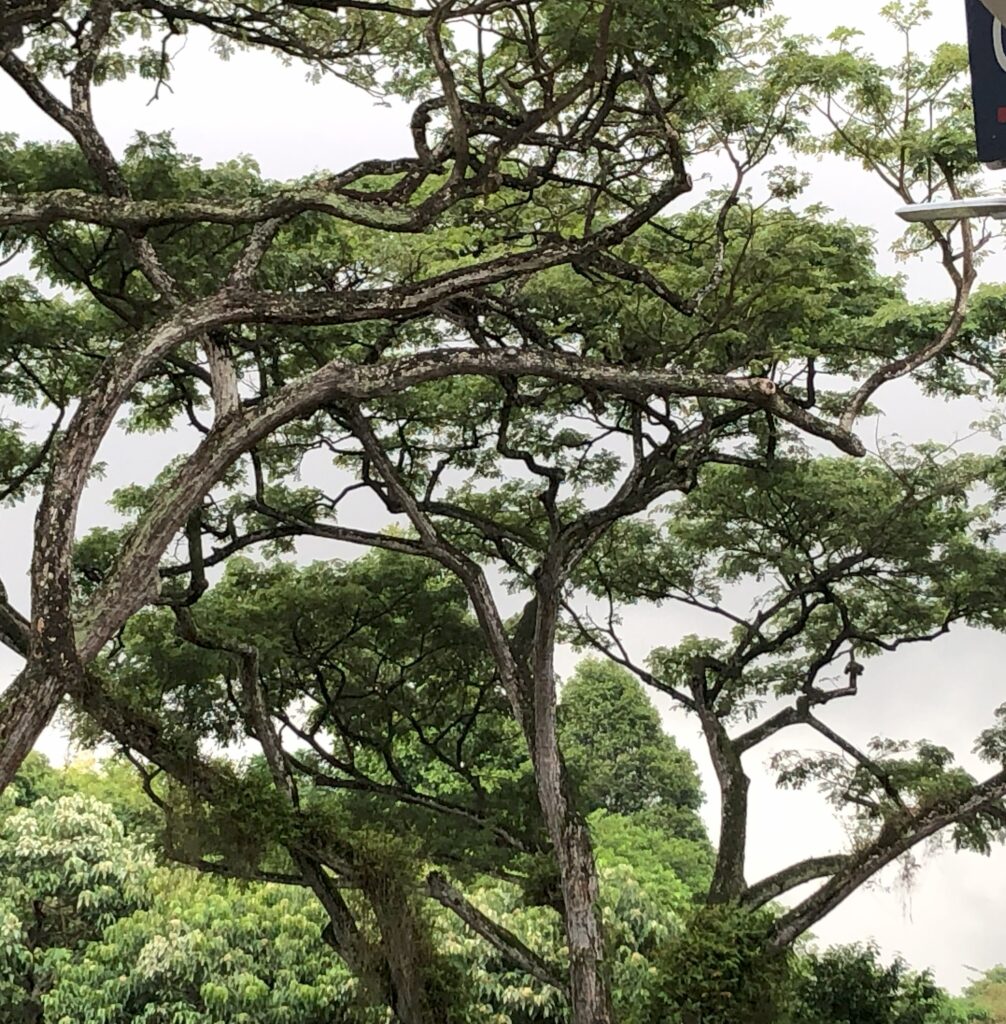
1. Imagine yourself sitting under a tree. It’s a useless tree in the sense that its wood is so knotted it cannot be made into anything by a carpenter. The only thing it is ‘good for’ is sitting under and doing no-thing. When you sit underneath it, it provides shade, calm and peace. It is a wonderful place to be and non-do.
 
2. You can also sense that the tree is entirely happy to be itself. It is not trying to be anyone or anything else. It rests within it’s own natural dignity, it’s sense of inner sufficiency and completeness. As you sit under it, you can feel yourself getting in touch with your inner wholeness and natural dignity. You are just fine as you are. You are a complete being.
 
3. Resting whole and complete like the useless tree, when a thought arises, ask yourself the question ‘Who is it that is thinking the thought?’ Turn your attention inward toward the consciousness that produced the thought. Let your attention return to simply being aware rather than thinking, like a person returning to the shade of a tree after being in the hot sun. Go deeper into being, non-doing and non-thinking.
 
4. From being, now reach into the deeper stillness of Un-being, the Void out of which all Being comes.
 
Return to your outer awareness and close the meditation.
 
Reference 1: The Useless Tree by Chuang Tzu
 
Hui Tzu said to Chuang: I have a big tree, The kind they call a “stinktree.”
The trunk is so distorted, so full of knots,
No one can get a straight plank out of it. The branches are so crooked
You cannot cut them up in any way that makes sense.
There it stands beside the road. No carpenter will even look at it.
Such is your teaching– big and useless.
 
Chuang Tzu repliedSo, for your big tree. No use? Then plant it in the wasteland
In emptiness. Walk idly around, rest under the shadow; No axe or bill prepares its end.
No one will ever cut it down. Useless? You should worry!
(Here is the full Thomas Merton version)
 
The Cedar Tree by Thich Nhat Hanh

“A cedar tree doesn’t have any desire to be a pine or a cypress or even a bird. It’s a wonderful manifestation of the Cosmos just as it is. You are a manifestation of the Cosmos. You are wonderful just like that.”
 
Resting under the tree of non-thinking – Quote from Ramana Maharshi ‘Who Am I?’

“The mind moves without rest, alternately going out of the Self and returning to it. Under the tree the shade is pleasant; out in the open the heat is scorching. A person who has been out in the sun feels cool when he reaches the shade. Someone who keeps on going from the shade into the sun and then back into the shade is a fool. Similarly, the mind of one who knows the truth does not leave Brahman (Self-as-consciousness)
 
Related articleWhat Does it Mean to Meditate on Non-Doing? (And why We should be interested in doing It)

Article content © Toby Ouvry & Integral Meditation Asia 2024. you are welcome to share, but please cite the source, thanks! Contact info@tobyouvry.com 


Follow Toby onLinkedInYouTubeInstagram

Integral Meditation Asia

Online Courses 1:1 Coaching * Books * Live Workshops * Corporate Mindfulness Training *Life-Coaching *  Meditation Technology
Categories
A Mind of Ease Energy Meditation Enlightened Flow Integral Awareness Integral Meditation Life-fullness Meditation techniques mind body connection Mindful Resilience Presence and being present

Pond & river. What is it that moves, what is it that is still?

Dear Integral Meditators, 

This week’s article looks at moving stillness as our object of meditation. It’s a capability that, when you start to get a practical handle on it can have a deeply transformative influence on your life!

If you enjoy it, then do check out the  Effortless effort – The art of doing by non-doing, a ten-week meditation course! that I’ll be starting this  week, both live & online on Tuesday & Wednesday evenings. 

You can also view my course  video on Effortless effort – Moving water that is still, still water that is moving

Final reminder, this Saturday 13th January, 9.30am-12.30pm I’ll be facilitating An Introduction to Integral Mindfulness & Meditation Practice 3 hour workshop. Great way to kick start your meditational year!
 
In the spirit of moving stillness,
 
Toby


Pond & river. What is it that moves, what is it that is still?
 
An important dimension of the practice of effortless effort is to bring stillness and movement together into a harmonic with you. This facilitates the ability to relax into our life and daily tasks ergonomically and effectively. It also enables us to combine two things:

  • Functional productivity, meaning getting our ‘to do list’ done in an effective manner
  • Creative productivity, meaning we are flexible and spontaneous, as well as capable of envisioning and articulating possibilities that have not yet come about

Ajahn Chah, the late well known Thai meditation teacher described the meditative state as ‘still water that moves, and moving water that is still’. When we are beginners at meditation, it seems like movement & stillness are the opposite of each other. Either we are still and relaxed, or we are thinking and active. To bring these two parts together into a state of effortless effort, we need to identify what part of our body-mind is always still, and what part of our body-mind moves.
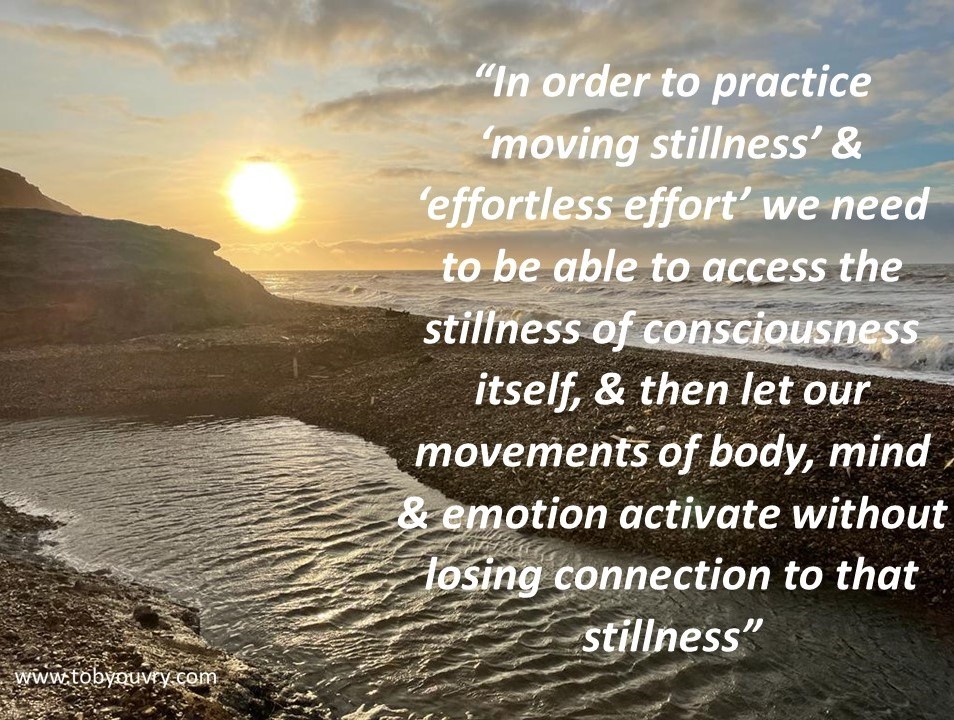
If you look at your experience moment to moment, it seems relatively clear that your mind, body, and emotions move when they are activated. When they become still temporarily, we start to notice the space of consciousness itself, which, because it has no form is always still. The mind, body and emotions move within the stillness of consciousness. So then, in order to practice ‘moving stillness’ we need to be able to access the stillness of consciousness, and then let our movements of body, mind and emotions move without losing our connection to that stillness. As you can imagine, this takes practice and with this in mind, here is an exercise that you can try out in order to develop your capacity.
 
Pond & river
Imagine yourself sitting in a landscape with a still pond on once side, and a relatively rapidly moving river on the other side.

  • Focusing on the pond, let your mind become still and quiescent like the pond, relax into the stillness for a while. Notice that when you do this you will start to contact the actual, ever-present stillness of your inner consciousness. The image connects you with the presence of your always-still consciousness-itself
  • Then focus on the river, letting your mind feel into the activity and dynamism of the water. Try and ‘flow’ with the movement as you breathe
  • Now bring them together, centre in the stillness of the pond, then brining the sense of movement into the stillness. Initially this might feel a little unnatural, or even jarring, and you might lose your focus a few times. But with a bit of practice you will be able to combine the ‘noise’ of the river with the stillness of the pond.
  • As a final section to the meditation, spend a short while envisioning yourself going about your daily activities. As you do so feel yourself connected to the stillness of your consciousness, whilst at the same time physically,, mentally and emotionally interacting with your world. Imagine yourself to be like ‘moving water that is still & still water that moves’

This meditation will then give you the basis to start practicing effortless effort, bringing together stillness and dynamism as you meet the challenges of the day!

Article content © Toby Ouvry & Integral Meditation Asia 2024. you are welcome to share, but please cite the source, thanks! Contact info@tobyouvry.com 


Follow Toby onLinkedInYouTubeInstagram

Integral Meditation Asia

Online Courses 1:1 Coaching * Books * Live Workshops * Corporate Mindfulness Training *Life-Coaching *  Meditation Technology