Categories
Awareness and insight Inner vision Insight Meditation Integral Awareness Life-fullness Meditating on the Self Meditation and Psychology Meditation techniques mind body connection Mindful Resilience Mindful Self-Leadership Mindfulness Presence and being present Shadow meditation Stress Transformation

Transcending & including – Integrating the big & the small selves

Dear Integral Meditators, 

This week’s article looks at the practice of transcending & including. It is an important practice for everyone, but particularly if you are on a path of inner growth, as you are actively transcending and including as your path evolves.

This week’s Tuesday & Wednesday meditation continues our journey into Therapeutic mindfulness, and will look at the theme of transcending & including. If you enjoy the article, feel free to join us!

In the spirit of inclusion, 
 
Toby


Transcending & including – Integrating the big & the small selves
 
As you grow you get inwardly, as well as outwardly bigger
Babies identify only with their physical body up until around 18months. Up until the age of 4 years, we can only take a first-person perspective: ‘me’, ‘I’ & ‘mine’. Growing older as children and teenagers, we see ourself as a part of a ‘we’ space, our family, our friends, my team. If we become fully fledged rational humans, we learn to take a healthy third person perspective, an ‘it’ space, where we consider everyone to have value, and our circle of concern becomes world-centric, universal and much bigger.
As we continue this growth further onto higher levels, our self-sense gets bigger and bigger, more and more inclusive. Our ‘I’ becomes more & more universal in nature.
 
The principle of transcending & including
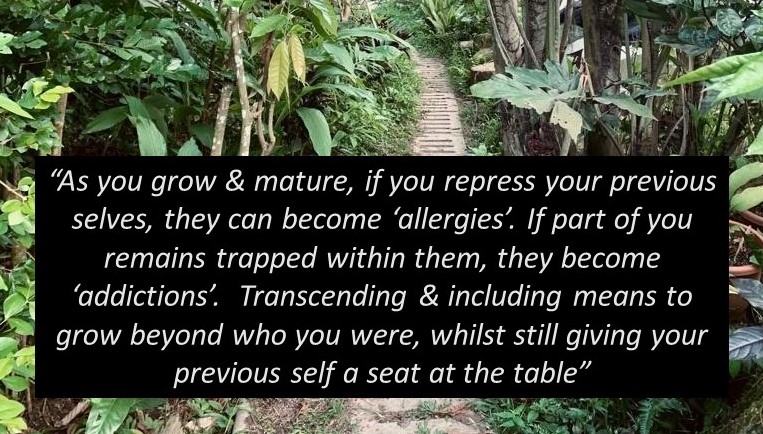
When we grow it’s not that our older, smaller selves cease to exist, it’s just that they get transcended. My child-like egoic self is still there when I grow to the next stage, it’s just that it becomes only a part of what I am, held and contextualized by the bigger, more inclusive self of the next stage. The bigger self transcends, but includes the smaller self.

  • The ‘transcending’ part of this means that we grow beyond our previous limited sense of who we are
  • The ‘include’ part of this ensures that the smaller self feels secure and honoured within the new self structure.

A simple example: Yesterday I spent quite a lot of time playing with my three year-old. This meant my ‘inner child’ coming online and me being ‘childish’! However, my child-self was held by my mature or adult self. For my daughter, she ‘is’ the child. For me as an adult I act in a child like way, but he is held by a bigger self-sense that is the adult. My adult self transcends and includes my child self.
 
Avoiding allergies & addictions
Transcending and including needs to be done in a healthy manner otherwise:

  • If I transcend the previous stage too much, instead of detaching from it healthily, I disassociate with it, it becomes an ‘allergy’, something foreign. For example if I dissociate with my inner child, outer children become incomprehensible, silly and foreign. Inwardly I lose the ability to be playful, joyful and spontaneous. I become a stiff, repressed adult, ‘allergic’ to child-like behaviour
  • If I include the previous stage too much, a part of my identity gets ‘stuck’ at that level. I find myself compulsively becoming child-like in some situations, the behaviours feel like ‘addictions’. I keep regressing to this level uncontrollably. To return to the child analogy, I might usually keep a good diet, but then keep sabotaging that by eating one biscuit, and then the whole packet. My self-regulation becomes periodically child-like and chaotic!

 
Mindful therapeutic integration
To work therapeutically with the transcend and include principle, take any part of your smaller selves as the object. For example, you could take:

  • Your child self
  • Your eating urges
  • A part of you very identified with a past trauma
  • A part of you identified with a particular belief

The list here is very large. Sitting in a mindful state you simply bring it to mind, and watch it. As Ken Wilber says, you imagine you are video -taping it as an observer. The part of you that observes simply witnesses it with a ‘transcend and include’ approach:

  • The ‘transcendent’ part of it means that your witness has a sense of itself as something bigger than and separate from the part of self you are observing
  • The ‘include’ part of it means that your witness self acknowledges, accepts, and gently embraces the smaller self.

If you do this, the idea would be that any ‘addictions’ or ‘allergies’ that you have developed to smaller parts of yourself as you have grown beyond them will gradually be released. You will find yourself in an increasingly balanced and integrated relationship to your smaller selves, free from addictions and allergies.
 
Related reading:  Creating an inner therapeutic mindfulness space
Suppression & repression – the difference, & it’s importance
Bodies within bodies – Witnessing with your energy bodies
The body is in you – How to go into deep meditation quickly

Article content © Toby Ouvry & Integral Meditation Asia 2023. you are welcome to share, but please cite the source, thanks! Contact info@tobyouvry.com 


Integral Meditation Asia

Online Courses 1:1 Coaching * Books * Live Workshops * Corporate Mindfulness Training *Life-Coaching *  Meditation Technology
Follow Toby onLinkedInYouTubeInstagram

Categories
A Mind of Ease Inner vision Integral Awareness Life-fullness Meditation and Psychology mind body connection Mindful Confidence Mindful Resilience

Wanting what you like, or liking what happens?

“Confidence comes not from being ‘in control’ of everything, but from knowing that, whatever way things work out today, I can come up with a way of liking it, using it, & deriving some form of fulfilment from it”

Dear Integral Meditators, 

This week’s article continues the theme of ‘making things workable’ from last weeks article on Effortless effort. Meditation, regardless of the type is always primarily about inner transformation which, if done well effects a transformation of our outer experience.

This week’s Tuesday & Wednesday meditation continues our journey into Therapeutic mindfulness, and last call for this weekend’s Shamanic meditation workshop retreat on Saturday & Sunday morning.

In the spirit of 
 
Toby


Wanting what you like, or liking what happens?
 
A couple of quotes to start this article and get the ball rolling:
 
“It is essential to understand that daily meditation will not ‘solve’ our problems. Anyone claiming to teach or sell methods that solve our problems is either misled or willfully deceptive. What happens is always and only our own inner transformation. After such transformation many problems will fade or seem irrelevant. However, deeply intractable problems and complex situations often require long-term work. One of the most curious and paradoxical effects of dedicated spiritual discipline is that some situations, previously insolvable, will evaporate.” – RJ Stewart, from the Sphere of Art Vol III
 
“The day you decide not to ask for things you like but rather to like things that happen, that day you become mature.” – Osho
 
Liberation is not freedom from problems
Meditation and mindfulness can free you from your own inner turmoil, but that doesn’t mean that your external life will get better in the sense of getting what you want all the time, or being free from inconvenience. What is does mean is that our inner self is transformed and changed, so that we experience our outer challenges and difficulties differently. They become more acceptable and workable with. We don’t need to fight with what ‘is’ so much.
 
Problems or situations?
A lot of the things that we have labelled ‘problems’ in our life are more like ‘situations’. A problem is something that by definition has a solution. A situation is more a set of circumstances that we find ourself in. There may be no apparent solution to the situation, or the solution would cost more than it would be worth to ‘solve’ the problem. In this case it is more like we have to simply accept and work with what is. If we can harmonize our relationship to what ‘is’ today, meaning our situations, then chances are we will find ways to enjoy it and derive some value from it.
 
Confidence from liking what is
If we can get good at liking what we find and working with it, then we start to become confident in life. This confidence comes not from being ‘in control’ of everything. Rather it comes from knowing that, whatever way things work out today, I can come up with a way of using it, of deriving some form of fulfilment from it.
 
Preferences not attachments
None of this means that you don’t have goals and preferences in your life, or that you aren’t working actively and intelligently towards them. But what it does mean is that, as you are experiencing the twists and turns of your journey, you are liberated to enter fully into this moment and live it with freedom. Even if what is it is not what you ‘want’, you can make it something that you feel alive and vivid in the presence of.
 
Different meditation techniques from the great traditions, from the Shamanic journeying methods that I’ll be leading a retreat around this weekend, to the more ‘Zen’ methods of effortless effort are all methods of inner transformation. If we go into them thinking that it is going to be a ‘wish fulfilment’ exercise, we are likely to be disappointed, certainly in the medium to long term. But if we enter them with the intention to really work on our inner transformation, then we find that our world really can change radically for the better.
 
Related articlesEffortless effort – Making everything workable
Solve no problem (& leave no problem unsolved)

Article content © Toby Ouvry & Integral Meditation Asia 2023. you are welcome to share, but please cite the source, thanks! Contact info@tobyouvry.com 


In case you missed last weeks article: Effortless effort – Making everything workable

When Chogyam Trungpa, the famous Tibetan Buddhist Master was asked “What is Dharma?” (Dharma means the teachings of the Buddha), he replied “Dharma means that everything is workable.”
The other day I was texting a friend I hadn’t seen in a while. He asked “How is everything?” to which I replied “With acceptance, everything is workable.” This made me recall the Trungpa quote, then leading to a few thoughts about the principle of ‘Effortless effort’.
You might think about Effortless effort as a way of accepting and working with the reality that you are presented with. It is a ‘state’ of being that then leads into…read full article 


Integral Meditation Asia

Online Courses 1:1 Coaching * Books * Live Workshops * Corporate Mindfulness Training *Life-Coaching *  Meditation Technology
Follow Toby onLinkedInYouTubeInstagram

Categories
A Mind of Ease Awareness and insight Energy Meditation Inner vision Life-fullness Meditating on the Self meditation and creativity Meditation and Psychology Meditation techniques mind body connection Mindful Confidence Mindful Resilience Mindful Self-Leadership Mindfulness Motivation and scope Presence and being present

Effortless effort – Making everything workable

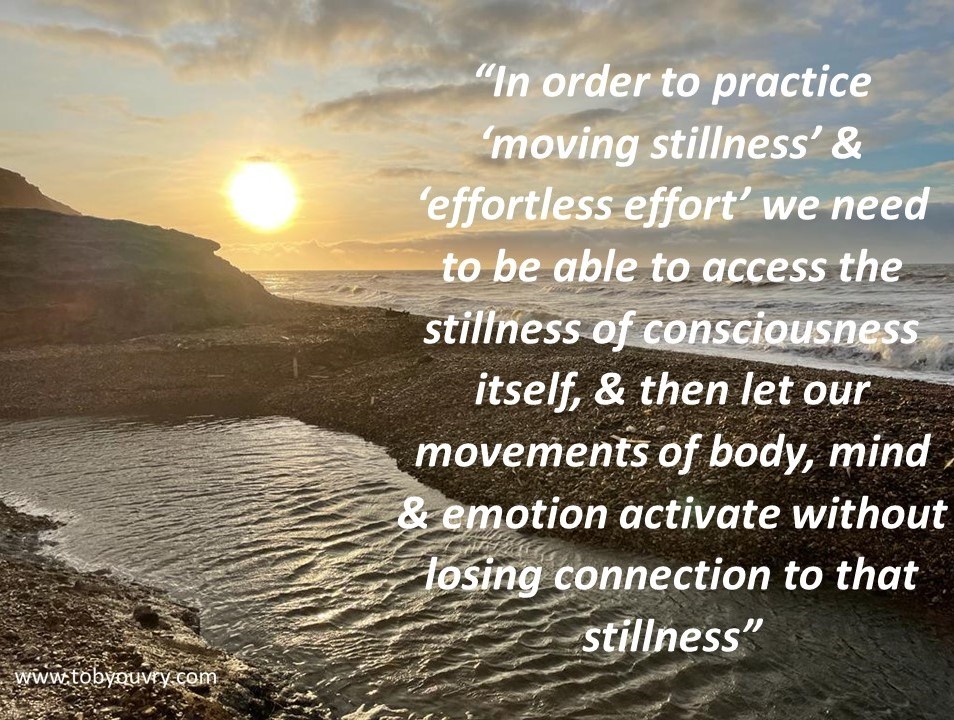
“The art of Effortless-effort makes difficult things feel manageable, & effort over a long period of time sustainable, even quietly joyful”

Dear Integral Meditators, 

Just starting to get my thoughts together regarding the  Effortless effort – The art of doing by non-doing, a ten-week meditation course coming up in January. The article below explores a few working definitions and practices

In the spirit of skillful sustainability,
 
Toby


Effortless effort – Making everything workable

When Chogyam Trungpa, the famous Tibetan Buddhist Master was asked “What is Dharma?” (Dharma means the teachings of the Buddha), he replied “Dharma means that everything is workable.”
The other day I was texting a friend I hadn’t seen in a while. He asked “How is everything?” to which I replied “With acceptance, everything is workable.” This made me recall the Trungpa quote, then leading to a few thoughts about the principle of ‘Effortless effort’.
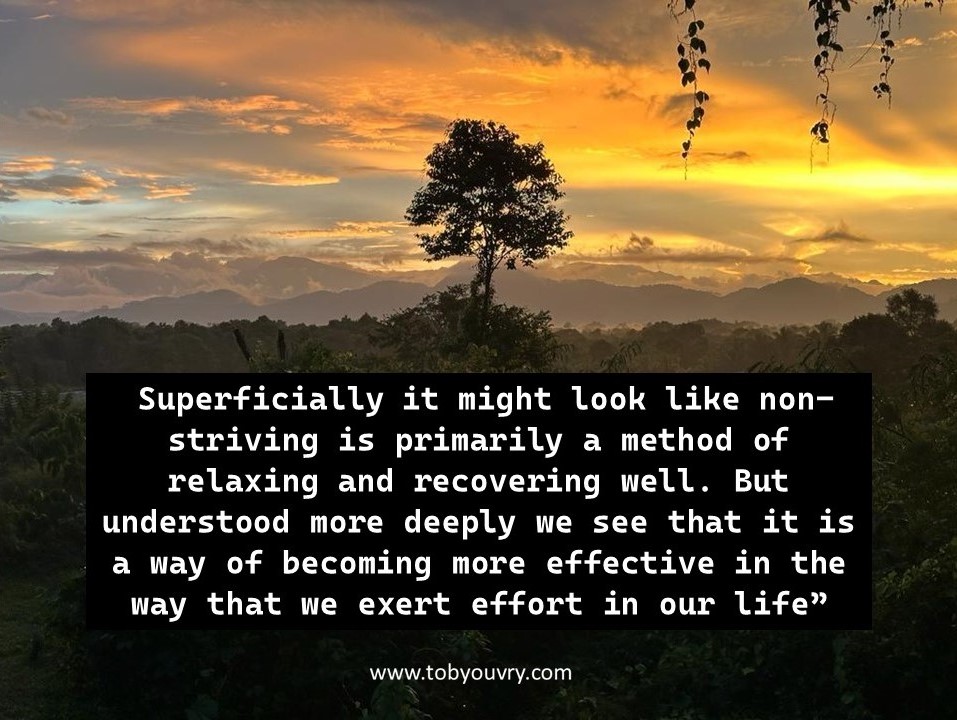
You might think about Effortless effort as a way of accepting and working with the reality that you are presented with. It is a ‘state’ of being that then leads into a way of doing that works with whatever we are facing.
‘Effortless effort’ could also be described as ‘Doing though non-doing’, also known as ‘Wei wu wei’ in Chinese (translating into ‘effortless action’). It is a philosophy of life & way of meditating found explicitly in the Zen, Chan & Taoist schools of meditation. Implicitly it is found in most of the great wisdom traditions of the world. It indicates skilful and ergonomic ways of working with life that facilitate balance, resilience, creativity & wisdom.
 
The feeling of Effortless effort (E-E) in the body


One of the things that I really enjoy and appreciate about E-E is the sense of flow and energy efficiency that it brings. It makes difficult things feel manageable, and effort over a long period of time sustainable, even quietly joyful.
The state of E-E can be described as a way of holding your body, as well as a state of mind. As a bodily state, here are some pointers:

  • The muscles are soft, with only enough tension in them to perform the presenting task. For example, if you are standing or sitting upright, the crown may be high and the body upright, but the centre of gravity is low in the belly, so that the chest and shoulders are not carrying their own weight. Hands and arms are loose, and the belly is not holding onto emotional stress.
  • The feeling of the inner self is one of comfort in the body, or ‘comfort in your own skin’. There is an absence of rush or panic, even, and particularly in the face of persistent stressors
  • The body feels at home in its environment. There is a sense that the world is a friendly place, where you are things are workable. As a sensation in the body, there is a feeling of trust in process, a sense of quiet alertness and relaxed attention

An everyday reflection


This morning I had a coaching appointment cancelled at short notice. So, I thought it would be nice to take my daughter to pre-school. I took her, but forgot to bring her nap-time bedding. I had planned to work on this article before going to work, but now I had no time, because I had to go back to the school. Pausing, relaxing, and  working on the principle that ‘everything is workable’, I transferred the article from my computer to my phone, and use the extra time on public transport to continue to edit my article. Through-out the process, I simply focused on staying calm, feeling flexible and accepting. Having come up with a simple battle-plan, I relaxed into it’s execution. I consciously worked on being smooth and ergonomic, working with the situation rather than fighting it.
This is a very simple example, but hopefully it gives you a feeling for how to start working with E-E in everyday situations. If you can practice daily actions with E-E, then you will burn up a lot less energy, and arrive at the evening feeling less fatigued, with your mood more positively disposed. A final point, if you get good at E-E during the day, when you sit down to meditate, you will find that you are already near a state of meditation, and that moving into formal meditation feels more like slipping into a warm bath; a natural, easy transition from doing to being!
 
Related readingWorking Samadhi – The way of the mindful warrior
Mindful ergonomics – Making the most of your energy
 
Article content © Toby Ouvry & Integral Meditation Asia 2023. you are welcome to share, but please cite the source, thanks! Contact info@tobyouvry.com 


In case you missed this week’s other article: Shamanic meditation – Psychopomping & other non-ordinary adventures
 
Shamanic meditation, often described as ‘Shamanic journeying’ occurs mainly in the dream state, which is to say the psychic and subtle levels of mind. You might think of shamanic meditation as a type of ‘conscious dreaming’ done whilst meditating…read full article


Integral Meditation Asia

Online Courses 1:1 Coaching * Books * Live Workshops * Corporate Mindfulness Training *Life-Coaching *  Meditation Technology

Follow Toby onLinkedInYouTubeInstagram

Categories
Awareness and insight Concentration creative imagery Energy Meditation Inner vision Integral Awareness Integrating Ego, Soul and Spirit Life-fullness Meditating on the Self Meditation techniques mind body connection Mindful Confidence Mindful Resilience Mindful Self-Leadership Mindfulness

The conscious-self – Your inner CEO

“Your Conscious-self is: The captain of your inner ship directing the crew, The CEO of your consciousness, setting the direction of your inner organization, & the conductor of your inner orchestra, co-ordinating all the different sub-elements of the self into a coherent unity”

Dear Integral Meditators, 

This week’s article explores the theme of the Conscious-self, and it’s importance in the health and wellbeing of our self-sense and personality. If you enjoy it, then do consider coming along to the Mindful Presence Masterclass & group coaching: The Inquisitive Sumo Wrestler – Turning up to life calm & curious , where we will be looking at mindfulness practices to create a high-functioning Conscious self. 

If you like you can combine the Masterclass with the Qi gong class as an  Integral Life Practice Session. It’s a morning you will come out of feeling at the top of your game!

In the spirit of your inner CEO,
 
Toby


The Conscious-self – Captain of your ship & CEO of your body-mind
 
The Conscious-self is that part of you that is aware in the present, and of what it finds in the present moment. This includes:

  • Sensory orientation in your environment
  • Co-ordinating what is going in within the body
  • Content of mind; thoughts, emotions, patterns of mental activity
  • The activity of your subconscious mind
  • Awareness of awareness itself, and where we are directing it through attention in any given moment

 
The Conscious-self is responsible for the wellbeing of our body, mind, and emotions. It oversees our choices and decision-making process. It is in charge of how we deploy our energy and resources. It is in charge of our life-plan and self-discipline. All the different sub-personalities that exist within ourself should be marshalled by and taken care of by the conscious-self. Think of your Conscious-self as being like:

  • The Captain of your Ship directing the crew
  • The CEO of your consciousness, setting the direction of your inner organization
  • The conductor of your orchestra, co-ordinating all the different sub-elements of the self into a coherent unity

 
The Conscious-self (C-S) is supported by your higher mind (your soul-level or philosophical/principled self), and your Overmind, or spiritual being. These appear mainly as aspects of our values, imagination & intuition that the C-S can access and refer to for guidance. The C-S is in charge of co-ordinating our ego and personality in everyday life, directing it towards a sense of effectiveness in the face of challenges, and happiness in its various forms. The Higher and Over-mind’s are like a wise inner ‘Board of directors’ that the C-S can refer to for advice and wisdom.
 
Leading yourself through life
The Conscious-self is, in essence the leader of your consciousness. As the leader, its main functions are:

  • Creating a compelling vision for the rest of the personality to follow, that can take us boldly and enthusiastically into our future from where we stand in the present
  • Getting the ‘buy in’ from the rest of the personality. For example, if a part of us is feeling doubtful about the vision, the C-S needs to listen and help the doubter to come along for the ride.

This leadership function is very much like the CEO of a company; The main job is envisioning the future creatively, getting the buy-in from the team, and then delegating tasks to the team members. The C-S delegates to the other parts of self, tells them what to do and why they are doing it!
 
Contemplation
 
Being present as your conscious mind – In meditation, get used to sitting and centring yourself in your conscious-self. Practice being present to the content of your consciousness, observing the movement of the different elements. Get used to distinguishing the C-S as the Captain and CEO in charge, and the other activities of your consciousness, which are what your C-S oversees.
 
Observing your relationship to choices – Notice how comfortable your C-S is with making choices and taking responsibility. Notice when you want to ‘duck’ choices, feel anxious and confused, want to give away responsibility for what you need to decide on. Work on getting more comfortable, confident, and responsible in this space.
 
Inspiring and supporting – From your position as the C-S, the CEO of consciousness, the captain of your ship, set an inspiring direction:

  • For the next 3-5 years,
  • For the next year, 6 months, 3 months
  • The next month, week, day,
  • For the next activity today!

Create a vision for your life that the rest of your body, mind and personality can follow. Then delegate tasks, and support your sub-selves, getting them on board and up for the program.
 
In conclusion, a high-functioning Conscious-self is the key to effective self-leadership, and to organizing your life effectively. The proposition would also be that the better at self-leadership you become, the better you will tend to be at outer leadership…
 
Article content © Toby Ouvry & Integral Meditation Asia 2023. you are welcome to share, but please cite the source, thanks! Contact info@tobyouvry.com 


Integral Meditation Asia

Online Courses 1:1 Coaching * Books * Live Workshops * Corporate Mindfulness Training *Life-Coaching *  Meditation Technology

Follow Toby onLinkedInYouTubeInstagram

Categories
Energy Meditation Inner vision Insight Meditation Integral Meditation Meditating on the Self Meditation techniques mind body connection Presence and being present Qi gong spiritual intelligence Zen Meditation

Bodies within bodies – Witnessing with your energy bodies

“Liberation in meditation is achieved by progressive, healthy levels of dis-identification with our different bodies, and the recognition that they are ‘in us’ as the witnessing consciousness, rather than we being ‘in them’. This then liberates us into a much more playful, creative and loving relationship to life ourself and others. Healthy dis-identification leads us toward a fuller, richer, deeper experience of life, rather than a blander one!”

Dear Integral Meditators, 

This week’s article explores the concept & experience of ‘energy bodies’, & the relationship between them & inner freedom. 
If you enjoy it, then the Shamanic meditation workshop retreat on Sat/Sun Nov 25th/26th November is about learning to ‘travel’ in your subtle energy bodies, so that may be of interest.
Also, theIntegral Life Practice Sessions, are very much about working with your different bodies, and getting them all into shape!

Finally, this week’s Tuesday & Wednesday class is the Seasonal classSamhain – Healing the wounds & receiving the gifts of our ancestors. It’s a nice way to appreciate and capitalize on our ancestral inheritance…
 
In the spirit of inner freedom,
 
Toby


Bodies within bodies – Witnessing with your energy bodies
 
We can all recognize our physical body, and if someone askes you to focus on your physical body you could probably do it for a while with a reasonable degree of proficiency, distractions aside. According to the meditative traditions, we have not just one body, but a series of bodies across a range of energy from gross to subtle to very subtle. There are different ways of describing it, but here is a relatively typical one:

  • The gross physical body, corresponding to the literal weight-&-mass aspect of our body
  • A vital, or etheric body corresponding to our biological life force, that surrounds and interpenetrates our physical body, but it is an ‘energy body’ rather than a physical body
  • An astral or emotional body, subtler still than the etheric, that surrounds and interpenetrates the physical and etheric
  • psychic or mental body that corresponds to our thinking self, more subtle than the three lower levels, surrounding & interpenetrating them
  • causal, or very subtle body, made of formless consciousness, that contains all the lower levels

There are ‘levels within each level’ so to speak, but the above gives you a basic idea. You can get a sense of each ‘body’ by observing them in meditation:

  • You can practice mindfulness of the physical body, and the sensations within it. You can further observe the more subtle movement of energy within the etheric or vital body
  • You can get a sense of your astral & psychic bodies by watching your thoughts and emotions, and getting a sense of the ‘body of energy’ that holds and contains them
  • As a slightly more advanced practice you can watch consciousness itself, and get a sense of the very subtle ‘body of energy’ that corresponds to the experience of awareness itself.

Practising all three of the above levels over time, you will get a sense of each body being contained, or held by the next level of energy-body.
 
Combining this with witnessing practice
‘Liberation’ in meditation is achieved by progressive, healthy levels of dis-identification with our different bodies, and the recognition that they are ‘in us’ as the witnessing consciousness, rather than we being ‘in them’. For example, we can observe that:

  • Often it feels as if our ‘I’ is sitting inside our physical body, we are it and it is us. If we take a position of ‘self as the consciousness that witnesses the body’, then we can flip this, reflecting that “I am not within my body, my body is within me”. The physical body becomes an object of consciousness (an ‘it’), rather than the subject (an ‘I’)
  • Similarly, we can notice that often our sense of self is locked inside our thoughts and emotions, we mistake our mental and emotional activity for ‘me’. Noticing this in meditation, we can perform a similar ‘flip’ of perception; “I am not my mind and emotions, my mind and emotions are within me.” Again, here we are identifying the ‘I’ as the witnessing consciousness, not the thoughts & emotions that are the ‘content’ of consciousness
  • A ‘level three’ practice is to observe the formless awareness of our consciousness body, and discern that there is ‘consciousness’ and ‘the observer of consciousness’. Once again, after noticing this we do a ‘flip’; “I am not within my consciousness, my consciousness is within me”.

The above practices gradually lead to a sense of self that is related to but different from our gross body, mind and consciousness. Our ‘I’ becomes liberated from, or ‘free’ from identification with the things that are not it.
The practical effect of witnessing our bodies in this way is that our life becomes much less stressful. Even when faced with challenges, sufferings and tribulations, we can sustain a sense of even-mindedness because we take it less personally. There is less ‘I’ caught up with the drama. This then liberates us into a much more playful, creative and loving relationship to life ourself and others. Healthy dis-identification leads us toward a fuller, richer, deeper experience of life, rather than a blander one!

Related articles:  The body is in you – How to go into deep meditation quickly

Watching & then dropping the watcher

Article content © Toby Ouvry & Integral Meditation Asia 2023. you are welcome to share, but please cite the source, thanks! Contact info@tobyouvry.com  


Integral Meditation Asia

Online Courses 1:1 Coaching * Books * Live Workshops * Corporate Mindfulness Training *Life-Coaching *  Meditation Technology
Follow Toby onLinkedInYouTubeInstagram

Categories
Awareness and insight Enlightened Flow Insight Meditation Integral Awareness Integrating Ego, Soul and Spirit Life-fullness Meditation and Psychology mind body connection Mindful Resilience Mindfulness Presence and being present

Fourteen levels of mindful intention

“We almost always have an intention, even in our dreams. That intention drives our actions & acts as the context for our experiences, shaping them substantially. What intentions have you been oriented around today, & how have they been shaping your experiences and actions?”

Dear Integral Meditators, 

One way you could define mindfulness is ‘Living with conscious intentionally’. The article below unpacks some aspects of this, I hope you enjoy it!

The Therapeutic mindfulness course  is ongoing, with this weeks class focusing on ‘Positive Acceptance vs resignation, repression vs suppression – Understanding the dynamic of good quality therapeutic mindfulness‘.

Heads up for this Saturday morning’s Monthly Qi Gong & Taoist Breathwork Clinic & Mini-retreat, & for the main event for October, theIntegral Meditation Two Day Retreat on the weekend of the 28/29th.
 
In the spirit of intention,

Toby 


Fourteen types & levels of mindful intention
 
We almost always have an intention, even in our dreams. Some of these intentions are conscious, some of them are unconscious. These intentions drive our actions & acts as the context for our experiences, shaping them substantially. What intentions have you been oriented around today, and how have they been shaping your experiences and actions?
 
One way you could define mindfulness is ‘Living with conscious intentionally’

When I was doing my first serious decade of meditation training back in the 90’s I was working with Tibetan Buddhism as a practice vehicle. One of the main practices was a series of twenty one practices called the ‘Lamrim’ or ‘stages of the path. Each stage was had a particular meditation object associated with it. What was interesting was that twenty of the twenty one meditations was about developing a specific intention, which shows you how important intention is in meditation in general, and in Tibetan Buddhism in particular. What I have done in this article is condense the twenty intentions into fourteen, in a way that can be understood and explored by anyone. The premise is that any one of these intentions will cause us to think, feel and act in ways that are beneficial both to ourselves and others. Our actions follow our intentions and thoughts. If you change your intention, you change your life, literally.
 
The fourteen levels of intention:

  1. The intention to seek out reliable guides who can provide us with reliable wisdom in the important areas of our life
  2. To recognize and appreciate the amazing opportunity of a human life and use it in the most meaningful manner
  3. Mindful of death and impermanence, to not waste our life on meaningless distractions, rather to ‘carpe diem’; seize the day!
  4. To seek out communities and people who have integrity and can provide us with genuine refuge from suffering, and ‘sail together’ to happiness and wellbeing
  5. To be mindful of our actions and the effects that they have in our life. To avoid thoughtless, counter-productive actions, and engage in ‘constructive’ life-enhancing ones
  6. To practice healthy detachment regarding our desires, and pursue more and more reliable forms of fulfilment, freedom, and wellbeing
  7. To cultivate equanimity and even-mindedness, both in our pursuit of success, and in our treatment of others
  8. To cultivate loving kindness toward ourself, our community and all living beings as far as possible
  9. To wish ourself and others true and lasting happiness
  10. The intention of compassion: To wish ourself and others to be free from needless pain and suffering
  11. The active intention to relieve the suffering & pain of ourself
  12. The active intention to relieve the suffering & pain of others, in fact all living beings
  13. The active intention to give happiness and joy to others, in fact all living beings
  14. The determination to realize enlightenment or awakening ourself, in order to fulfil our intention to relieve the suffering of all others, and bring them true and lasting happiness

 
Intentions 1-6 are primarily focused on ourself, 7-14 progressively lead us to a concern for others; from our ‘close circle’ (friends, family, colleagues) progressively to include all living beings.
The final intention ‘to realize enlightenment and awakening’ means something specific in Tibetan Buddhism. But it can equally be interpreted as simply to become the wisest, most capable person you can be in order to benefit to the evolution of the world. Dwelling upon each of these intentions mindfully can lead us to some powerful, pro-active places within ourselves, you can work with them systematically, or just drop into the ones that catch your attention as you read through.

Article © Toby Ouvry 2023, you are welcome to use or share this article, but please cite Toby as the source and include reference to his website www.tobyouvry.com 


In case you missed last week’s articles: 

Tree of Life – The union of ego, soul & spirit
&
Distinguishing suppression & repression


All upcoming classes and workshops at IMA:

Ongoing – Weekly Tuesday, Wednesday Online class schedule

Ongoing on Wednesday’s, 7.30-8.30pm – Wednesday Meditation for stress transformation and positive energy with Toby (Bukit Timah)

Ongoing on Tuesday evenings, 7.30-8.30pm – Tuesday Meditation for stress transformation and positive energy with Toby  (East Coast)

Ongoing – Re-discovering your inner vitality & joie-de-vivre – An introduction to integrative therapeutic mindfulness & meditation

Saturday October 7th, 9.30-11.30am – Monthly Qi Gong & Taoist Breathwork Clinic & Mini-retreat

Saturday & Sunday October 28th & 29th – Integral Meditation Two Day Retreat

Tues/Weds Oct 31st, Nov 1st – Seasonal classSamhain – Healing the wounds & receiving the gifts of our ancestors

Tues/Weds Nov 14th/15th – Seasonal classDeepavali -connecting to your inner light

Sat/Sun Nov 25th/26th, 9.30am-1pm – Shamanic meditation workshop retreat


Integral Meditation Asia

Online Courses 1:1 Coaching * Books * Live Workshops * Corporate Mindfulness Training *Life-Coaching *  Meditation Technology
Follow Toby onLinkedInYouTubeInstagram

Categories
Biographical creative imagery Energy Meditation Inner vision Integral Awareness Life-fullness Meditating on the Self meditation and creativity Meditation and Psychology mind body connection Presence and being present

Progressively recovering your joie de vivre (Meditating with your inner child)

If you are prepared to do the work, it seems there truly are no edges to your level of inner joy

Dear Integral Meditators, 

The photo of the child with this article is me when I was around 8 or 9. I keep it on the fridge. I noticed last week that the fridge magnet marked ‘l’excitacion’, or excitement in French had been placed on my forehead, which inspired me to write about my own ongoing journey in the domain of Therapeutic mindfulness. 
If you enjoy the article, then do consider participating in the upcoming Therapeutic mindfulness course, which is full of practices to help you re-connect to the joy of living, and move beyond long-held fears.  

And final heads up for this Wednesday’s Autumn Equinox meditation, either live or online!
 
In the spirit of exitacion,

Toby 


Progressively recovering your joie de vivre (Meditating with your inner child)
 
When I left my life as a Buddhist monk, aged 31, I had been practising eastern meditation forms in a very disciplined manner for a decade. I had experienced many wonderful and amazing meditation states, and had a solid working experience of the awakened state/enlightenment experience. Despite this I noticed that there were still parts of my everyday consciousness that seemed to have been untouched by all this work. I found that certain types of anxiety, irritability and fear had not gone away, and sometimes seemed even worse. This was partly why I left my life as a monk, because I felt I needed to broaden my search for answers to these unresolved areas. The answer was not just ‘do more meditation’, I had to do something differently.

One of the things that I focused on that year was exercises specifically based on the psychological level of my being, based around western theories of trauma and around working with emotional states. I began regular work with my ‘inner child’, exercises including visualization, dialoguing, breathing and body-work. I was very surprised how much work there was to be done! I considered myself pretty well-adjusted as a person, which I think I was, but even so, there was so much to re-connect to, so much to work with, so much to discover. During this period, I really felt I recovered much of my joie de vivre, and got a badly needed ‘second-wind’ for my inner growth that powered me into the next decade of my life.
But the amazing thing about this is that even though I felt that I now had a very good relationship to my inner child (and other sub personalities), it is a process that does not seem to end. Fast forward to the beginning of this year. At the beginning of the year, I often check in with my ‘inner family’ in meditation. When meeting my inner child, I had this experience:

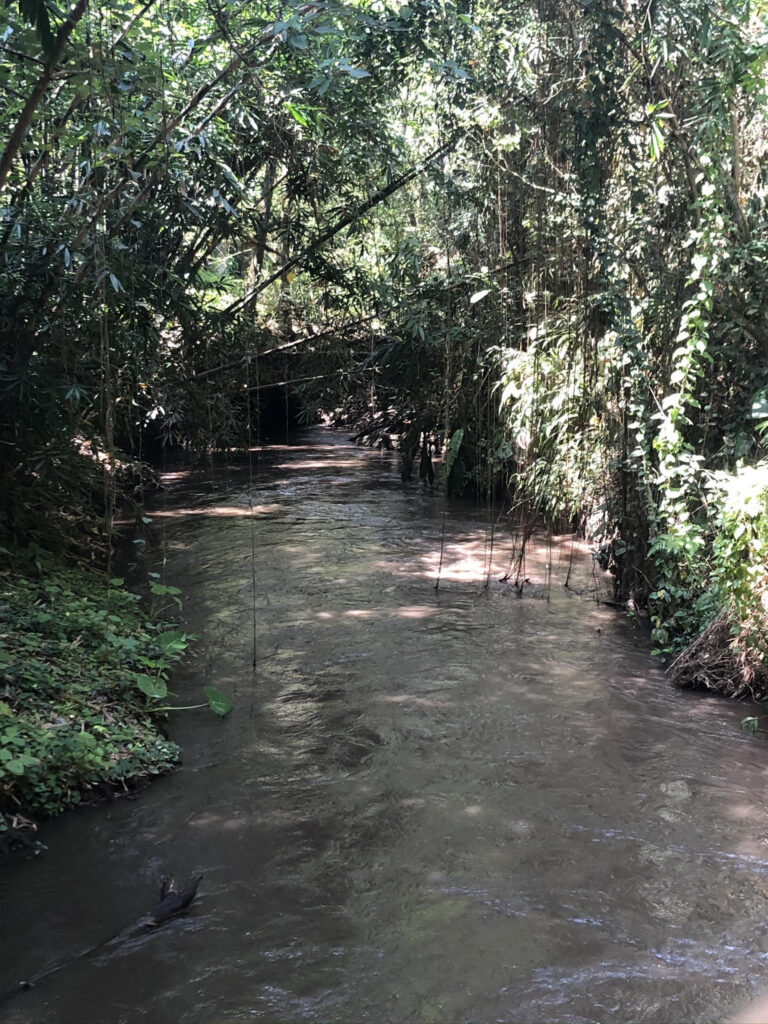
I am walking along the middle of a shallow river that I used to play in as a child. I come to a bridge from which I used to look down at the big fish swimming in and out of the dark water underneath. On the sand to one side of the bridge I see my inner child. I wade over to him, and we squat for a while looking under the bridge. Then he smiles to me and we begin to walk into the water and under the bridge (I never went under the bridge as a child). We stand in silence looking and feeling the fish around our feet, in gentle awe and excitement. After while we walk on and out from the other side of the bridge. We walk on to a meadow next to the river. My child-self utters a cry, and starts to run around the meadow, whooping, and laughing out of pure joy, I watch on, quite amazed, and aware of a new level of joy in myself that I have never experienced before.

After the meditation, this new level of joy within myself has persisted, and it seems clear to me that some level of inhibition or fear in my child has been resolved. This is a full fifteen years after starting my active relationship with him. So even now my life and experience are expanding and growing from my inner work with my child self and other related therapeutic mindfulness practices aimed at building a strong inner-self psychologically. If you do the work, it seems there truly are no edges to your level of inner joy.
   
 
Related articleMeditating with your child self
Creating a therapeutic mindfulness space
Wake, up, Grow up, Clean up, Flow – The Art of Enlightened Flow


Special Coaching Offer for the Month of September – Free 20minute coaching session with Toby

For the remaining two weeks of September Integral Meditation Asia is offering free 20minute coaching sessions with Toby!
If you have been interested in the idea of getting some personal coaching on a particular issue or challenge, and/or want to explore what 1:1 meditation coaching can do for you in terms of both your quality of and direction in life, this is a great opportunity to find out what it is like with Toby. These 20minute sessions can be done on Zoom or via Whatsapp.
You can find read the general write up of Toby’s Life-fullness Coaching here, & his other forms of coaching here.
You can read feedback and reviews from Toby’s coaching sessions here

To arrange your 20minute session or for further enquiries: Email info@tobyouvry.com, or W-App65-96750279


Integral Meditation Asia

Online Courses 1:1 Coaching * Books * Live Workshops * Corporate Mindfulness Training *Life-Coaching *  Meditation Technology
Follow Toby onLinkedInYouTubeInstagram

Categories
A Mind of Ease Energy Meditation Life-fullness Meditation and Psychology Meditation techniques mind body connection Mindful Breathing Mindful Resilience Qi gong Zen Meditation

Reverse abdominal breathing – Relieving inner stress effectively

“The pattern of reverse abdominal breathing can be combined with the recognition and feeling of stress, thus enabling us to feel confident about releasing tension & stress, even if it feels strong and intractable”

Dear Integral Meditators, 

This week’s article looks at a traditional Qi gong breathing technique that, as well as the physical health benefits, I also find particularly effective for regulating my psychological & somatic tension. If you enjoy the article then we will be exploring reverse abdominal breathing in this week’s Tuesday & Wednesday meditation class, and in the Monthly Qi Gong & Taoist Breathwork Clinic & Mini-retreat on Saturday. 

In the spirit of in the spirit of positive reversals,

Toby 


Reverse abdominal breathing – Relieving inner stress effectively
 
Reverse abdominal breathing is a traditional form of Qi gong breathing practice that is designed to promote the circulation of qi/life-force in your body, and particularly in your abdominal region. The pressure it creates gives a massaging effect to your abdominal organs which is very good for their (and your) health.
 
Psychological & somatic stress
As well as the physical benefits, R-A breathing can also help you regulate your mental stress effectively. Our mental and emotional stress builds up as a felt-tension in our physical body, that can be quite difficult to release and let go of. The pattern of R-A breathing can be combined with the recognition and feeling of that stress, thus enabling us to feel confident about releasing stress, even if it feels strong and intractable.
 
Reverse abdominal breathing – The practice
 
Step 1: Establishing basic functional breathing
Sitting or standing in a comfortably upright position, relax your shoulders and chest. Breathe in through the nose, extending the air down into your lower lungs. Feel yourself activating your diaphragm as you inhale. As you do this you will feel your belly moving out gently, and then moving back to resting position as you breathe out (breathe out through the nose or mouth). This pattern of breathing is your basic functional breath, enjoy breathing in this way for a short while.
 
Step 2: Contracting the pelvic floor
Now as you breathe in, gently contract the muscles in your pelvic floor, to about 30% of their strength. If you do this, you will notice the downward pressure of the diaphragm and the upward pressure of the pelvic floor creates a gentle squeezing effect on the abdominal organs. Relax the pelvic floor as you exhale. Get used to this pattern of breathing for a few breaths.
 
Step 3: Contracting the abdominal wall
As you breathe in, contract the pelvic floor, and at the same time gently contract the abdomen, so that your belly cannot move out as the pressure builds from the descending diaphragm. You will feel a ‘pressure cooker’ effect on the abdominal organs as you inhale, that is then released as you exhale. This is the reverse abdominal breathing technique. Stay with this for a few breaths, noticing the building & releasing of pressure.
 
Step 4: Combining reverse abdominal breathing with stress release
As you breathe in allow yourself to feel some of your psychological and emotional stress from the day. Feel it to be centring in your belly as the pressure builds, then, as you exhale, feel yourself releasing the stress as you release into your exhalation. You can to this for say 3-6sets of six breaths, taking small pauses in between to relax.
 
At the end it’s a good idea if you have the time to just go back to your basic functional breathing and meditate, enjoying the feeling of release and relaxation that has come from the R-A breathing.
 
Related articlesFunctional breathing
Breathing like a wave

Find out about Toby’s Qi gong coaching

© Toby Ouvry 2023, you are welcome to use or share this article, but please cite Toby as the source and include reference to his website www.tobyouvry.com


All upcoming classes and workshops at IMA:

Ongoing – Weekly Tuesday, Wednesday Online class schedule

Ongoing on Wednesday’s, 7.30-8.30pm – Wednesday Meditation for stress transformation and positive energy with Toby (Bukit Timah)

Ongoing on Tuesday evenings, 7.30-8.30pm – Tuesday Meditation for stress transformation and positive energy with Toby  (East Coast)

Ongoing Tues/Weds in August/Sept – The Wisdom of Awakening Series: Meditations for developing wisdom around inner-growth, happiness & fulfillment

Saturday July 15th, 9.30-11.30am – Monthly Qi Gong & Taoist Breathwork Clinic & Mini-retreat


Integral Meditation Asia

Online Courses 1:1 Coaching * Books * Live Workshops * Corporate Mindfulness Training *Life-Coaching *  Meditation Technology
Categories
A Mind of Ease Awareness and insight creative imagery Insight Meditation Life-fullness Meditation and Psychology Meditation techniques mind body connection Presence and being present

Tides of emptiness & fullness – On meditation & being alone

“The silence, the absence of contact with others, the empty freedom of aloneness is something that we can discover, drop into and be renewed, fed and nurtured by”

Dear Toby, 

This article looks at the transition from loneliness to the enjoyment of being alone, and offers some ways to work with it in meditation. If you enjoy the article then it will be the subject of class 1 of the new  The Wisdom of Awakening Series: Meditations for developing wisdom around inner-growth, happiness & fulfillment starts on Aug 15th/16th. You are welcome to join, either live or online!

In the spirit of  ease in your own company,

Toby 


Tides of emptiness & fullness – On meditation & being alone
 
Human & mammalian contact
As humans and as mammals we naturally crave company, touch, relational contact. This can make us afraid of being alone, and of aloneness, because the immediate experience of being alone makes us feel lonely. This instinctive aversion to alone-ness can prevent us from experiencing the pleasure and restorative energy of being alone.
 
Meditation – Building comfort & ease in your own company
Meditation, even when we do it on a group is very much about getting comfortable being alone and enjoying the experience of being in our own company. Therefore, in order to meditate implies an ability to confront and come to terms with our loneliness. It means to be able to sit with ourselves in a warm, friendly way that can feed, rather than drain us energetically.
 
Encountering & plugging the tide of loneliness
When we sit alone with ourselves, one reason that we find it uncomfortable is that our insecurity often causes us to start thinking and reflecting on our life in a negative or imbalanced manner that is unpleasant to experience. To be alone can sometimes feel as if we are being flooded by a tide of negativity and paranoia which makes us run back to the company of others and to being ‘busy’ simple to escape it. When we sit at the beginning of meditation then, it can be useful to ‘plug’ this tide by anchoring our attention to sensations, images and thoughts of a benevolent nature, so that we don’t get swept away or panicked by the flow of lonely, alienating thoughts and feelings.
 
Opening to the empty fullness of aloneness
Once we have stabilised our position in aloneness using the anchoring to benevolence method in the above paragraph, we can then start to let go of thoughts and thinking, and relax into the empty space of being alone in the moment. The silence, the absence of contact with others, the empty freedom of aloneness is something that we discover, drop into and be renewed, fed and nurtured by.
 
Returning to company
By learning to enjoy aloneness, we also change our relationship to being with others. We can enjoy being with others as a complement to our enjoyment of aloneness. Our way of bonding and forming attachments to others changes, as we connect to them through a healthy sense of independence at the same time as forming interdependent and enriching bonds with them.
 
So, in meditation there are really three stages to this as described above:

  1. Building a sense of comfort and ease in your own company
  2. Stemming the tide of empty loneliness by anchoring to benevolent thoughts and images
  3. Opening to the empty fullness of aloneness

5-10 minutes on each stage would give you a 15-30minute meditation to begin exploring and enjoying this domain.
 
Finally, whenever you find yourself alone, you will know what to do with it!

Related articlesDiscovering the pleasure of alone

© Toby Ouvry 2023, you are welcome to use or share this article, but please cite Toby as the source and include reference to his website www.tobyouvry.com


Integral Meditation Asia


Online Courses 1:1 Coaching * Books * Live Workshops * Corporate Mindfulness Training *Life-Coaching *  Meditation Technology
 

Categories
A Mind of Ease Energy Meditation Meditation techniques mind body connection Mindful Breathing Mindful Resilience Mindfulness Presence and being present Zen Meditation

On patience, productivity & the breathing

“Using your breathing to facilitate patience does not mean that you won’t have any stress, but it means that your stress will side on eu-stress, or productive stress, rather than negative or debilitating stress”

Dear Integral Meditators, 

The article below is a personal reflection on my current situation. It outlines a way of using your breathing to be patient and calm, and using the patience to then be productive. If you get these fundamentals right, it can be life changing!

Quick heads up for the weekly classes which will be re-starting next week with The Wisdom of Awakening Series: Meditations for developing wisdom around inner-growth, happiness & fulfillment starts on Aug 15th/16th. 

In the spirit of patient creativity, 

Toby 


On patience, productivity & the breathing
 
This article outlines a way of using your breathing to be patient and calm, and using the patience to then be productive. If you get these fundamentals right, it can be life changing!
I’ve been on holiday with my toddler for the last 10 days or so without my wife. As a solo parent with a toddler, it can actually be quite stressful and frustrating being on holiday. The routine of the child is interrupted, familiar surroundings are interrupted and so getting anything constructive done beyond the bare minimum is quite tricky. Each day I have had a certain amount of work to do, and only a small, non-fixed window of time to do it in. So, this means that I must take it when I can!
In order to do that however, I need to arrive at my work window un-strained and reasonably calm, otherwise I’ll just use quite a bit of my ‘work’ time de-stressing and getting in the mood to work, rather than actually working.
The way I’ve been doing this on this holiday has been simply regulating my breathing in an informal way as I’m going about the day and parenting duties. As one of my favourite coaches Scott Sonnon says:
 
Nearly half of all stress-regulation, attentional stamina, and calmness are accomplished merely by paying attention to what breathing sensations feel like
 
With this principle I mind, I’ve been simply being mindful of my breathing, focusing on good ‘breathing form’ and letting that process modulate my mental, emotional, and physical stress, so that when I arrive at my work window, or find an opportunity to really relax and enjoy the holiday, my body-mind is in a state to really take advantage of the opportunity!
 
Below are seven basic aspects of Qi Gong breathing as I teach in my Qi gong classes. To begin with you will have to practice each aspect separately, in order to get a feel for it, but after a while you will find that you can combine all the features into a smooth cycle of breathing without having to exert effort. Using these pointers, you can be checking in on your breathing and using good breathing form to help regulate your stress as you go through your day.
This does not mean that you won’t have any stress, but it means that your stress will side on eu-stress, or productive stress, rather than negative or debilitating stress.

1.  Breathe in through the nose and out through the mouth*. The tip of the tongue should be placed on the palette behind the top front teeth.
*Specifically when practicing formal Qi Gong exercises – In daily life breathing in and out through the nose is generally recommended if possible.

2.  Breathe into the belly. This means, as you breathe in, you are directing air down into the bottom of the lungs, so that you can feel your diaphragm expanding downward, and exerting a gentle pressure on the abdominal organs.

3. Breathe in to about 60-70% of your lung capacity, not to shallow, not too deep. Do not breathe in more deeply than is comfortable and relaxing.

4. When inhaling, as well as directing the air down into the bottom of the lungs, try also to utilize the sides, the front and the back of your lower-mid lungs. This means that as you inhale you can feel the front, back and sides of your lower and mid ribcage gently expanding. Then as you exhale you will feel your ribcage contracting accordingly.

5. As you inhale, gently (no more than 40% strength) contract the muscles in the perineum, so that you can feel your pelvic floor rising and becoming firm. As you do this you will feel a gentle squeeze or pressure being exerted upon the abdominal organs as the diaphragm pushes down on them from above, and the pelvic floor rises from below. You don’t need to do this all the time during the day, but regular ‘sets of 3-6’ are really helpful.

6. Make your breathing regular and balanced. Below is one Qi gong method, it is an example, not the only option you might choose!
Make quality of the breathing should be smooth, gentle and continuous, without a gap or break between the inhalation and the exhalation. This is called circular, or wave breathing. In the same way that as soon as a wave has broken upon the shore it begins to ebb and be absorbed back into the ocean, as soon as we have reached the peak of our inhalation, we should begin our exhalation. Likewise, at the end of the exhalation, we should begin the inhalation immediately and smoothly with no break between.
 
7. Combine your breathing with your movement. For example, if you are walking, co-ordinate your inhaling and exhaling with your stepping. There is a lot of possible depth and variation in this subject, but it can be done in simple ways right away.

Related articlesFour functional breathing techniques

© Toby Ouvry 2023, you are welcome to use or share this article, but please cite Toby as the source and include reference to his website www.tobyouvry.com


Integral Meditation Asia

Online Courses 1:1 Coaching * Books * Live Workshops * Corporate Mindfulness Training *Life-Coaching *  Meditation Technology