Categories
Beginners mind, resilient body Concentration creative imagery Enlightened Flow Integral Meditation Life-fullness Meditating on the Self Meditation techniques Mindful Breathing Mindful Resilience Presence and being present Zen Meditation

The swinging door – when the breathing does itself

“Rather than trying to focus on your breathing, simply try & experience the breathing doing itself, just BE the breathing. This often results in better focus, without having to try so hard.”

Dear Integral Meditators, 

How much will power do you need to exert in meditation, and in life? This week’s article explores what happens when you take your ‘I’ out of your efforts to meditate, and instead let it ‘do itself’.
 
If you enjoy the article, we will be exploring these subjects in both the weekday (Tues&Weds) and Saturday sessions this week.

In the spirit of the singing door, 

Toby


The swinging door – when the breathing does itself
 
“What we call ‘I’ is just a swinging door that moves when we inhale and when we exhale” – Shunryu Suzuki, from Zen Mind, Beginners Mind
 
Making your meditation focus more ergonomic
 
When we try and focus in meditation, or in a daily task, often we try in a particular way, where the feeling is ‘I’ am trying to focus on ‘it’. So as the ‘I’ in meditation we exert effort to focus on the breathing and cut out distractions as an act of will.
You can try an interesting experiment; rather than trying to focus on your breathing, simply try and experience the breathing doing itself, just BE the breathing. You can be the breathing doing itself, or, alternatively ‘do’ the breathing doing itself. The proposition here is that our ‘I’ or the idea of our I is actually surplus to requirements, unnecessary. A side effect of this is that you may find that your attention to the breathing starts to become free-er, more relaxed, effortless. You find your focus becomes better quality, but you don’t have to try so hard.
 
The breathing as a swinging door
 
In Zen meditation the image of a swinging door is used; you focus on your breathing in the throat as if it were a swinging door; swinging in as you inhale, out as you exhale. With the technique of the breathing doing itself, you simply watch that swing in and swing out, attuning to the rhythm and as far as feels possible leaving your I out of the equation. Put another way you could relate to your ‘I’ as being nothing more than the swing-door of the breath.
 
Bringing your inner and outer worlds together
 
Continuing with the Zen image, you can then imagine the breath flowing from your outer world to your inner world as you breathe in, and from your inner world to your outer world as you breathe out. You can then develop this in the way described by Shunryu Suzuki in the same passage as the first quote at the top of the article:
 
“The inner world is limitless, and the outer world is also limitless. We say “inner world” and outer  world,” but in reality there is just one whole world, our throat is like a swinging door. The air comes in and goes out like someone passing through a swinging door. If you think “I breathe,” the I is extra.”
 
Using the breathing in this way we can go from the breath moving from our “inner” to out “outer” world and back again, to simply the movement of the breath to and from a single world, a unified world. It is just the movement of the breath in a unified world, in a state of one-ness with the world, with no “I” necessary.
 
A heart union
 
I also like to do this practice down at the heart level. At the heart level we connect with our feeling nature, so the meditation takes on a more emotive dimension when I go down there. As I breathe in, I feel a soft light and energy expanding out into the world, as I breathe in I feel the light and life from the outer world flowing back into my heart. This then simply becomes the one-world, the one being expanding and contacting as I breathe. You can try it and see if you like it, or work with the traditional Zen techniques outlined above.

© Toby Ouvry 2026, you are welcome to use or share this article, but please cite Toby as the source and include reference to his website www.tobyouvry.com


Follow Toby onLinkedInYouTubeInstagram

Integral Meditation Asia

Online Courses 1:1 Coaching * Books * Live Workshops * Corporate Mindfulness Training *Life-Coaching *  Meditation Technology
Categories
A Mind of Ease Beginners mind, resilient body Energy Meditation Integral Meditation Meditation techniques mind body connection Mindful Breathing Mindful Resilience Primal Spirituality Qi gong

Creating ‘healing & energy snacks’ – meditating on Jing qi

Dear Integral Meditators, 

Movement coaches that I follow often recommend ‘movement snacks’, meaning short mobility and movement breaks in your day to keep your body and joints nourished. I think this can be applied just as easily and importantly to nourishing our mind, heart and inner energy. To this end, here is an example of a short meditation snack to promote healing and energy:

Stand or sit comfortably, feet shoulder-width apart, spine straight, shoulders relaxed.
Place hands over the lower abdomen.
Inhale slowly through the nose, letting the belly expand.
Exhale gently, drawing the belly inward.
Repeat for 6–12 breaths, focusing on building warm, grounding energy in the belly.

 
Try it 3x a day for the next 5 days and notice how you feel!
 
There is an article of mine explaining a bit more about energy in the belly (from a qi gong perspective) below if you want to find out a bit more.
 
And if you want to learn a whole range of healing and energy snacks, as well as full meditations, then I invite you to this Saturdays workshop Meditation and Mindfulness for Self-Healing and Creating High Levels of Energy, live or online.
 
In the spirit of healthy snacking,
 
Toby


Article: Guided qi gong healing visualization and breathing exercise for developing, maintaining and increasing our Essential energy or “jing-qi”
 
The main body of this article is going to be a practical guided exercise, but first I want to mention expand a little on the term “jing qi” (see also my article of the four levels of qi).

What is jing qi?

Jing qi translates as meaning “essential energy.” Our essential energy is derived from the potency of the fluids in our body that carry the energy of our life force, particularly our sexual fluids, hormones and neuro-chemicals.
Qi gong exercises and lifestyle advice often centre on the development of this form of qi within our energy system, as when it is strong our immunity system will be strong and our energy levels will be high.
Our jing qi is supported by our “Yuan qi” or primordial energy (the pre-natal life force that we received from our parents) and “Jen qi” or true energy (postnatal energy derived from breathing and metabolism of food). Thus, qi gong exercise nurtures our jing qi, and we support this by good diet and breathing habits (yuan qi), and the preservation and care of our yuan qi.
In general our jing qi pervades our body and all of the subtle energy meridians that interpenetrate our physical being. However, in qi gong the focus or fulcrum of our jing qi is explained to be in our lower dan-tien (dan tien meaning elixir filed or energy centre). For this reason the exercise below uses the lower belly area as its point of focus.

Qi gong healing visualization and breathing exercise for developing, maintaining and increasing our Essential energy

Preparation
Sit or stand in a relaxed position, with the head, neck, chest, belly and pelvis aligned vertically with each other, so that the weight of your upper body is able to travel down your lower torso in to the chair (if seated), or down your lower torso and legs into the floor (if standing).

Finding your core
Visualize a line of light and energy coming down from the sky, passing through the dead centre of your crown, brain, neck, chest, belly and pelvis, exiting through your perineum and passing down into the centre of the Earth. This is the vertical core line of your body. Once you have a clear image or feeling for it, breathe in and out of it gently for a little while.

Focusing your jing qi
Now see along the core line of your body at the level approximately 3cms beneath your belly button there is a ball of light about the size of a golf ball. This is the fulcrum of the jing qi or essential energy in your body. Focus on it gently for a while, as you focus on it you will feel its light begin to glow and intensify.
(See general article for core body breathing HERE).

Building and distributing your jing qi

As you breathe in, visualize the ball of light in your belly glowing intensely with energy and qi. As you breathe our, feel light and energy flowing out from your lower belly into the energy meridians of your body. By the time time you finish your exhalation you can feel all the energy meridians of your body from your crown to your toes glowing with the light of your jing qi. Follow this breathing pattern for as long as is comfortable.

© Toby Ouvry 2026, you are welcome to use or share this article, but please cite Toby as the source and include reference to his website www.tobyouvry.com


Follow Toby onLinkedInYouTubeInstagram

Integral Meditation Asia

Online Courses 1:1 Coaching * Books * Live Workshops * Corporate Mindfulness Training *Life-Coaching *  Meditation Technology
Categories
A Mind of Ease Beginners mind, resilient body Energy Meditation Enlightened Flow Inner vision Integral Awareness Integral Meditation Integral meditation training pages Life-fullness Meditation Recordings Meditation techniques mind body connection Mindful Breathing Mindful Resilience Mindfulness Presence and being present Primal Spirituality Qi gong Zen Meditation

Foundational beginners mind/energy resilience practice with guided meditation

Dear Integral Meditators, 

The Beginners mind, resilient body integral meditation courses start this week!
 
The article below outlines the basic practices, and links to two guided meditations that you can have a listen to. I’ve been enjoying my own practice preparing for these sessions, you might find participating is just the thing to get your 2026 going from good to great!

In the spirit of new beginnings, 

Toby


Foundational beginners mind/energy resilience practice with guided meditation
 
This article outlines the basic forms of two meditations:

  • The beginners mind meditation,
  •  and the microcosmic orbit meditation.

 
These are the two meditations that we will be exploring in the ‘Beginners mind, resilient body’ meditation programs’. There are then two short, 10minute meditations that you can use to get some experience of both practices.
 
Here are two quotes that communicate something of the essential meaning and benefit of each meditation style.
 
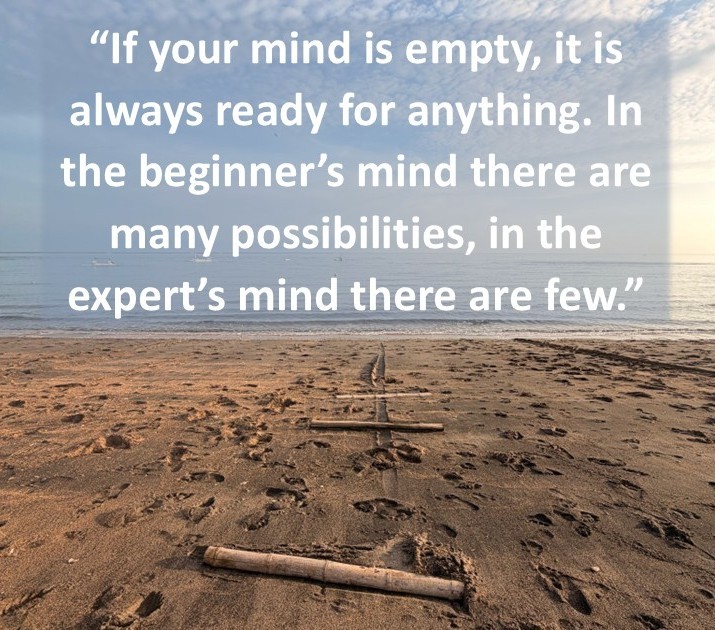
Beginners mind“If your mind is empty, it is always ready for anything. In the beginner’s mind there are many possibilities, in the expert’s mind there are few.” – Shunryu Suzuki from the book ‘Zen mind, beginner’s mind.’
 
Microcosmic orbit“When we do not know how to conserve, recycle and transform our internal force, our energy consumption becomes as inefficient as a car that only goes at 5miles per gallon…. By practicing the M-O meditation, we can get in touch with our energy-flow and locate weak spots in its path, so that we can correct them. This helps us to use our life-force more efficiently and achieve better internal ‘milage’.” – Mantak Chia, from the book ‘Awaken healing light.’
 
Basic descriptions, & guided meditations
 
With the both basic descriptions, you can see links to more detailed articles embedded. The recording links are at the end of each description.
 
Beginners mind basic ‘mindful positions:
 
Position 1: Establishing stable meditation posture & breath, sitting between the two trees, being present, not lost in thought, not falling asleep.
Position 2: Meditating on the two Soto Zen principles:

  1. Sitting meditation and awakening are not two different things
  2. One must not wait for awakening

Position 3: Recognizing each moment as a new beginning
 
Practice the 10minute beginners mind meditation with the recording
 
Microcosmic orbit basic mindful positions
 
Position 1: Connecting to our light body, or energy body,
Position 2Visualizing the microcosmic orbit within our energy body
Position 3: Practicing circulating energy within the M-O, up the back & down the front of the body. Noticing areas of the orbit that feel open and areas that feel closed
Position 4: Pausing the flow of the MO, letting the energy go to an area of our body that needs healing or energizing
 
Practice the 12miute basic microcosmic orbit meditation with the recording.
 
Initially, you can practice them individually to get a feel for the process. What I like to do, and what I teach in the Beginners mind, resilient body programs, is to then combine them together. So, you can listen to the beginner’s mind first, and then do the microcosmic orbit practice after. You’ll find that:

  • With a relaxed, open beginners mind, you can open to the energy flow in your body, when you do the microcosmic orbit practice.
  • When you do the microcosmic orbit practice, this helps to feel alert and balanced which makes your beginners mind more accessible.

You can also put them together in different ways, for example you might do the beginners mind in the morning, and the microcosmic orbit in the evening; not all at once, but doing both in the same day. It’s up to you to find a combination that works for you and your schedule.

An integration recording

Once you have some familiarity with the ten-minute guided meditations above, you can try this:

Beginners mind + Microcosmic orbit 10minute integration form
 
Enjoy!

© Toby Ouvry 2026, you are welcome to use or share this article, but please cite Toby as the source and include reference to his website www.tobyouvry.com


Upcoming classes & workshops

Ongoing on Tuesday’s & Wednesday’s (live & online), 7.30-8.30pm 
– Weekly integral meditation classes

Ongoing on Saturdays, 5.30-6.45pm SG time – Saturday Integral meditation deep-dive sessions with Toby

Tues 13th, Weds 14th January, & then weekly – Beginners mind, resilient body – a 10-week integral meditation course

Starts Saturday 17th January, 5.30-6.15pm, & then weekly – Beginners mind, resilient body deep-dive: An 11 -session practice series

Saturday 24th January, 9.00am-12.30pm – Meditation and Mindfulness for Self-Healing and Creating High Levels of Energy


Follow Toby onLinkedInYouTubeInstagram

Integral Meditation Asia

Online Courses 1:1 Coaching * Books * Live Workshops * Corporate Mindfulness Training *Life-Coaching *  Meditation Technology
Categories
Concentration Energy Meditation Enlightened Flow Inner vision Integral Meditation Life-fullness Meditation and Psychology Meditation techniques Mindful Breathing Mindful Self-Leadership Presence and being present Primal Spirituality spiritual intelligence Zen Meditation

Dancing between time & eternity

“The Eternal Present a place (or non-place) we can take a holiday, returning to time & our life refreshed,
enthused & ready to go”

Dear Integral Meditators, 

This week’s article looks at time mastery from a meditative perspective. If you enjoy it it will be a focus point of this week’s meditation classes on Tuesday & Wednesday. 
The Eternal Present will also be a point of deeper focus of the upcoming Tues & Weds Freedom & Fullness – A practical introduction to non-dual meditation practice classes, as well as the companion deep-dive non-dual meditation sessions beginning on Saturday 15th February, 5.30pm SG time.

In the spirit of Presence, 

Toby


Dancing between time & eternity
 
Looked at from a certain point of view, we are points of energy moving in time and space. That may see a little abstract, but really it is quite simple, mastery of human life involves mastery of our time, our energy and our movement, physical, mental, emotional spiritual. In this article I want to focus on time mastery, outlining four mindful positions that can be used progressively and then in a circular, mutually re-enforcing manner. Here they are.
 
Position 1 – Positivity in time. This first position entails becoming present enough to be aware of the stream of thoughts and experiences flowing through your body-mind and, even though you might still be a bit distracted, steering your attention towards the positive. For example, as I am sitting here now watching my attention, I can notice that;

  • my sore back is feeling much better today than yesterday
  • I’m looking forward to doing some gentle exercise tonight
  • I’m enjoying the process of writing
  • I’m slept well last night

So, the idea here is that, as I stay generally present and self-aware, I keep my attention primarily centred around objects that give rise to resilient, positive thoughts and feelings.
 
Position 2 – The present moment in time. In this second position I’m interested in trying to identify THIS present moment in time, as it moves through time, and staying with it. Using my breathing as an orientation point:

  • As I breathe in, I am focused and aware of this present moment in time
  • As I breathe out, I relax into the PMIT, noticing what is there

Practising in this way we build proficiency at being more present and in the now-moment in time, not lost in thought, not falling asleep. This builds temporary peace of mind, trains in undistracted concentration and builds relaxed focus that is useful both in meditation and daily life.
 
Position 3 – The eternal present. As I relax into the present moment in time, I start to notice that there is a watcher, or a witness within myself that is simply awareness, a formless consciousness. This witness-self always remains the same; an always open expanse of pure, free awareness. If I turn my attention away from the objects of consciousness, the things that come and go in time, and instead gently rest in the freedom of consciousness itself I start to drop into the Eternal Present. This is the present moment beyond time. It is not moving from moment to moment, it is the always already here and now. It is the space that contains all time(!) By practising position three, we drop out if time into the formless timeless Present. This is great for a radical deepening and expanding of our consciousness in meditation, but it is also fantastic for giving our everyday mind a complete break from all its worries and concerns in time. It’s a place we can rest and take a holiday, returning to time and our life refreshed, enthused, creative and ready to go!
 
Position 4 – Integration of the three positions. The three positions above summarized are:

  • Different degrees of distracted in time, but being present enough to keep your attention sufficiently focused on the positive to build resilience and perspective
  • Increasing proficiency at being in the present-moment-in-time, both in and out of meditation
  • Dropping into the Eternal Present to enjoy the radical freedom and bliss of it, then returning to time and life refreshed and enthused

Position 4 then is practising them together, in meditation and informally in daily life, so that most of our time we are in one or other of these conditions, dancing in and out of time lightly, creatively and playfully.
 
Related readingEternal life (& where to find it)
The Eternal Present and the Four Types of Time
 

© Toby Ouvry 2025, you are welcome to use or share this article, but please cite Toby as the source and include reference to his website www.tobyouvry.co


All upcoming classes & workshops
 

Ongoing on Tuesday’s & Wednesday’s (live & online), 7.30-8.30pm – Weekly integral meditation classes

Final session this week! 7.30-8.30pm – The Wisdom of Awakening Series – Meditation for leaping into reality

Saturday February 8th, 15th, 22nd, 10-11.40am – Mindful Life-skills for Teenagers – a three module course

Starts Tues 11th, Weds 12th February, 7.30-8.30 pm – Freedom & Fullness – A practical introduction to non-dual meditation practice

Begins Saturday 15th February – Freedom & Fullness deep-dive non-dual meditation sessions

Tues 18th, Weds 19th March, 7.30-8.30pm – Spring Equinox balancing and renewing meditation


Follow Toby onLinkedInYouTubeInstagram

Integral Meditation Asia

Online Courses 1:1 Coaching * Books * Live Workshops * Corporate Mindfulness Training *Life-Coaching *  Meditation Technology

Categories
A Mind of Ease Inner vision Integral Meditation Integrating Ego, Soul and Spirit Life-fullness Meditation and Psychology Meditation techniques mind body connection Mindful Breathing Mindfulness Presence and being present Zen Meditation

Making your physical awareness balanced & whole

“When our physical awareness is balanced and whole, intuitively our sense of who we are starts to take on a more complete feeling”

Dear Integral Meditators,

In the article below I look at the link between physical, sensory awareness and our sense of overall wholeness in life. If you enjoy the article, we will be exploring it in the Tuesday & Wednesday meditation session, so do feel free to join us!

In the spirit of wholeness & balance, 

Toby


Sessions this week:

Ongoing, Tuesday/Wednesday evening’s, 7.30-8.30pm – Meditating with the power of intention – An eleven module course

Saturday 26th October, 9.30am-12.30pm – Meditation & Mindfulness for Creating a Mind of Ease, Relaxed Concentration and Positive Intention

Saturday October 26th, 5-6pm Singapore time – Engaged mindfulness & meditation online class : What is self-awareness?


Making your physical awareness balanced & whole
 
This article explores mindfulness for creating a more well-rounded and balanced physical awareness. On of the side effects of this is a more balanced overall awareness, including psychological and spiritual.
 
The present imbalance
For most people, their awareness and sense of space focuses on what is in front of them. This is natural because your eyes are in the front of your head and look forward. When you focus on something you turn forwards it and then look at what is in front of you. So, most of the time our attention extends like a narrow cone out in front, excluding the our potential range of awareness to this narrow zone.
 
The full range
Our full range of physical awareness of course extends 360° around us:

  • To our left and right
  • In front and behind
  • Above and below

In terms of balancing our awareness, a very simple mindful ‘form’ consists of sensing into our full range of directional awareness, and experiencing ourself in the centre of that. Sitting standing or walking you can:

  • Sense to your left and right, extending your awareness each way. Initially you can do it one after the other, then put them together, sensing left and right simultaneously. You can look left and right at first if you like, but then practice using your body itself; sense left with the left side of your body, the skin of your arms, legs and sides. Then to the right with the right side of the body
  • Similarly, do this with the front and back. With the front of your body, practice sensing into what lies in front of you not just using your eyes, but with your chest, belly, and hips. Feel into what is in front of you. Then working with your back, and the back of your head, neck and legs, sensing into what is behind you
  • You can do the same thing with your Above and below; sensing into what is beneath you with the soles of your feet, and the crown of your head

 
Breathing in and out of centre
 
Once you get used to sensing the directions individually and in pairs, you can put them together, sensing the totality of your field of physical awareness. If you then imagine a point of energy in the centre of your chest that is your bodies inner centre, you can practice breathing into your centre and as you inhale, and breathing awareness out into the six directions as you exhale. If I am doing it outside I like to breathe out to the horizon as I exhale, gathering it in again as I inhale.
 
 
Non-conceptiality, peace and psychological wholeness
 
One of the side effects of practicing this directional, physical awareness is that we become a lot more sensory, physical and non-conceptual. We stop excessive thinking and arrive naturally wherever we happen to be, landing stably in a balanced manner in the place we are in.
Another benefit is, because our physical awareness is balanced and whole, our overall sense of our self starts to feel more rounded and whole. Intuitively our sense of who we are starts to take on a more complete feeling. When we start to think from this feeling of wholeness and balance, we start to notice our thinking changes for the better, mimicking its structure from the feeling of wholeness in our habitual physical awareness.
 
You can use directional awareness as a way of moving into deeper meditation in formal practice. Or we can simply drop into it regularly in daily life to ground, centre and connect to wholeness. Our sense of how we operate in space is fundamental, so affecting it for the better in this way can have a profound effect upon us if we do it regularly!
 
Related articles:
Finding your spiritual, physical home
Aspects of environmental meditation


© Toby Ouvry 2024, you are welcome to use or share this article, but please cite Toby as the source and include reference to his website www.tobyouvry.com


Follow Toby onLinkedInYouTubeInstagram

Integral Meditation Asia

Online Courses 1:1 Coaching * Books * Live Workshops * Corporate Mindfulness Training *Life-Coaching *  Meditation Technology

Categories
Awareness and insight Energy Meditation Enlightened Flow Inner vision Life-fullness Meditation techniques mind body connection Mindful Breathing Mindful Resilience Presence and being present Tree of Life

Anchoring & moving from center

“Breathe into the fullness of your attention and intention. Breathe out relax into the freedom of awareness. At the bottom of the breath rest in stillness”

Dear Toby, 

This week’s article focuses on centering as a theme, & outlines a practice that you can do to help you center effectively in a number of key ways…
If you enjoy the article, you can explore aspects of it at this weeks Tuesday or Wednesday class, live or online.
And heads up for anyone who may be interested in the Developing Your Self-Confidence Through Mindfulness Workshop on the 28th September.

In the spirit of centered-ness, 

Toby


Anchoring & moving from center
 
In this article I want to bring together a few techniques into a ‘Form’. A form basically means a practice that is quite simple, and can be done at the level of the person doing it, beginner or more advanced. The characteristic of a form is that it grows with the abilty of the practitioner, thus remaining relevant to us as we grow. The three domains we bring together in this form are:

  • Physical and energetic centering
  • The ‘holy trinity’ of integral mindfulness; intention, attention and awareness
  • Our foundational freedom, fullness, and stillness

 
Centering

Imagine a line of light coming down from the sky. Imagine it descending through the crown of your head, and down through the dead-center of your body, brain, neck, chest, abdomen hips. It then leaves through your perineum and descends into the earth moving through the center of the Earth’s core. Feel this line of light to be in the middle of the front and back, left and right halves of your body. As you breathe in, breathe your energy into this ‘vertical core’ of your body, as you breathe out, feel yourself relaxing from center, from the core to the periphery of your body.**
After few breaths, locate the mid-point of your vertical core between your crown and your perineum. This is the mid-point of your torso, the absolute physical centre. Imagine this as a point of light, somewhere between your heart-centre and solar-plexus. Breathe into this mid-point, gathering your energy & power there. Breathe out, relax from your mid-point. Feel the inner balance that this practice starts to give rise to.
 
Aligning your mindfulness with your center

Now imagine that the three foundations of mindfulness, your intention, attention and awareness (IAA) are all focused within your vertical core, and particularly your mid-point/center. If you like, imagine your mid-point becomes like a little sun, shining your intention, attention and awareness out from your centre in a balanced, powerful and harmonious manner. Initially you can keep this a general feeling around your IAA, but then if you like you can make it into a practice around a specific domain of your life, reflecting upon particular intentions, and ways of directing your attention and awareness in this situation. Just centring your IAA and then holding a situation in mind, seeing if from this balanced point of center can be a surprisingly powerful and useful practice.
 
Relaxing into freedom, fullness and stillness

As you breathe in, imagine the sun-like fullness of your balanced intention glowing brightly. As you breathe out, imagine it shining out into the freedom of your sky-like awareness. Enjoy this feeling of freedom and fullness. If you like. As you reach the end of your exhalation, pause briefly, and relax into the physical and mental stillness in that pause. So, then we have:

  • Breathing into the fullness of attention and intention
  • Breathing out relaxing into the freedom of awareness
  • At the bottom of the breath resting in stillness

There is a lot in this form, but I hope you can see that the basic elements are really quite simple. The felt benefits are fairly immediate, and as your practice deepens, so will your experience of the form!
 
**When people start to meditate, quite often they notice that they feel ‘lop-sided’ with one side of the body feeling full of energy and the opposite side feeling empty or without feeling. Centering practice can really help with the re-balancing of this.
 
Related readingLocating your deep centre
The holy trinity of mindfulness
Sky & sun, freedom & fullness

Article & content © Toby Ouvry 2024, you are welcome to use or share this article, but please cite Toby as the source and include reference to his website www.tobyouvry.com


Follow Toby onLinkedInYouTubeInstagram

Integral Meditation Asia

Online Courses 1:1 Coaching * Books * Live Workshops * Corporate Mindfulness Training *Life-Coaching *  Meditation Technology

Categories
Books on mindfulness & meditation Concentration Integral Awareness Integral Meditation Life-fullness Meditation and Psychology Meditation techniques Mindful Breathing Mindful Self-Leadership Mindfulness Presence and being present

The mindfulness holy trinity, & the engaged mindfulness book & training

“The skill of mindful awareness is actually a pre-skill, meaning that if you are good at it, you can use it to develop any other skill or capacity relatively easily.”

Dear Integral Meditators, 

This week’s article is on the foundational components of effective mindfulness. If you enjoy it, feel free to join us for the Tuesday or Wednesday meditation class, where it will be a focus point. 

It will also be a focus point of the Engaged mindfulness online class this Saturday 13th July @ 5pm Singapore time. 

I have now expanded my first book Engaged Mindfulness to an ‘Engaged Mindfulness Project’. On this page, you can:

  • Download the PDF copy
  • Buy a hard copy of Engaged Mindfulness
  • Follow the links to the training pages with guided meditations based upon the book, & the online live meditation classes.

Do visit the page, & stay tuned for more details!

In the spirit of engaged mindfulness,

Toby


Awareness, attention, intention – The holy trinity of integral mindfulness
 
This article is designed to encourage people to understand some primary elements of integral mindfulness practice, and to get practicing!
 
Component one – Awareness
Mindfulness is essentially awareness training. Awareness is what is called in objectivist philosophy is called an ‘irreducible primary’. “An irreducible primary is a fact which cannot be analysed (i.e., broken into components) or derived from antecedent facts”. The quality of awareness or consciousness is something that we experience directly, and that cannot be broken down into smaller parts, hence primary. To be alive is to be aware, our only choice is whether we are consciously aware, or unconsciously aware. Thus the first task of mindfulness is to make the choice to be consciously aware, and to sustain that conscious awareness. Put another way:
“Mindfulness is the choice to be consciously aware as we go through life, rather than unconscious, and to direct our awareness consciously and skilfully.”
The skill of mindful awareness is actually a pre-skill, meaning that if you are good at mindful awareness, then you can use that awareness to develop any other skill or capacity relatively easily. Lacking the skill of awareness impairs the development of all other capabilities and skills in life. The capacity for mindful awareness sets you up for success in any given area of life. Lack of awareness impairs that potential.
 
Component two – Attention
The second foundation is conscious attention. The aim with mindfulness practice is to develop the capacity to direct your awareness where you want it to go, using your attention. “What am I trying to focus upon? And where do I need to focus my attention?” Are two fundamental mindfulness questions. Exactly where you need to focus your attention optimally is going to vary from task to task, but good quality mindful attention generally consists of a balanced combination of focus and relaxation. This combination is what I call the mindful-flow state, where we practice the skill of holding our attention on our chosen objects/activities with high quality, relaxed, focused attention.
 
Component three – Intention
Component three is intention. Like awareness and attention, we have an intention present within our mind almost all the time. This intention can be conscious or unconscious. The idea with integral mindfulness is that we become as mindful of our intentions as possible, and are generating them purposefully. ‘Why am I doing this?’ is a fundamental question, mindfully speaking!!
There are an infinite number of specific intentions, but a good place to start is cultivating three general levels of conscious intention with regard to self, other and the world. Underlying all of our other intentions, we hold the intention to:

  • Be of benefit to ourself
  • Be of benefit to our community
  • Be of benefit to the world

These three benevolent intentions can be the guiding light for most of our actions during the day.
 
So, putting these three together then gives us a kind of ‘holy trinity’ of integral mindfulness. All integral mindfulness trainings are designed to improve your awareness, attention and intention. These in turn are fundamental pre-skills that enable you to develop any other skills, and meet your life challenges more effectively.
 
As a practice to get started, simply take as your object of conscious awareness your breathing as you find it. Focus upon it with focused relaxed-attention (mindful flow), with the intention to:

  • Benefit yourself by calming and centering
  • By calming and centering, be of more positive influence to your community
  • By influencing your community in this way, being of benefit to the world

And there you go; you are practicing the holy trinity of integral mindfulness.
 
Related reading: Page 4 of Engaged Mindfulness that you can download as a free PDF of purchase as a hard copy

© Toby Ouvry 2024, you are welcome to use or share this article, but please cite Toby as the source and include reference to his website www.tobyouvry.com


Upcoming meditation sessions & workshops with Toby 


Ongoing – Weekly Tuesday, Wednesday Online class schedule

Starts Tues /Weds 25th & 26th June, 7.30-8.30pm – The Wisdom of Awakening Series:  Meditations for cultivating your inner guidance & guru

Saturday 13th July 5-6pm Singapore time – Engaged mindfulness & meditation online class : An introduction to the art of engaged mindfulness

Saturday 27th July, 5-6pm – Mantra yoga meditation classThis month – Healing meditation with the Medicine Buddha


Follow Toby onLinkedInYouTubeInstagram

Integral Meditation Asia

Online Courses 1:1 Coaching * Books * Live Workshops * Corporate Mindfulness Training *Life-Coaching *  Meditation Technology

Categories
A Mind of Ease Inner vision Integral Meditation Meditation techniques mind body connection Mindful Breathing Mindfulness Presence and being present

Using mindful flow to train in strengths-building

“Using mindful-flow to develop particular inner-strengths can rapidly accelerate the pace at which we can grow them. What would normally take much longer, mindful-flow enables us to assimilate with confidence in a much shorter period”

Dear Integral Meditators, 

This week’s article looks at a major foundation of integral meditation practice, mindful-flow, what it is and how to go about starting to use it in your life.


In the spirit of flow,
 
Toby


Using mindful flow to train in strengths-building
 
What is mindful flow?

Mindful flow is a method of concentration that meditators use to remain present in their practice, and stay present for extended periods. It consists of two complementary qualities:

  • The quality of focus
  • The quality of relaxation

Often when people begin meditation, they try a bit too hard to focus, which means they then have difficulty relaxing, which then means their mind has difficulty settling into meditative presence. Other people relax a bit too much and find themselves falling asleep, which is the other end of the spectrum. So good quality mindful concentration contains the alertness of focus, in combination with the ‘flow’ of relaxation, hence mindful-flow. If complete relaxation to the point of sleep is a 0, and absolute effortful focus is a 10, in meditation we are generally trying to stay somewhere within the 4-6 range.
 
Building the technique of mindful flow

Generally, I recommend specifically developing your practice of mindful flow as an exercise, which can be done using a simple breathing technique:

  • Breathing naturally, as you breathe in, emphasize focusing your attention on your in-breath. You can focus on a particular area of the breathing (like the movement of the belly for example), or the overall sensation of it.
  • As you breathe out, emphasize relaxing your body and mind. If you are aware of particular areas of tension in the body, you can be specific in relaxing those body parts.

You can practice mindful flow continuously for 5-10minutes, or if you like you can do it in sets, for example:

  • 3-5 breaths of mindful flow, followed by a short pause, and when you are ready repeat.

I find that this second technique is quite useful, because it encourages you to really focus well for those 3-5 breaths! 

Using mindful flow to bring strengths & strength-combinations

Once you have practiced mindful flow, and got a sense of that balance of focus and relaxation, you can then use it to build strengths, qualities and capacities within you. Here I am going to use gentle-determination as an example. Once you understand how to do it with one quality, you know how to do it with others. So then with gentle-determination:

  1. For the first part, as you breathe in, connect of a sense of gentleness, as you breathe out, relax into that feeling of gentleness.
  2. In the second part, connect to a sense of determination, perhaps about something specific in your life right now. As you breathe out, feel that sense of determination as an attitude in the mind and as an energy in the body.
  • In the third section, bring the qualities of gentle-determination together; as you breathe in connecting to determination, as you breathe out soften that determination with an appropriate degree of gentleness.

You can spend as much time as you like on each section, but ideally the most time would be spent with stage three, bringing the gentleness and determination together into a flow.
Dropping into a mindful-flow state and using it to develop particular strengths and qualities can rapidly accelerate the pace and depth at which we can grow them within us. What would normally take much longer to develop competency around, mindful-flow enables us to assimilate with confidence in a much shorter period of time!


Article & content © Toby Ouvry 2024, you are welcome to use or share this article, but please cite Toby as the source and include reference to his website www.tobyouvry.com


Follow Toby onLinkedInYouTubeInstagram

Integral Meditation Asia

Online Courses 1:1 Coaching * Books * Live Workshops * Corporate Mindfulness Training *Life-Coaching *  Meditation Technology

Categories
A Mind of Ease Concentration Integral Meditation Life-fullness meditation and creativity Meditation techniques Mindful Breathing Presence and being present

The foundational pillars or ‘goal-posts’ of meditative presence

Dear Integral Meditators, 

It can be good to really get clear about the basics of what you are trying to do in meditation, in a way that invites many deeper levels of understanding of those basics. The article below aims to offer some pointers for this….
In the spirit of presence, 

Toby

The foundational pillars or ‘goal-posts’ of meditative presence


In my previous article on basic mediative presence, I defined meditation as:
 “Meditation is the state of being awake, not lost in thought and not falling asleep. It is a state of being present in the moment, and aware of the present

This gives us a nice broad, ballpark within which we can start to practice. Here are two images to work with in meditation to help get comfortable in this space.

Sitting between the goal posts
In this first image, imagine yourself sitting in the middle of a football goal mouth. Either side of you are the goal posts.

  • Going to the far side of the left goal posts means getting completely lost in thought
  • Going to the far side of the right goal post means falling asleep

All you are trying to do is keep your attention oriented around the body and breathing, stay in the centre of the goal mouth, and avoid ‘traveling’ to the far side of either post.

  • Notice that you can have thoughts arising, but not be lost in those thoughts. Just because there are thoughts does not mean that you have lost your meditative presence
  • Notice also that you can feel a bit sleepy, without falling asleep. You just need to notice the sleepiness and avoid totally dropping off!

It should feel like you are sitting in quite a forgiving, comfortable space that you can relax in. Even if you do get lost in thought, or fall asleep a little, is not a problem. As soon as you become aware of it, bring your attention back between the goal-posts, and re-establish your basic meditative presence.

Two trees or pillars
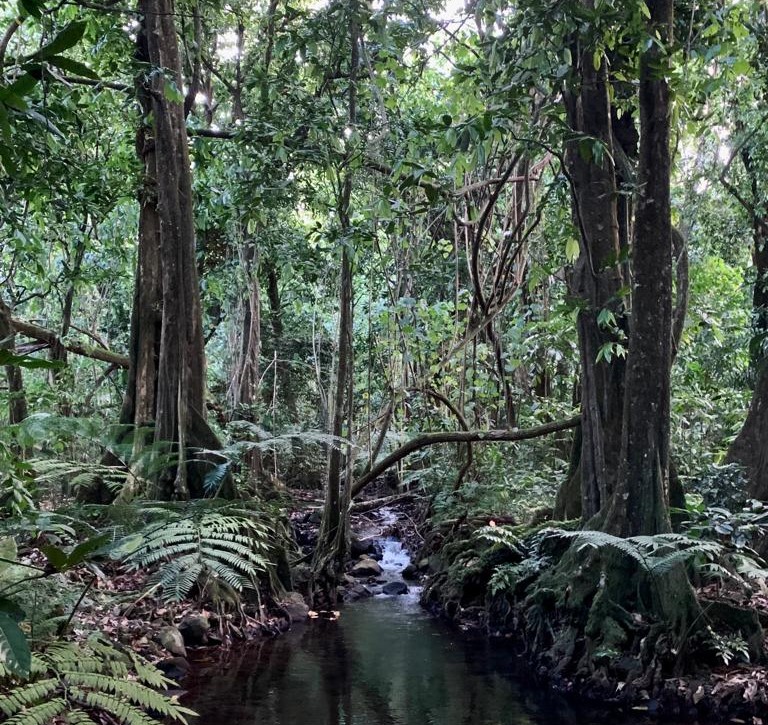
An alternative to the goal-posts image is to imagine yourself between two pillars or trees. If you imagine yourself between two pillars, you could imagine yourself in your own ‘meditation temple’. Perhaps you are looking out into a beautiful landscape from the steps of the temple, between the two pillars.
Or you can see and feel yourself between two trees, sitting in a harmonious landscape within nature.
Both the pillar and tree option are equally good, you just choose the one that appeals the most to you, and that you feel most comfortable with. Like the goal posts image:

  • Going beyond the tree/pillar on the left represents getting lost in thought
  • Going beyond the tree/pillar on the right represents falling asleep

Your goal is simply to remain in the middle, avoiding either extreme, and cultivate your basic meditation state.
If you are a visual person, you can build the image of the goalposts, pillars, or trees quite strongly, and use the image as an orientation point in addition to your body and breathing. Imagining yourself in a place that is beautiful or harmonious can really help to access a state of meditation more quickly for some people.
If you are not a visual person, then you are mainly using the image as a metaphor or set of practice principles to guide you as you meditate. You would mainly simply stay with the body and breath, not worrying about building a picture so strongly.
Try sitting between the goalposts or pillars for 5-10minutes initially, and then for 15-20minutes using it to help you build your basic meditation state more tangibly and stably.

Related articleWhat is the point of being more present?
Meditation, not missing your life

Article & content 
© Toby Ouvry 2024, you are welcome to use or share this article, but please cite Toby as the source and include reference to his website www.tobyouvry.com


In case you missed it: The simple, positive, creative & aware training page

I’ve posted an integral meditation training page for my Simple, positive, creative & aware practice. Click on the link or scroll down below to

  • Watch the video
  • Listen to the studio quality guided meditations. There is a 20minute & an 8 minute version
  • Read the related article

Listen to the meditations & access the related article 


Follow Toby on
LinkedInYouTubeInstagram

Integral Meditation Asia

Online Courses 1:1 Coaching * Books * Live Workshops * Corporate Mindfulness Training *Life-Coaching *  Meditation Technology
Categories
Awareness and insight Integral Awareness Integral Meditation Life-fullness Meditation techniques mind body connection Mindful Breathing Mindful Resilience Presence and being present

Meditation – Not missing your life

Ordinarily we are often primarily lost in thought, secondarily conscious of the present moment. A meditator aims to become primarily present in life, and secondarily thinking’

Dear Integral Meditators, 

This week’s article explores a foundational definition of meditation & how to start working with it on a practical level. Experience of it gives you a solid base for your practice that you can easily create enjoyable variations around.
 
In the spirit of presence,
 
Toby


Meditation – Not missing your life (Your basic meditation state or space)
 
Awakening in meditation

In some ways awakening to the state of meditation could not be simpler. Here is a working definition:
Meditation is the state of being awake, not lost in thought and not falling asleep. It is a state of being present in the moment, and aware of the present
If you bring your attention to your breath for the next three breaths, avoiding distraction, or falling asleep, and holding the recognition of the breathing in the present, then you are in meditation.
 
We are often close to being in meditation already

Through-out the day we spend periods of time when we are focused in the present moment, on a particular task, not lost in thought, and not asleep. Particularly when we are enjoying something or feeling relaxed, we can do it without too much trouble. Think of an activity you take pleasure in, and recall how it helps you land in the present more, temporarily liberating you from being ‘somewhere else’ in your head.  Children spend long periods of time completely absorbed in and present to activities they enjoy.
The difference between these times that we all experience and a state of meditation becomes clear in the second part of the above definition: “A state of being in the present in the moment, and aware of the present moment.” Most non-meditators, when they arrive in the present moment do so by accident, as a side effect of an activity. They are present, but they are unconsciously present, rather than consciously present. To be in meditation we need:

  • To be aware that we are in the present, and
  • Conscious of what we are trying to focus on in the present

The state of meditation is therefore very similar to a state that you are already quite familiar with. It is just a matter of making it conscious, and then it becomes basic meditative presence
 
Your basic meditation state as your ‘inner studio space’
Your basic meditation state, once you can identify it and hold it consistently, then becomes like an ‘inner studio space’ where you can place and cultivate a range of different states of body, mind, and heart. For example, you can use it to:

  • Build focus and relaxation
  • Cultivate stillness
  • Build greater love and compassion for yourself and others
  • Work on healing inner wounds
  • Develop your self-knowledge

There is a whole range of creative things you can cultivate within your meditation space, but there is one over-riding reason for meditating, and that is so that you don’t miss your life!
 
Meditation – Not missing your life

For many of us, much of the day is spent in a state of non-presence, or the opposite of meditation.

  • We are often lost in thought and distraction
  • When we are not lost in distraction, it is often due to mental fatigue or exhaustion so we find ourselves sleepy, unconscious and in a state of dullness

The result of this is that we miss our life. Our life itself is always happening now, in the present moment, but we forget to turn up, we are somewhere else. To put it simply:
 
Ordinarily we are often primarily lost in thought, secondarily conscious of the present moment. A meditator aims to become primarily present in life, and secondarily thinking’
 
As a meditator, thinking and reflecting consciously becomes a complementary activity to our primary activity of being aware and anchored in the present, thus turning up to our life rather than missing it.
 
The breath of life
As a practical way of exploring your basic meditation state, here are some simple pointers. Breathing comfortably and naturally:

  • Notice how awareness of the breathing brings you naturally into your basic meditation state
  • Notice what it feels like to be primarily present to your life, not lost in thought or on auto-pilot
  • Notice what it is like to be ‘awake’ to your life, here and now
  • See how deeply you can drop into your basic meditation state, and notice what happens when you do
  • Practice taking the basic meditation state into your everyday activities as the orientation point in the moment. Notice how it changes your experience.

Article content © Toby Ouvry & Integral Meditation Asia 2024. you are welcome to share, but please cite the source, thanks! Contact info@tobyouvry.com 


Follow Toby onLinkedInYouTubeInstagram

Integral Meditation Asia

Online Courses 1:1 Coaching * Books * Live Workshops * Corporate Mindfulness Training *Life-Coaching *  Meditation Technology