Categories
A Mind of Ease creative imagery Inner vision Life-fullness meditation and creativity Meditation techniques Mindful Resilience

From ‘life is a problem and…’ to ‘life is good and…’

“Meditation is developing our capacity to generate happiness within & project it outward, rather than needing outer circumstances to align before we can be happy”

Dear Integral Meditators, 

This week’s article explains a fundamental paradigm for how meditation works that I use often in my workshops and sessions. Once you ‘get it’ its easy to stay motivated in your meditation practice!

Heads up for this Saturday’s Saturday 13th December, 9am-12.30pm – Psychic & Psychological Self-defence half day workshop, & also I have just posted the new class series’ for January: 
Tues 13th, Weds 14th January, & then weekly – Beginners mind, resilient body – a 10-week integral meditation course
Starts Saturday 17th January, 5.30-6.15pm, & then weekly – 
Beginners mind, resilient body deep-dive: An 11 -session practice series

 
In the spirit of ‘life is good and…’,

Toby


Article: From ‘life is a problem and…’ to ‘life is good and…’
 
One definition of meditation that I learned from my Tibetan Buddhist days is this one:
 
“Meditation means to focus our attention on an object (or in a state) that, when we dwell on it, causes our mind to become positive, calm and/or happy.”
 
The task of a meditator from this point of view is to discover as many ‘positive’ states, ways of thinking, ways of non-thinking, emotions, temperaments, dispositions and so on as they can. A meditator then tries to keep her attention oriented around one or other of these positive objects or states during the day. The net effect of this is that they spend most of their life in a condition of happiness, even in the face of substantial obstacles. To be a meditator is empowering in this sense, because we are developing our capacity to generate happiness within ourselves and project it outward, rather than needing outer circumstances to align before we can be happy.
 
From life is a problem to life is good
 
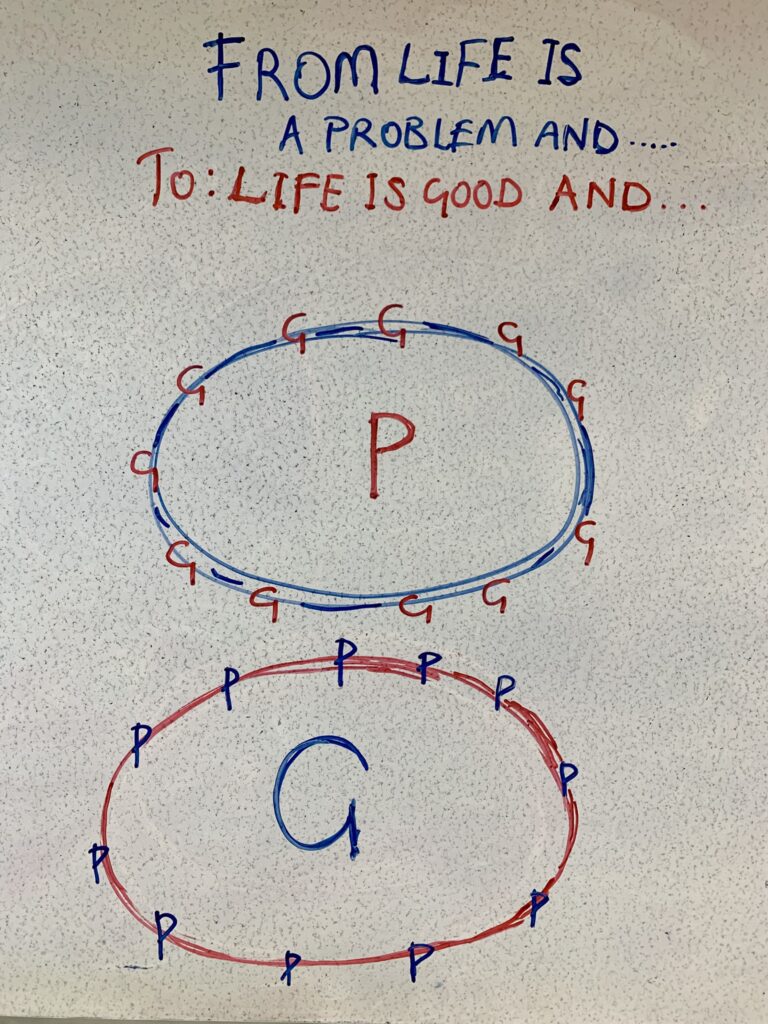
One simple paradigm I often use to illustrate the basic task and practice of a meditator is the one that you can see in the picture. Both oval shapes represent a person’s field of awareness.
 
Life is a problem and… The upper circle represents the everyday persons awareness field. In it you can see in the center there is a ‘P’ which stands for problem. On the edge of the circle, you can see several small ‘g’s, which represent the good things in our life. Unless we are careful, this is a place where we can spend a lot of our day and life; with our problems front and center of our awareness, and the good things in our life a secondary, background element of experience. With this perceptual dynamic or habit in place we literally experience our life as mostly a problem, as it is our problems that appear front and center of our awareness. This position can feel very defensive; our problems dominate, and the good things lack power due to their peripheral position.
 
What we are trying to do as meditators is ‘flip’ this so that our perceptual state goes from ‘life is a problem and…’ to:
 
Life is good and… the lower circle you can see has a ‘G’ for good things in the center, with the ‘p’ for problems pushed out to the periphery. Here you are simply keeping the good things in your life front and center of your awareness as you go through the day. You can understand ‘good things’ to represent a broad category here, that you are then making specific to your particular life experience. Because we keep the good things front and center, the power of our problems to dominate our awareness reduces as they are pushed out to the periphery.
An important thing to note here is that the change is perceptual, nothing external needs to change for us to do this. The difference between someone with the ‘P’ mostly front and center of awareness, and someone with a ‘G’ is the habit and discipline of focusing awareness in a particular way. You could have two people with almost identical life-circumstances, but a completely different experience simply due to their habit of focus. When we push the ‘p’s out to the periphery, we are not denying our problems, or the need to deal with them effectively. We are just placing them in a particular context, the ‘G’s, in a way that puts them in perspective and makes them feel much more manageable
 
A simple practicum: Set aside a fixed amount of time, say 5-10mins. Watch your awareness. Notice the ‘P’s often taking center-stage. Practice placing your ‘G’s front and center instead, pushing the ‘p’s benevolently to the periphery. Notice how your experience changes, and enjoy.
 
Related articleMeditation – Life as a positive mindfulness game 
© Toby Ouvry 2025, you are welcome to use or share this article, but please cite Toby as the source and include reference to his website www.tobyouvry.com


Upcoming classes & workshops

Ongoing on Tuesday’s & Wednesday’s (live & online), 7.30-8.30pm 
– Weekly integral meditation classes

Starts Tuesday 11th & 12th November, 7.30-8.30pm – Going beyond your limitations, tapping into your hidden strengths – Meditating with your bright shadow, a 6-week course

Starts Saturday 15th November, 5.30-6.15pm SG time – Bright shadow meditation Deep-dive – A 5 session practice series

Saturday 13th December, 9am-12.30pm – Psychic & Psychological Self-defence half day workshop

Tues 13th, Weds 14th January, & then weekly – Beginners mind, resilient body – a 10-week integral meditation course

Starts Saturday 17th January, 5.30-6.15pm, & then weekly – Beginners mind, resilient body deep-dive: An 11 -session practice series


Follow Toby onLinkedInYouTubeInstagram

Integral Meditation Asia

Online Courses 1:1 Coaching * Books * Live Workshops * Corporate Mindfulness Training *Life-Coaching *  Meditation Technology

Categories
A Mind of Ease Concentration creative imagery Energy Meditation meditation and creativity Meditation and Psychology Meditation techniques Mindful Self-Leadership Mindfulness Presence and being present

Squares & triangles – Mindful strengths building

“Once you know how to breathe in squares and triangles, you can create your own mindful flow practices to build the qualities & capacities that you wish”

Dear Toby, 

This week’s article looks at a practice I have evolved over the years, designed to enable creativity within a basic, consistent structure. Enjoy!

Last call for this Saturday 22nd Nov, 9am-12.30pm – Meditations for Developing the Language of Your Shadow Self Workshop
 
In the spirit of building strength,

Toby


Squares and triangles – Mindful strengths building
 
Square and triangular breathing, the basic concepts
 
Square and triangular breathing are methods where you combine your inhalation and exhalation with short pauses. The practice of pausing your breath in itself offers benefits such as: 

  • calming the nervous system, improving focus, and enhancing emotional regulation
  • increasing the amount of carbon dioxide in the blood, which reduces the excitability of the amygdala (the brain’s fear center) and promotes a sense of calm
  • greater control over the breathing process, which can lead to increased mental clarity, resilience, and better decision-making

 
Square breathing is where we place a short pause both at the top and the bottom of the breath. A well-known form of this is called box-breathing where you breathe in, pause, breathe out and pause at the bottom of the exhalation, each for a count of four, hence ‘breathing in a box’, or square.
 
With triangular breathing there is just one pause, at the bottom of the breath, hence three stages or ‘sides’ like a triangle.
 
To use these breathing forms for strengths building, we simply combine the breathing with qualities, or states of mind to build them as we breathe. For example in my Wednesday class last week we began by practising breathing in a square in the following manner to cultivate mindful flow and presence:

  • Breathing in, gathering and focusing our energy in our body
  • Pause, being focused and present
  • Breathing out, relaxing our body, relaxing into the present moment
  • Pause, holding a state of relaxed presence

We practiced with sets of three square breaths like this, with pauses in between just to enjoy the sense of being in state of focused, relaxed presence. Focused, relaxed presence are foundational strengths for building competence in meditation and mindfulness. In this practice we used square breathing to build these strengths systematically.
 
In the Saturday class last week, we opened with a triangular breathing form, where:

  • As we breathed in, we opened to a state of adventurousness
  • Breathing out, dropping into a state of calm
  • Pausing at the bottom of the breath, relaxing in a state of calm adventurousness

 
Adventurousness and calm are qualities we can use to meet our challenges and opportunities in such a way that we enjoy them where possible, and also navigate them with calm strength. The triangular breathing provides a structure to cultivate these qualities deliberately in a structured way.
 
Once you know how to breathe in squares and triangles, you can create your own mindful flow practices to build the qualities and capacities that you wish to develop in our life and work. I like to combine qualities together into polarities that balance and complement each other. From the above examples you can see:

  • Relaxed and focused
  • Adventurous calm

 
There are many, many variations that I have used over the years:

  • Engaged detachment
  • Humble self-assertion
  • Gentle courage
  • Serious lightness

And so on…
 
The great thing about meditating with squares and triangles is that you have one technique, with many variations. So, you can create variety and stimulation in your practice, whilst at the same time keeping it basically consistent and ‘the same’.
 
Related reading:
Using mindful flow to train in strengths-building
Adventuring with attention (What is a Meditator?)
Meditation wings – Five foundational meditation polarities

 
© Toby Ouvry 2025, you are welcome to use or share this article, but please cite Toby as the source and include reference to his website www.tobyouvry.com


Upcoming classes & workshops

Ongoing on Tuesday’s & Wednesday’s (live & online), 7.30-8.30pm 
– Weekly integral meditation classes

Starts Tuesday 11th & 12th November, 7.30-8.30pm – Going beyond your limitations, tapping into your hidden strengths – Meditating with your bright shadow, a 6-week course

Starts Saturday 15th November, 5.30-6.15pm SG time – Bright shadow meditation Deep-dive – A 5 session practice series
 

21 Nov & 28th Nov, 8am-12pm – The wisdom of Zen meditation practice retreat & course, levels 1&2

Saturday 22nd November, 9am-12.30pm – Meditations for Developing the Language of Your Shadow Self Workshop

Saturday 29th November, 7-9pm – Living Life From Your Inner Center – Meditations for Going With the Flow of the Present Moment

Saturday 13th December, 9am-12.30pm – Psychic & Psychological Self-defence half day workshop


Follow Toby onLinkedInYouTubeInstagram

Integral Meditation Asia

Online Courses 1:1 Coaching * Books * Live Workshops * Corporate Mindfulness Training *Life-Coaching *  Meditation Technology
Categories
A Mind of Ease Insight Meditation Integrating Ego, Soul and Spirit Meditating on the Self Meditation and Psychology Meditation Recordings Meditation techniques Mindful Resilience Shadow meditation Stress Transformation Videos

Journeying with your shadow self – Free recording, video & upcoming courses

As we  gather our shadow back into our I, our I starts to feel strong, resilient and whole in ways that we had forgotten was possible

Dear Integral Meditators, 

This week’s newsletter has the links to:

After beneath these are the details of four upcoming shadow workshops & meditation session series’ that I will be doing, starting with my ‘finding freedom from what holds you back‘ shadow workshop this Saturday 25th October.

There are also details of a special offer on my shadow coaching services. 

This week’s Tues/Weds or Saturday Zen meditations are on Signless-ness for anyone that would like to join.
 
In the spirit of shadow play,

Toby


ArticleId to ego, It to I; The essence of shadow integration

As you may be aware, it was Sigmund Freud and Carl Jung who first coined the term ‘shadow’ as an aspect of their theories of the conscious and unconscious minds. They indicated the split that can occur between the two when parts of our personality/psychological self are repressed and banished to the unconscious mind, with the resulting phenomenon of the shadow self being a part of the result…read full article

Listen to Toby’s ‘Meditating with your shadow self introductory talk & meditation


Watch Toby’s video on ‘Meditating with the bright shadow‘: 

Upcoming workshops & series’  on the shadow & the golden shadow

Saturday 25th October, 9am-12.30pm – Finding Freedom From What Holds You Back in Life: Practical meditations & techniques for working with your shadow-self
Starts Tuesday 11th & 12th November, 7.30-8.30pm – Going beyond your limitations, tapping into your hidden strengths – Meditating with your bright shadow, a 6-week course

Starts Saturday 5.30-6.15pm SG time – Bright shadow meditation Deep-dive – A 5 session practice series

Saturday 22nd November, 9am-12.30pm – Meditations for Developing the Language of Your Shadow Self Workshop


Special coaching offer: 15% off of all 1:1 shadow coaching sessions with Toby up until End November 2025

In a sentence: Shadow coaching shows you how to spot your shadow self. It offers practical and accessible methods for helping to release the energy within you that has been trapped in your shadow self, so that you can live your life at its fullest, deepest potential.


Follow Toby onLinkedInYouTubeInstagram

Integral Meditation Asia

Online Courses 1:1 Coaching * Books * Live Workshops * Corporate Mindfulness Training *Life-Coaching *  Meditation Technology
Categories
A Mind of Ease Awareness and insight Integral Awareness Life-fullness Meditation techniques Mindful Resilience Mindfulness Presence and being present Zen Meditation

Finding inner space within your mind by focusing on outer spaces

“Normally, when we walk into a room, it is the objects in the room that we notice, when by far the biggest element in the room is the space, and the light or darkness in it”

Dear Integral Meditators, 

This week’s newsletter features an article I wrote originally all the way back in 2010 which I have updated. If you enjoy it, it will be a part of the focus for this week’s Tues/Weds or Saturday Zen meditations.
 
In the spirit of inner space,

Toby

PS: Final shout out of this Friday morning’s The wisdom of Zen meditation practice retreat & course


Finding inner space within your mind by focusing on outer spaces
 
An ongoing motivation for both beginners’ starting meditation and those who are more experienced practitioners is the need to create and preserve a sense of space within our mind which we can relax into and use to keep the rest of our busy lives in perspective.
One technique I use regularly that I find creates a sense of inner space very quickly is to focus on an awareness of the outer spaces that exist in our physical environment. The mind basically becomes like what it focuses upon, so when you focus on an outer physical space, this in turn quite naturally starts to give rise to a sense of an inner space within our mind. Here is one example of a way in which you can do this:
 
Making your mind BIG

We have been using this technique recently in the class I facilitate. Once you have sat down in a comfortable posture, become aware of the sky and stars up above you and the earth beneath you, allow your awareness to become big and open like the sky above you, and vast solid and stable like the Earth beneath you.
After you have done this, extend your mind horizontally around you, out to the horizon of the land, to the north, east, south and west. Extend your awareness as far out as you can to feel the curve of the Earth’s surface all about you. Now you have a sense of your mind as being BIG, and spacious, taking in the vast physical spaces all around you.
Stay with this feeling for as long as you like, let yourself relax as much as possible into your sense of the big space all around you; above, below, and extending out into the for directions of the horizontal/horizonal plane.
If you do this for a while, you will find quite quickly that a sense of inner space and calm arises within your mind. By focusing on the big space outside, you start to feel the big space inside!
 
Smaller space focus
 
You can also do the above exercise in a similar way but with a much smaller space, such as the room that you might be sitting in. Normally, when we walk into a room, it is the objects in the room that we notice, when by far the biggest element in the room is the space in the room, and the light or darkness in it. We can make our mind much more spacious in a short period of time by relaxing into an awareness of the outer space of the room, and let it create a corresponding sense of inner space within us.
 
A final point here is that I have found that this meditation helps ANY problem that I may be facing and that I am concerned about. When your mind feels big, then problems seem much more manageable. In a small mind consumed by itself and its own challenges, even small issues can take on a distorted life of their own!
 
© Toby Ouvry 2025, you are welcome to use or share this article, but please cite Toby as the source and include reference to his website www.tobyouvry.com


Watch Toby’s video on Meditating with the bright shadow

Upcoming workshops & series’  on the shadow & the golden shadow

Starts Tuesday 11th & 12th November, 7.30-8.30pm – Going beyond your limitations, tapping into your hidden strengths – Meditating with your bright shadow, a 6-week course

Saturday 25th October, 9am-12.30pm – Finding Freedom From What Holds You Back in Life: Practical meditations & techniques for working with your shadow-self

Saturday 22nd November, 9am-12.30pm – Meditations for Developing the Language of Your Shadow Self Workshop


All upcoming classes & workshops

Ongoing on Tuesday’s & Wednesday’s (live & online), 7.30-8.30pm – Weekly integral meditation classes

Ongoing Tuesday & Weds September, 7.30-8.30pm, – Integral Meditation from the Perspective of Zen – A 10 week series

Ongoing Saturdays 5.30-6.15pm – Zen meditation Deep-dive – A 10 session practice series

 17 Oct 2025, 8am-12pm & 21 Nov 2025, 8am-12pm – The wisdom of Zen meditation practice retreat & course, levels 1&2

Saturday 29th November, 7-9pm – Living Life From Your Inner Center – Meditations for Going With the Flow of the Present Moment


Follow Toby onLinkedInYouTubeInstagram

Integral Meditation Asia

Online Courses 1:1 Coaching * Books * Live Workshops * Corporate Mindfulness Training *Life-Coaching *  Meditation Technology

Categories
A Mind of Ease creative imagery Energy Meditation Inner vision Integral Awareness Life-fullness Meditation techniques Mindful Resilience Mindfulness Presence and being present Primal Spirituality Zen Meditation

Sitting unself-consciously – The primal pre-present

“Sit unself-consciously, like a tree – Birds come to eat and nest. Animals rest in its shade. Yet the tree does not know itself. It follows its own nature. It is as it is.”

Dear Integral Meditators, 

Cultivating unself-consciousness & living a conscious life may sound like a bit of a contradiction, but bringing them together is a great way to make your meditation & life more effortless & natural!

If you enjoy it, you’d be welcome to join this week’s Tues/Weds or Saturday Zen meditations, where we will be exploring the pre-present moment as a gateway to meditation.
 
In the spirit of natural-ness,

Toby

PS: This Saturday: The Six Healing sounds: Qi gong for Self-Healing & Inner Balance Workshop


Sitting unself-consciously – The primal pre-present
 
In my previous article on the four types of present moment awareness I define the primal pre-present as:
 
“Essentially the “present moment” before we had any idea of time. We could also think about it as being the “pre-conceptual present.” Babies are always in the pre-present moment, because their minds have not developed the power of conceptuality, they have no idea of what the past or future is, and so their mind remains placed firmly in the here and now, before time existed! Likewise, animals live in the pre-present because they have non-conceptual minds. Similarly trees and rocks can be thought of as abiding in the pre-present, the time before concepts and before the past and future came into existence”

Meditating on the pre-present enables us to:

  • relax, returning to a state of innocent awareness
  • tap into a state of deep regeneration and re-energization

 
We ourselves can meditate on the pre-present simply by:

  • deeply observing a (peaceful) baby, or an animal
  • sitting quietly in a landscape and just dropping our sense of time temporarily, becoming like a tree or a rock or a baby, with a mind that has forgotten all sense of time and abides in the peaceful space of the pre-present, the pre-time

 
The pre-present, the eternal present & non-duality
 
Dropping into the pre-present enables us to access the non-dual, or Eternal Present, which is the recognition that everything that is happening is always happening NOW. To quote again from my previous article:
 
“The eternal present in many ways resembles the primal pre-present, but to be able to really appreciate and value the eternal present we must have gone into conceptual time, understood and lived within it, and then see through its illusion. You could say that the eternal present is the post-transient present.
Meditating on the eternal present gives us maturity of vision, depth of perception, a sense of everything possessing its own natural perfection, and opens us up to our first classical “enlightenment experiences”.
We can meditate on the eternal present by simply recognizing that every aspect of our experience right here right now is contained within the embrace of the eternal present, and learn to relax our awareness into that ever present, eternal space”

 
Two quotes for meditating unself-consciously
 
A nice way to approach the above two types of present is to simply meditate unself-consciously, placing yourself in a state that is natural, close to nature and non-conceptual.
 
A mountain poem

Imagine yourself sitting on the side of a mountain. Imagine your body and the mountain merge, be the mountain. From the Chinese poet Li Bai:
  
“The birds have vanished down the sky.
Now the last cloud drains away.
We sit together, the mountain and me,
until only the mountain remains.”

The second quote is a favourite of mine from the Forest Monk teacher Ajahn Chah:
 
“People have asked me about my practice. How do I prepare my mind for meditation? There is nothing special, I just keep it where it always is. They ask “Are you an Arhant?” (Liberated being) Do I know? I am like a tree in the forest, full of leaves, blossoms and fruit. Birds come to eat and nest. Animals rest in its shade. Yet the tree does not know itself. It follows its own nature. It is as it is.”
 
Sit naturally, forget yourself, follow your own nature, as you are.

Related article: Scratching out your name card, & other gateways to Zen meditation

© Toby Ouvry 2025, you are welcome to use or share this article, but please cite Toby as the source and include reference to his website www.tobyouvry.com


All upcoming classes & workshops

Ongoing on Tuesday’s & Wednesday’s (live & online), 7.30-8.30pm – Weekly integral meditation classes

Tuesday 2nd & 3rd September, 7.30-8.30pm, & then weekly – Integral Meditation from the Perspective of Zen – A 10 week series

Saturday 6th September, 5.30-6.15pm, & then weekly – Zen meditation Deep-dive – A 10 session practice series

Saturday 20th September, 5.30-6.30pm – Autumn equinox balancing & renewing meditation

Saturday 20th September, 9am 12.30pm – The Six Healing sounds: Qi gong for Self-Healing & Inner Balance Workshop

 17 Oct 2025, 8am-12pm & 21 Nov 2025, 8am-12pm – The wisdom of Zen meditation practice retreat & course, levels 1&2

Saturday 29th November, 7-9pm – Living Life From Your Inner Center – Meditations for Going With the Flow of the Present Moment


Follow Toby onLinkedInYouTubeInstagram

Integral Meditation Asia

Online Courses 1:1 Coaching * Books * Live Workshops * Corporate Mindfulness Training *Life-Coaching *  Meditation Technology
Categories
A Mind of Ease creative imagery Energy Meditation Integral Awareness Integral Meditation Life-fullness Meditation and Psychology Meditation techniques mind body connection Mindful Confidence Presence and being present Zen Meditation

Moving from center – a diagram of how meditation works

“A meditator sits in the hub of the wheel without being lost in the spinning”

Moving from center – a diagram of how meditation works

In this short piece I want to show you and explain a diagram that I draw frequently in my workshops, organizational trainings. It’s a way of explaining how meditation makes things better for those that practice it. it is called ‘Moving from centre’.

Moving from center

In the diagram you can see there are two circles, both represent someone’s consciousness in daily life and then patterns that it flows in. Here we might define meditation as ‘a way of moving back to your center’;

  • back to the present moment
  • back to awareness of your body and breath
  • back to the central reason you are doing something
  • back to what you were intending to focus upon
  • back to what is most important

All of these are examples of ‘coming back to center’ as a meditative act.

The top circle represents someone who does not meditate, or who has no mechanism for moving regularly back to their inner-center. You can see that basically their pattern of consciousness is basically a big squiggle; all their activities, and the thoughts, emotions and impulses that accompany them are all getting mixed up. One activity bleeds into another, one thought leads sideways to another unrelated thought. Emotional states from work come back home at night, worries from home come into your work activities.

Mr Messy

When I was a child there was a character in a story called Mr Messy. He was a guy who was completely chaotic, and whose body was basically just a big squiggle. Many peoples mind and energies are like this, which is tiring and inefficient, but also not a lot of fun…

In the second circle, you can see that the pattern of consciousness has changed, there is now a center-point with lines leaving and returning from it. At the end of these lines are little squiggles, representing daily activities, physical, mental emotional. This is the pattern of consciousness of a meditator. S/he may not be doing anything different from the person in the first diagram, but the way in which their consciousness relates to the activity is different, Going something like this:

  • Wake-up, center, make breakfast, organize,get kids to school, center
  • Off to work, staying centered during commute, arrive relaxed and ready
  • Center around the first task of the day, relax into it
  • Have a challenging meeting, heated conversation, difficult emotions, center afterward
  • Lunch, use food to center, aware of but not lost in emotions from meeting
  • Afternoon, center around first activity, relax into it
  • Going home, center, don’t carry work into interactions with family
  • Center around the dinner, reflect on the day

….and so it goes on, the same day, but experienced differently. A meditator sits in the hub of the wheel without being lost in the spinning. They center in the eye of the storm as it blows around them. When you go through life moving to and from center, the sense of harmony and balance that comes from this results in a profound change. The externals don’t change, the internal strong emotions and mental busyness comes and goes like it did before, but we experience it differently.

Welcome to the world of the meditator.

Last week’s article: Scratching out your name card, & other gateways to Zen meditation

© Toby Ouvry 2025, you are welcome to use or share this article, but please cite Toby as the source and include reference to his website www.tobyouvry.com


All upcoming classes & workshops

Ongoing on Tuesday’s & Wednesday’s (live & online), 7.30-8.30pm – Weekly integral meditation classes
 

Tuesday 2nd & 3rd September, 7.30-8.30pm, & then weekly – Integral Meditation from the Perspective of Zen – A 10 week series

Saturday 6th September, 5.30-6.15pm, & then weekly – Zen meditation Deep-dive – A 10 session practice series

Saturday 20th September, 5.30-6.30pm – Autumn equinox balancing & renewing meditation

Saturday 20th September, 9am 12.30pm – The Six Healing sounds: Qi gong for Self-Healing & Inner Balance Workshop

 17 Oct 2025, 8am-12pm & 21 Nov 2025, 8am-12pm – The wisdom of Zen meditation practice retreat & course, levels 1&2

Saturday 29th November, 7-9pm – Living Life From Your Inner Center – Meditations for Going With the Flow of the Present Moment


Follow Toby onLinkedInYouTubeInstagram

Integral Meditation Asia

Online Courses 1:1 Coaching * Books * Live Workshops * Corporate Mindfulness Training *Life-Coaching *  Meditation Technology
Categories
A Mind of Ease creative imagery Insight Meditation Integral Awareness Integral meditation training pages Meditation and Psychology Meditation Recordings Meditation techniques mind body connection Mindful Self-Leadership Mindfulness One Minute Mindfulness Presence and being present Primal Spirituality Zen Meditation

Scratching out your name card, & other gateways to Zen

“What might happen if you temporarily put down your identification with the job title that you carry on your name card, you just scratched it out for a while?”

Dear Integral Meditators, 

 On the 23rd of August I led a Zen meditation on the ‘Man or woman of no rank’ at the One Heart open day. This theme is one of what I like to call ‘the gateways of Zen’, you can listen to the meditation we did by clicking on the link.
 
In the article below I talk a little about the idea of the person of no rank, and share a short story related to it. If you enjoy the meditation & the article, then do consider participating in the Zen sessions that start this week, weekdays, or Saturdays, or both. You can participate in person, online or via the recordings!
 
In the spirit of label-less-ness,

Toby

PS: Full details of all events in September below article!


Scratching out your name card, & other gateways to Zen meditation
 
What might happen if you temporarily put down your identification with the job title that you carry on your name card, You just scratched it out for a while?
What would happen if you did something similar with other roles that you identify with;

  • Your family roles as a parent, child, or sibling?
  • Your identification with gender roles, nationality of culture?
  • Your age, your personality ‘type’?
  • The story that you carry around with you almost all the time?
  • What if you even forgot your name?

 
To put down your labels in this way is to become a ‘man or woman of no rank, and is one of the gateways to Zen. The traditional story below illustrates this quite vividly.
 
Zen Story: The Governor’s Card
 
In the city of Kyoto, there lived a great Zen master called Keichu. He was the head of Tofoku, a huge cathedral in the city. Keichu held sway over his jurisdiction and was well-respected for his astute perceptiveness.
When Kitagaki took over as the Governor of the city of Kyoto, he heard much about Keichu’s wisdom. Deciding to pay his respects, Kitagaki called upon Keichu one evening. Upon reaching the cathedral, Kitagaki presented his business card to Keichu’s attendant and asked for an audience with the Zen Master. The attendant asked Kitagaki to wait and went inside to give the card to Keichu.
“Master, there is someone here to see you,” the attendant announced.
“Who is it?” Keichu asked.
The attendant gave Keichu the Governor’s calling card which read: Kitagaki, Governor of Kyoto.
“I have nothing to do with this fellow!” bellowed Keichu, throwing the card in disgust. “Tell him to leave right away!” he said, turning to the attendant. The attendant picked up the calling card and dashed to the hall where Kitagaki was waiting. “My apologies, dear Sir,” he said. “The Master does not wish to see you,” he told the Governor, remorsefully returning his card.
Kitagaki was startled. He took his card and was about to leave when he read the words on his card. Realizing his folly at once, the Governor took a pencil and scratched out something from his card. “That was my mistake,” he told the attendant, giving him the calling card again. “Would you please be kind enough to ask your Master one more time?”
The attendant returned to Keichu’s chamber and handed him the Governor’s card again. The card now simply read: Kitagaki. The Governor had scratched out the words, ‘Governor of Kyoto.’
Keichu read the card and his eyes lit up.
“Oh, it is Kitagaki? Yes, I would like to see him now; send him in please!” he told his attendant.
And that’s how the Governor of Kyoto got an audience with the Zen Master Keichu.
 
Related readingBecoming a man or woman of no rank
Meditation spaghetti western style


© Toby Ouvry 2025, you are welcome to use or share this article, but please cite Toby as the source and include reference to his website www.tobyouvry.com


All upcoming classes & workshops

Ongoing on Tuesday’s & Wednesday’s (live & online), 7.30-8.30pm – Weekly integral meditation classes
 

Tuesday 2nd & 3rd September, 7.30-8.30pm, & then weekly – Integral Meditation from the Perspective of Zen – A 10 week series

Saturday 6th September, 5.30-6.15pm, & then weekly – Zen meditation Deep-dive – A 10 session practice series

Saturday 20th September, 5.30-6.30pm – Autumn equinox balancing & renewing meditation

Saturday 20th September, 9am 12.30pm – The Six Healing sounds: Qi gong for Self-Healing & Inner Balance Workshop

 17 Oct 2025, 8am-12pm & 21 Nov 2025, 8am-12pm – The wisdom of Zen meditation practice retreat & course, levels 1&2

Saturday 29th November, 7-9pm – Living Life From Your Inner Center – Meditations for Going With the Flow of the Present Moment


Follow Toby onLinkedInYouTubeInstagram

Integral Meditation Asia

Online Courses 1:1 Coaching * Books * Live Workshops * Corporate Mindfulness Training *Life-Coaching *  Meditation Technology
Categories
A Mind of Ease Energy Meditation Life-fullness meditation and creativity Meditation and Psychology Meditation techniques Mindful Resilience Mindfulness Zen Meditation

Zen ergonomics – Sailing with, rather than rowing against life

“How might I start to sail with this?”

Dear Integral Meditators, 

This week’s article explores an image that I use a lot in my coaching practice, and that also have found to be of enduring value in my own life challenges.

In the spirit of sailing rather than rowing, 

Toby


This week’s article: Zen ergonomics – Sailing with, rather than rowing against life
 
Zen – Buddhism meets Taoism
 
Zen is a non-dual school of meditation, and a Mahayana Buddhist one. Being a non-dual school means that is aims at a direct perception of reality As It Is, rather than as our mind thinks it is. To be a Mahayana school essentially means that Zen is underpinned by the motivation and aspiration of universal wise compassion, aiming to help all living beings find a release or liberation from their suffering.
 
Zen also offers an ergonomic approach to life, meaning that it aims to help us relax into our challenges and tribulations, rather than fighting with them. By learning to gradually accept things as they are and as we find them, we can find ways to work with what is going on rather than fighting it. It is very practical and ‘earthy’ in a way that combines the ‘transcendence’ of Buddhist meditation with the nature-based ‘flow’ philosophy of Taoism.
 
Sailing – working with, not fighting against
 
Alan Watts often used the image of sailing rather than rowing to give a sense of how this works. If you have a particular situation you are facing, notice the way in which you are approaching it. Are you trying to fight to overpower it, or are you relaxing into it, trying to find a way of relating to what is going on that is skilful? Fighting with a situation is like being in a boat and trying to row against the wind – every stroke takes effort, you pit your strength and energy against the wind and every stroke takes toil. A ‘sailing’ approach on the other hand involves trying to catch the wind and work with it, to use the energy to help you. If the wind is against you, then a good sailor knows how to tack, or sail diagonally into the direction of the wind, so even if the situation is difficult or challenging, we are looking to find ways to use it rather than fight it!
 
Centering, putting down concepts, your self-concept & entering relaxing into the beginning
 
Before you think about what to do in a situation to sail rather than row, it’s good to simply be present to it. A few pointers for this:

  • Center yourself in your body, in the moment. Try and feel the centre-line of the body, the mid-point between the front and back of the body, and the left and right halves of the body that runs from your crown to your perineum. Take a few slightly deeper breaths if you need to relax
  • Put down thinking, clear your mind. If you can’t stop thinking, then a skilful way is to not think about the thinking; be present to thoughts without causing them to generate more thoughts (if that sounds a bit Zen, it’s because it is!)
  • Notice and then put down your self-concept. Don’t just put down your thoughts, also notice you are carrying an idea of yourself into the situation; all the labels, roles and images you have about what and who you are
  • Relax into the beginning. Meet your situation in the moment, the now, free from your ideas about it, and what it should or shouldn’t be. Try and resist the temptation to start seeking a solution or a fix, just take your time being present with it, and relaxing into that as best you can

 
From this position of relative center, presence and relaxation ask yourself the question, “How might I start to sail with this?”
 
The better you get at sailing, the more relaxed you become under pressure, the less exhausted you feel when you become tired, and the more you notice how many small ways there are to sail through your life challenges with a degree of enjoyment, pleasure and creativity!
 
Related articlesNot thinking about thinking –  A Zen approach to non-conceptual awareness


© Toby Ouvry 2025, you are welcome to use or share this article, but please cite Toby as the source and include reference to his website www.tobyouvry.com


All upcoming classes & workshops

Ongoing on Tuesday’s & Wednesday’s (live & online), 7.30-8.30pm – Weekly integral meditation classes

Tuesday 2nd & 3rd September, 7.30-8.30pm, & then weekly – Integral Meditation from the Perspective of Zen – A 10 week series

Saturday 6th September, 5.30-6.15pm, & then weekly – Zen meditation Deep-dive – A 10 session practice series

Saturday 20th September, 5.30-6.30pm – Autumn equinox balancing & renewing meditation


Follow Toby onLinkedInYouTubeInstagram

Integral Meditation Asia

Online Courses 1:1 Coaching * Books * Live Workshops * Corporate Mindfulness Training *Life-Coaching *  Meditation Technology



Categories
A Mind of Ease Inner vision Insight Meditation Integral Meditation Integrating Ego, Soul and Spirit Meditation techniques Mindful Confidence Presence and being present Primal Spirituality Zen Meditation

Not thinking about thinking –  A Zen approach to non-conceptual awareness 

“Often, we feel like we must escape our thoughts to get into meditation. Not thinking about thinking turns our thoughts into a doorway to meditation, & a space of calm amidst any inner storm”

Dear Integral Meditators, 

One of the deep and abiding pleasures of meditation is that of being able to sit in a state of non-conceptual awareness. One of the reasons people don’t achieve this is because in their minds they think it must be really difficult to achieve, it must be a lot of effort. In reality, achieving non-conceptual awareness is more a matter of trying smarter, rather than trying harder! The article below explores how to start relaxing into the pleasure of non-thinking. 

If you enjoy the article, there are many sessions on non-cenceptual meditation coming up that you can join live, online of via the recording; The One Heart Zen open day, The upcoming Zen classes & deep dive sessions, and the Finding your inner-center workshop. Further details via the links.

In the spirit of non-conceptuality,

Toby


Not thinking about thinking –  A Zen approach to non-conceptual awareness (AKA cultivating Prajnic awareness)
 
Non-conceptuality – A central practice for awakening
 
In the Tibetan school of Buddhism I spent my first decade of meditation training in back in the 1990’s, the main meditation was the meditation on emptiness. A central way of understanding emptiness is that it is simply non-conceptual awareness; the ability to see and be with things as they are, rather than as we think they are. Another word for non-conceptual awareness is ‘prajnic-awareness’,
 
To give a slightly more rounded sense of the word prajna, here is a quote from the Wikipeida page on it: Prajñā is often translated as “wisdom”, but according to Buddhist bioethics scholar Damien Keown, it is closer in meaning to “insight”, “non-discriminating knowledge”, or “intuitive apprehension”
 
The meditation on non-conceptual wisdom is a central practice all the Mahayana schools of Buddhism, Tibetan, Japanese Zen, Chinese Chan. So, when we cultivate it, we are cultivating a lineage of meditation that has a long and central role in the practice of awakening and enlightenment! Perhaps more importantly, accessing non-conceptual awareness enables us to find a place of reliable peace and wellbeing amid stress, uncertainty, emotional upheaval and all variety of life challenges. If you make it a part of your experience, you can find the ‘calm amidst the storm’ wherever you are and wherever you go.
 
Cultivating non-conceptual awareness
 
One simple trick to start cultivating non-conceptual awareness is to deliberately try and be aware of several things at the same time. For example:
 

  1. The sky above you
  2. The earth beneath you
  3. Your breathing
  4. The overall sensation of your body

Or

  1. Your senses
  2. Your emotional state
  3. Your thoughts
  4. Awareness itself, or the simple experience of being conscious

 
You can create your own variations.
 
Spend a bit of time cultivating an awareness of each domain, getting a feeling for each. Then put them all together and try and be aware of all of them simultaneously. To do this, you have to stop thinking and just be aware. You can’t be aware of 3-4 thigs at the same time AND think about them! So, what this does is it ‘traps’ or ‘tricks’ you into just looking, just being aware. This then gives you a gateway to the actual experience of non-conceptual awareness, or prajnic-awareness. If you do this then you are practising ‘seeing without thinking’, ‘awareness without thoughts’.
If you continue to meditate in this way, then you will start to drop deeper and deeper into non-conceptual awareness (aka consciousness-itself, or emptiness), which is the gateway to realizing the awakened or enlightened state in many of the great wisdom schools of the world.
 
Not thinking about thinking – A Zen approach to non-conceptual meditation
 
Another fun ‘meditation game’ you can play is with thoughts themselves. Watch your thoughts. Normally you will notice that you will them have thoughts about the thoughts; judgments, assessments, thoughts on other related subjects etc… So here, the practice is to experience any thought that comes up simply as itself, without thinking or reflecting upon it. Here we are practising turning our conceptual awareness into a doorway to non-conceptual awareness. If that sounds quite Zen and paradoxical, it is because it is!
Normally we feel like we have to escape our thoughts to get into meditation. Not thinking about thinking turns our thoughts into a doorway to meditation and prajnic-awareness. You might think of this as a ‘trick for the wise’, try  it in your own practice, you may be pleasantly surprised.

 
Related reading:  Prajna – Seeing things from all angles & none
Non-Dual meditation & Organismic reality


© Toby Ouvry 2025, you are welcome to use or share this article, but please cite Toby as the source and include reference to his website www.tobyouvry.com


All upcoming classes & workshops

Ongoing on Tuesday’s & Wednesday’s (live & online), 7.30-8.30pm – Weekly integral meditation classes
 

Saturday 23rd August, 3-4.30pm – One Heart Open Day: Sound of Zen meditation with singing bowls

Saturday 30th August, 7-9pm – Living Life From Your Inner Center – Meditations for Going With the Flow of the Present Moment

Tuesday 2nd & 3rd September, 7.30-8.30pm, & then weekly – Integral Meditation from the Perspective of Zen – A 10 week series

Saturday 6th September, 5.30-6.15pm, & then weekly – Zen meditation Deep-dive – A 10 session practice series

Saturday 20th September, 5.30-6.30pm – Autumn equinox balancing & renewing meditation


Follow Toby onLinkedInYouTubeInstagram

Integral Meditation Asia

Online Courses 1:1 Coaching * Books * Live Workshops * Corporate Mindfulness Training *Life-Coaching *  Meditation Technology
Categories
A Mind of Ease Energy Meditation Enlightened Flow Integral Meditation Life-fullness meditation and creativity Meditation and Psychology Mindful Confidence Mindful Resilience Stress Transformation

Cycles of receiving, gratitude, & joy

“The more joy you feel, the easier it is to open in a state of receptivity, which leads to more gratitude, which in turn leads to more joy, in a virtuous cycle!”

Dear Integral Meditators, 

What might be a  skillful way of getting a better return on investment from your process of mindful attention? in this week’s article I outline a method that I have been enjoying this summer in my own practice.

In the spirit of virtous cycles, 

Toby


Cycles of receiving, gratitude, & joy
 
Integral mindfulness = Virtuous cycles of attention
 
Integral mindfulness is, in large part about putting together different elements of mindful attention in a way where the sum of the different elements produces a bigger effect than the individual parts. It’s a skillful way of getting a better return on investment from your practice. What I’m going to outline below is a cycle that I have been enjoying this summer in my own practice.
 
The receiving, gratitude, joyfulness cycle
 
Receptivity – This involves placing oneself in a state of receiving; openness to receiving all the good energy and experiences that are available to you in the moment. When we are open to these good things we can receive them. Receiving them is a little bit like, instead of just looking at nice food, you actually put it in your mouth and eat it! Receiving is like intentionally ingesting what is being given you in life, experiencing it in a way that then leads to the next stage…
 
Gratitude – If I am receiving and ‘eating’ the good things that life has to offer me, then it’s natural and relatively effortless to feel appreciation and gratitude for them. Its different from just making a gratitude list, because my receptivity is giving me an experience, a ‘tase’ that I can enjoy. This goes beyond the mere intellectual recognition. When you eat food, you start to feel full, satisfied, replete. This then leads to the third stage…
 
Joyfulness – Receiving and feeling grateful then gives us a sense of joy, a wonderment in being given a life to lead that has so much to offer us. This then leads to our being able to open receptively to good things as they come up in the moment, and feel joy as we are doing them rather than after the event. You might think of joyfulness (in this context) as spontaneous gratitude; the capacity to recognize and receive the good energy in life that is being offered right now!
 
Putting yourself in a state of receiving – As you sit and breathe now, gently soften your body, putting is in a state of receiving and receptivity.

  • Receiving the air that nourishes your body each breath
  • The love and care available to you in your relationships
  • Your health
  • Your ability to live a human life today that has freedoms

 
Let gratitude emerge from your state of receptivity – No need to try too hard, just let the thankfulness emerge naturally and easily from your experience of receiving. If you notice any inner resistance, don’t force, just stand at the doorway and wait until your mind and heart are ready to walk through.
 
Feel the fullness of joy emerging from your gratitude – You have been receiving energy, which helps you to feel fuller, to start to regenerate your energy. You have ‘eaten’ what you have received, which has led to experiencing gratefulness. From the gratefulness, now let the sunlight of joy start to emerge. It shouldn’t feel like much hard work.
 
The more joy you feel, the easier it is to open in a state of receptivity, which leads to more gratitude, which in turn leads to more joy, in a virtuous cycle!
 
This week I have been getting over the jet-lag from traveling back to Singapore after a few weeks in Europe. Jet lag as I’m sure you will know can make you feel pretty dreadful and discombobulated. Whilst awake in the middle of the night and in spare moments during the day I have been practising the receiving-gratitude-joy cycle, which has made the challenge of the jet lag much easier to navigate. So don’t wait until things are perfect in your life to give this a go, it’s a great way to mitigate pain and suffering!
 
Related articlesMindfully eating your thoughts
For every suffering a joy – cultivating positive non-attachment
A flower opening to the Sun – Choosing (& making distinctions around) joy


 © Toby Ouvry 2025, you are welcome to use or share this article, but please cite Toby as the source and include reference to his website www.tobyouvry.com


All upcoming classes & workshops

Ongoing on Tuesday’s & Wednesday’s (live & online), 7.30-8.30pm – Weekly integral meditation classes

Saturday 16th August, 9am-12.30pm – Taoist Pranayama & Breathwork Workshop – Improve physical health, wellbeing & inner peace though deep breathing
 

Saturday 23rd August, 3-4.30pm – One Heart Open Day: Sound of Zen meditation with singing bowls

Saturday 30th August, 7-9pm – Living Life From Your Inner Center – Meditations for Going With the Flow of the Present Moment

Tuesday 2nd & 3rd September, 7.30-8.30pm, & then weekly – Integral Meditation from the Perspective of Zen – A 10 week series

Saturday 6th September, 5.30-6.15pm, & then weekly – Zen meditation Deep-dive – A 10 session practice series

Saturday 20th September, 5.30-6.30pm – Autumn equinox balancing & renewing meditation


Follow Toby onLinkedInYouTubeInstagram

Integral Meditation Asia

Online Courses 1:1 Coaching * Books * Live Workshops * Corporate Mindfulness Training *Life-Coaching *  Meditation Technology