
Categories
Awareness and insight creative imagery Energy Meditation Essential Spirituality Gods and Goddesses Inner vision Life-fullness meditation and creativity Meditation techniques Presence and being present Shadow meditation spiritual intelligence Uncategorized

Understanding and working with your Guardian Angel

Dear  Integral Meditators,

Every now and again I do an article on something a little esoteric, usually informed by what is going on in my own meditation process. This week’s article is on how to understand work mindfully with the idea of your Guardian Angel.
If you enjoy it, then on Sunday 27th January, 2-5pm I’ll be facilitating a Meditations for connecting to and working with your Guardian Angel workshop.

In the spirit of our inner guidance,

Toby


Working with your Guardian Angel

All of the great wisdom traditions speak of speak of spiritual guardians who can offer us support, guidance and protection on our journey through life. What I am going to offer here is two working definitions of your Guardian Angel that will enable you to start working with it, and the idea of it in a practical manner.

1. If there is a guiding, universal spirit of some kind, and it is benevolent towards us, then your guardian angel is that spiritual force, appearing in the image of a personal guardian.
If you believe in any way that there is a spiritual force that is bigger than all of us and that is working for our wellbeing, then our Guardian Angel the part of that spiritual force that guides and protects us as individuals. Each of us has our ‘own’ Guardian Angel. It could be visualized in a humanoid form, as a light or actually in a number of other ways. The way in which we imagine it enables us to connect to that force in a way that enables us to trust it, feel protected by it and let its influence into our life.
Having understood our Guardian Angel in this way, we can start to relate to it in a personalized, subjective manner, visualizing it and connecting to it as a spiritual friend, ally and confidante.

2. Our Guardian Angel is that part of the ‘divine plan’ that accompanied our own divine spark or spirit when it split off from source at the beginning of this cycle of creation. Its function is to help us to complete our own particular piece of that ‘divine plan’.
This is a slightly deeper definition that follows (in large part) the definition of Dion Fortune in the Mystical Qabalah. Here are two analogies that may help you to relate to this definition:

 Your guardian angel as ‘spiritual software’ – If you think about your spiritual self as being like the original core and centre of your being, then your Guardian Angel is like a special piece of ‘software’ that was built in in order to help you in your path of personal growth. It is designed to help, support, protect, and to provide healing and guidance as your  soul treads its path of evolution in this life. It also has the capacity to connect with and communicate with the Guardian Angels of those around you, communicating and co-ordinating your life paths together in supportive ways.
As R2D2 – You may recall in the first Star Wars movie, Luke Skyalker had an assistant droid robot called R2D2. When Luke was flying his X-wing fighter craft in combat, R2D2 would be sitting behind him in the craft providing information and assistance as he flew. So, in this analogy, you are the fighter pilot, and your guardian Angel is like R2D2, giving you help and assistance as you experience the ‘combat’ of your life path. It is trying to help you even without your awareness, but when you consciously engage with it, then you can start to leverage to a much greater degree on the support that is available.

A simple meditation on and with your Guardian Angel
Sit quietly and centre. Imagine the presence of your Guardian Angel as a light and energy centred in between your shoulder blades, sitting half in and half out of your physical body. The ‘heart centre’ of your guardian angel is sitting just behind your own heart centre/chakra. Feel the energy of your Guardian Angel strengthening and supporting your body, your heart and your mind. If you like you can also imagine the ‘wings’ of your Guardian Angel enfolding and protecting your energy field, forming a circle around you. As you sit, gently start to commune with your Angel, receive its love, talk to it about any issues you want feedback on, mostly just cultivate awareness of its presence, and allow that to inform your experiences as you go through your day.

© Toby Ouvry 2019, you are welcome to use or share this article, but please cite Toby as the source and include reference to his website www.tobyouvry.com


Upcoming Courses at Integral Meditation AsiaOngoing on Wednesday’s, 7.30-8.30pm – Wednesday Meditation Classes at Basic Essence with Toby

Ongoing on Tuesday evenings, 7.30-8.30pm – Tuesday Meditation Classes at One Heart with Toby (East coast)

Monday 6.15-7.15 & Wednesday 12.15-1.15 – Integral Meditation classes at Space2B on Stanley Street

Saturday mornings 9-10.15am :5th & 12th January – Qi Gong workout and meditation class

Saturdays January 5th & 19th, 4-5.30pm – Mindfulness group coaching sessions with Toby

Saturday 19th January 2.15-3.45pm – Get your meditation practice started now- The shortest and most time effective meditation workshop ever

Saturday 26th January, 1-4pm – Growing your mindful freedom meditation workshop

Sunday 27th January, 2-5pm – Meditations for connecting to and working with your Guardian Angel

FEBRUARY
Satruday 9th February, 9.30-12.30 – Going from overwhelmed to overwell meditation workshop


Integral Meditation Asia

Online Courses 1:1 Coaching * Books * Live Workshops * Corporate Mindfulness Training *Life-Coaching *  Meditation Technology

Categories
Awareness and insight Concentration creative imagery Integral Awareness Life-fullness Mindful Self-Leadership Presence and being present

Six aspects of mindful self-leadership – (Channeling your inner mountain-goat)

Dear  Integral Meditators,

Setting your own pace and direction in life is a big key to personal fulfilment and esteem. In the article below I detail six aspects of self-leadership that I have found to be useful in terms of my own path.

In the spirit of self-leadership,

Toby


Six aspects of mindful self-leadership – (Channeling your inner mountain-goat)

We can receive support and encouragement from others in our life, but finally we are the ones who are responsible for choosing what we want, and taking the direction that we want to go in. Good mindful self-leadership skill are among the most important qualities that you can develop if you are looking for happiness and personal fulfillment. Here are six aspects of self-leadership that it is worthwhile being aware of and practicing.

Setting your own pace and giving yourself permission
As mammals we are always looking left and right to see what people around us are doing, and making comparisons between ‘where we are, and where they are’. This can result in us speeding up or slowing down in reaction to what’s around. The set your own pace means  know what you want, and set the right pace for you to get things done in the way you want. If everyone is going out to party, and your tired out, then stay in. If everyone else is telling you to go in one direction, but your inner signals are telling you not to, then listen to them and act accordingly. Know yourself and set your own pace and speed.

The courage of acceptance
Accepting who you are, what you are feeling, the situation in front of you. Accepting your anxiety or excitement, your loneliness, your passion or insecurity. Accept and work with what is really present for you in this moment, don’t live in denial of it. This gives you your basic ‘reality orientation’ from which you can then proceed to lead yourself to where you want to go.

Owning your goals and taking responsibility 
What are the goals that when you hold them in your heart you really notice a tangible movement toward enthusiasm, excitement, passion? Identifying the goals that are really, truly important to you, yours and not other peoples is super important. From there the task becomes ‘What can I do today to take myself one step closer to this goal?’ In other words taking full personal responsibility to turning your abstract goal into a tangible reality, one action at a time.

Going beyond boredom and novelty
Going beyond boredom and novelty means having the capacity to be process oriented, consistent, and having the mental stamina to keep on going beyond the point where you can rely on the excitement of a new inspiration and enthusiasm.

Being ok with alone
Finally, if you are doing what you want, in the way that you want to do it, this may (not always, but sometimes) mean that you have to spend periods of time alone, in your own company and not being encouraged or affirmed by others. If you are leading from the front, then it can feel like an isolated position to be in. Being comfortable with that, and even enjoying it enables you to take the direction needed, without fear of loneliness.

Don’t lie to yourself, or make promises to yourself that you don’t keep
This final point is important, because often we can be more conscientious about our promises to others than we are in our conversation with ourself. If you are at all interested in building self-leadership and self-esteem, then really work on keeping your commitments to yourself.

Channeling your inner mountain-goat
One image I like for self-leadership (relating to the start sign of Capricorn) is that of a mountain goat. See yourself and your path of self-leadership as a mountain goat, patiently and agile-ly traveling up a steep mountainside. You have the strength, the patience and the ingenuity to lead yourself all the way to the top. No matter what the obstacles or difficulties you persist, all the way to the peak of your mountain!

Related articlesMindfully dancing between doing and being
Effortless effort – The cycle of mindful growth

© Toby Ouvry 2019, you are welcome to use or share this article, but please cite Toby as the source and include reference to his website www.tobyouvry.com


Upcoming Courses at Integral Meditation AsiaOngoing on Wednesday’s, 7.30-8.30pm – Wednesday Meditation Classes at Basic Essence with Toby

Ongoing on Tuesday evenings, 7.30-8.30pm – Tuesday Meditation Classes at One Heart with Toby (East coast)

Monday 6.15-7.15 & Wednesday 12.15-1.15 – Integral Meditation classes at Space2B on Stanley Street

Saturday mornings 9-10.15am :5th & 12th January – Qi Gong workout and meditation class

Saturdays January 5th & 19th, 4-5.30pm – Mindfulness group coaching sessions with Toby

Tues & Weds January 1st, 2nd, 7.30-8.30pm – New year balancing and renewing meditation

Tues & weds January 8th & 9th – Monthly astrological meditation – Capricorn; developing your inner self-leadership 

Saturday 19th January 2.15-3.45pm – Get your meditation practice started now- The shortest and most time effective meditation workshop ever

Saturday 26th January, 1-4pm – Growing your mindful freedom meditation workshop

FEBRUARY
Satruday 9th February, 9.30-12.30 – Going from overwhelmed to overwell meditation workshop


Integral Meditation Asia

Online Courses 1:1 Coaching * Books * Live Workshops * Corporate Mindfulness Training *Life-Coaching *  Meditation Technology

Categories
creative imagery Energy Meditation Enlightened Flow Greenworld Meditation Life-fullness meditation and creativity Meditation Recordings Meditation techniques mindful dreaming Mindful Self-Leadership Motivation and scope Presence and being present Primal Spirituality

Relaxing into your potential – Renewal meditation & recording

Dear  Integral Meditators,

I hope your winter Solstice and Christmas breaks are going great! We’re now in that little pocket of time between Christmas and the new year. Here’s a half hour meditation on renewal that I recorded in class recently (click to listen and/or download). It’s one that I really enjoy and find useful. A basic description of the meditation is below.

In the spirit of renewal,

Toby


Renewal

Christmas comes around the same time as the winter solstice (northern hemisphere the 21st/22nd December). It is the time when the light of the sun, having reached its lowest ebb begins to gradually become stronger once more, eventually taking us into spring. Here is a simple meditation image that I like to contemplate around this time:

  • Imagine you are a seed in the ground in a winter landscape. Up until now you have been dormant, almost as if dead, but now at this time of the year something awakens deep within you; a spark of light, an awakening of life, right within the centre or core of yourself as a seed.
  • As you meditate on the image of the seed, feel a renewal of light and life deep within your heart of hearts; an awakening of the first seeds of your highest potential as you move forward in to a new cycle of life in the new year.
  • You may not know what this new cycle of life will bring, but for now there is no need to worry about that. For now simply sit quietly and acknowledge the first awakening of this new life deep within you and allow it to nurture and renew you.
© Toby Ouvry 2018, you are welcome to use or share this article, but please cite Toby as the source and include reference to his website www.tobyouvry.com

Until January 8th: Special offer of 15% off on Toby’s Mindful goals coaching

Get your new year started on the right note1 This is a 1:1 coaching service with Toby that focuses upon how you can use engaged mindfulness and meditation as a way of achieving specific goals in your life.

  • Are you looking for concrete ways that you can combine improving your mental peace and centeredness with moving forward toward your goals in life?
  • Do you sometimes find yourself struggling to bridge the gap between your life goals and your daily actions/experiences?
  • Would you like to have a personally created mindfulness training program designed specifically for your needs and to help you achieve what you want in life? …click here for full details!

Upcoming Courses at Integral Meditation AsiaOngoing on Wednesday’s, 7.30-8.30pm – Wednesday Meditation Classes at Basic Essence with Toby

Ongoing on Tuesday evenings, 7.30-8.30pm – Tuesday Meditation Classes at One Heart with Toby (East coast)

Monday 6.15-7.15 & Wednesday 12.15-1.15 – Integral Meditation classes at Space2B on Stanley Street

Saturday mornings 9-10.15am :5th & 12th January – Qi Gong workout and meditation class
Saturdays January 5th & 19th, 4-5.30pm – Mindfulness group coaching sessions with Toby
Tues & Weds January 1st, 2nd, 7.30-8.30pm – New year balancing and renewing meditation
Tues & weds January 8th & 9th – Monthly astrological meditation – Capricorn; developing your inner self-leadership 
Saturday 19th January 2-3.30pm – Get your meditation practice started now- The shortest and most time effective meditation workshop ever
Saturday 26th January, 1-4pm – Growing your mindful freedom meditation workshop

FEBRUARY
Satruday 9th February, 9.30-12.30 – Going from overwhelmed to overwell meditation workshop


Integral Meditation Asia

Online Courses 1:1 Coaching * Books * Live Workshops * Corporate Mindfulness Training *Life-Coaching *  Meditation Technology

Categories
Awareness and insight Concentration creative imagery Integral Meditation meditation and creativity Meditation techniques Mindful Breathing Mindful Resilience Mindfulness Presence and being present

Stabilizing your pyramid of consciousness

Dear  Integral Meditators,

What is the simplest, stabl-est and most basic way to stabilize your mind and attention? The article below explores one answer to this in a practical way.

In the stability,

Toby


Stabilizing your pyramid of
consciousness

Within your field of awareness, you have three basic areas; your senses, your feelings and your thoughts. Of these, which do you imagine is the most stable and reliable? Which of these three moves slowest and is the most predictable? If you watch for a while, you will see clearly from experience that the answer to this is your senses. The mind and emotions can move and change very quickly and unpredictably. Your physical awareness and senses however are much slower moving. For example, if you bring your attention to the sensation of your physical body over a one minute period, you’ll see that it remains fairly constant, even as your mind moves here and there, and your moods shift.

Anchoring your attention to your senses
In mindfulness terms then, if you want to establish basic stability in this moment, the obvious place to go is to your physical body and senses. You can use them as an anchor for your attention. If you think about your attention as like a boat, and your thoughts and feelings as being like the waves, wind and other moving conditions around the boat. Your body and senses then become like the anchor that keeps the boat in one place. You don’t even need to try too hard still your mind and feelings. Just keep coming back to the anchor of your body, and you’ll find this gives you the basic ‘weight’ and stability for a sense of calm to start to come into your mind.

The weight of your body
I find it particularly useful to focus on the weight and solidity of my body. In particular the sensation of the weight where my body is on contact with the floor or surface where it is sitting or standing. So, if you are standing, that would be the soles of your feet, or if you are sitting it’s the back of your legs and butt that is on contact with the seat. If you like you can focus on the weight of your body as you inhale and then feel the tension in your upper body flowing down into the floor through that contact point as you exhale.

Your pyramid of consciousness 
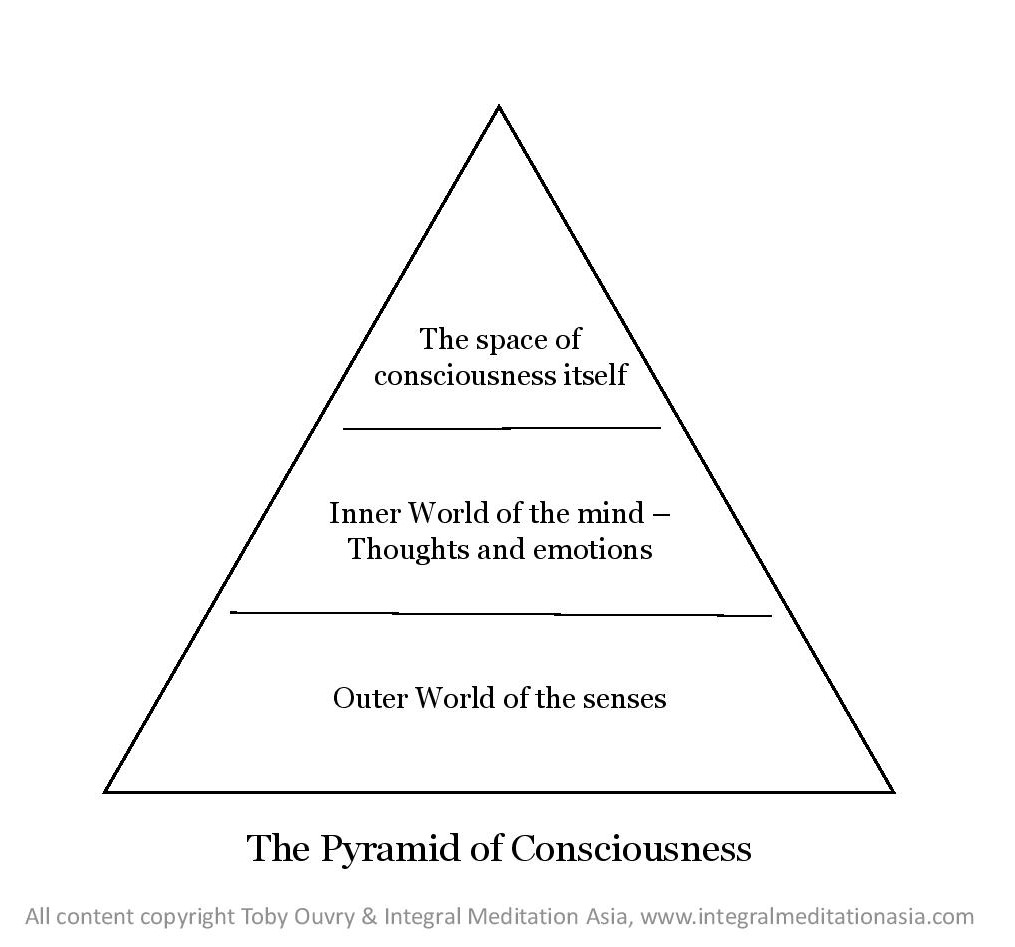
If you think about your consciousness as being like pyramid, with your senses as the broad base, your mind and emotions as the mid-section, and consciousness itself as the top tip (see the article diagram). In this exercise, we are focusing upon stabilizing the ‘base’ of our pyramid by paying attention to the weight of the body. If the base is stable, then everything above it is going to feel basically strong and stable, even when your under pressure.

You don’t need perfect concentration!
Even if as you are focusing on the weight of your body you are only able to concentrate 10-20% of your attention on it, then that is still 10-20% more stability and centre than you have when your lost in your thoughts and feelings. What’s more, if you lose focus on the weight of the body, its very easy to find again, as it is such a simple, obvious sensation. When you have a sensory ‘anchor’ for your consciousness, then even if you ‘get lost’ its easy to find centre again!

This week you might like to spend a few minutes each day ‘stabilizing the pyramid of your consciousness’ by paying attention to the weight of your body.

© Toby Ouvry 2018, you are welcome to use or share this article, but please cite Toby as the source and include reference to his website www.tobyouvry.com


Integral Meditation Asia

Online Courses 1:1 Coaching * Books * Live Workshops * Corporate Mindfulness Training *Life-Coaching *  Meditation Technology

Categories
creative imagery Energy Meditation Essential Spirituality Inner vision Integral Awareness meditation and creativity Meditation and Psychology Meditation techniques Mindful Resilience

Psychic self-defence & spiritual sources of compassion

Dear  Integral Meditators,

What is the difference between open and closed compassion? And how can you protect yourself from the attacks and imbalances of others around you without withdrawing your compassion from them? The article below explores how…

In the spirit of compassion,

Toby


Psychic self-defence & spiritual sources of compassion 

To be competent at ‘psychic self-defence’ means to be able to protect yourself from negative or unbalanced energies that may try and invade your subtle energy field. This energy can come from other people, from an environment, from yourself, or from a source within the inner world. An attack may be deliberate, or it may be unconscious, or co-incidental (just a case of ‘wrong place at the wrong time). In my past articles I’ve written about both ‘hard’ and ‘soft’ forms of psychic self-defence. Here I’m going to be writing about how to protect yourself from other people’s negative energy, without withdrawing your compassion for them.

Saying yes and no: A foundational aspect of psychic self-defence is psychological boundaries. On a simple level, this means if you are happy to do something with someone, you say ‘yes’, but if you aren’t, then you know how to say ‘no’. This means not saying yes to people all the time just because you want to please them, keep them happy, or are afraid of their disapproval. If something or some behaviour is not acceptable to you need to know how to firmly and politely say no. It sounds simple, but in practice a lot of people don’t do it well.

Open and closed compassion: So then if you have someone who you may know and whose pain you may have compassion for, you need to be conscious whether you are going to keep your energy field ‘open’ to them, which means taking on some of their energy (and possibly pain), or whether you are going to ‘close’ your energy field to them. Closing means to take a step back from them, and deliberately not allow their energy to affect you too much, even though you may have compassion for them.
Closing your energy field to someone: One traditional visual way to close your energy field is to imagine yourself surrounded by a golden bubble of light. It’s around your body in a circle or egg shape, but you can shrink it to fit your body like a glove when necessary. This bubble is semi-porous, which is to say it lets in the energy that you want to let in, but blocks the energy you don’t want. So if there is someone whose energy you want to block, the bubble doesn’t let any of their energy in. I sometimes also imagine star-shapes spinning on the surface of my golden bubble; when there is someone whose energy I want to block, one of the stars positions itself (whilst spinning) on the point of my bubble directly between myself and that person making that point totally impenetrable.

Opening a channel for spiritual compassion: So then, what if you have blocked your connection to a person, but still want to extend compassion to them? One way to do this is to send it via a spiritual source. So, any spiritual master, or source of spiritual energy that you feel connected to, you simply visualize that source and see compassionate energy flowing to the person from the source. For example, you can visualize a deity above that person’s head and the light of compassion flowing down through their crown. Or you can visualize compassionate healing light from the earth flowing up through their feet into their body. This is also a visualization you can do for yourself if you feel access your own self-compassion is blocked. Visualize yourself receiving it from a spiritual source and let yourself gradually re-open to receiving compassion and healing.

Related articleDiscovering your mindful compassion – Seven ways

© Toby Ouvry 2018, you are welcome to use or share this article, but please cite Toby as the source and include reference to his website www.tobyouvry.com


 Integral Meditation Asia

Online Courses 1:1 Coaching * Books * Live Workshops * Corporate Mindfulness Training *Life-Coaching *  Meditation Technology
Categories
creative imagery Energy Meditation Greenworld Meditation Inner vision Life-fullness meditation and creativity Meditation and Psychology Primal Spirituality Shadow meditation

Developing your inner vision (Mindful composting)

Dear  Integral Meditators,

As we meditate we develop our inner vision. This gives rise over time to various experiences of ‘spiritual light and darkness’ that it’s worth spending a bit of time pausing and reflecting upon before jumping to conclusions. In the article below I offer one of my own stories about this.
We’ll be exploring the theme in this weeks Deepavali meditations, and its kind of implicit in the Qi gong meditation we do on Saturday mornings.

In the spirit of clear vision,

Toby


Developing your inner vision: The darkness that you encounter in meditation may not be what you think! (Mindful composting)

If you meditate consistently over a period of time, at some point you are going to awaken one or other of your faculties of inner vision. This whole area is a big one, but I want to share just one short story now.
When I first started meditating, I had inadvertently, through some basic hatha yoga, activated my kundalini. As a result, I started to have visions, and the visions that I saw were quite varied, but as often as not they were very dark, dense and apparently malevolent in nature. It seemed to happen in waves, for days at a time, then going away, only to come back at a later time. I seemed to encounter dark beings within the dark energy, with hooked noses, long hands and so forth, very Harry Potter.
I found this a bit disconcerting and tried to force these evil visions away with prayers of protection, power mantras and all this type of thing, but the visions persisted causing a certain degree of fear and anxiety. I thought that I must be doing something wrong in my meditation, or I had some form of evil in me that must be magnetizing these funny beings to me.
I was able to clarify the situation as a result of starting to make my own compost. I noticed that when I lay down to bed at night, if I had been doing any work in the garden, and in particular doing composting work, then I would almost always see these same dark beings in my inner vision as I went to sleep. It was at this time also that I started to read a little bit on the idea of nature elementals, the spiritual beings who over-light the fundamental life and death processes of nature. Putting two and two together I realized that what I was seeing in my inner vision was not the forces of darkness in an evil sense, but rather the natural elemental forces of death, decay and breaking down as they exist in the natural world.
These natural forces of death and decay in the natural world are just as important as the life giving forces, and are in no way malevolent. However, for a human such as me encountering them for the first time, they often produce a reaction of confusion and aversion. Once I had clearly understood who and what they were, my fear for them dissolved and I learned to welcome them into my awareness in the same way that I welcomed light, blissful and radiant experiences.
When we start to develop our inner vision we may have some experiences that we do not understand, but it is important not to jump to conclusions too quickly, as what we see may not be what we think it is!

© Toby Ouvry 2018, you are welcome to use or share this article, but please cite Toby as the source and include reference to his website www.tobyouvry.com


Upcoming Courses at Integral Meditation AsiaOngoing on Wednesday’s, 7.30-8.30pm – Wednesday Meditation Classes at Basic Essence with Toby

Ongoing on Tuesday evenings, 7.30-8.30pm – Tuesday Meditation Classes at One Heart with Toby (East coast)

Monday 6.15-7.15 & Wednesday 12.15-1.15 – Integral Meditation classes at Space2B on Stanley Street

Saturday mornings 9-10.15: November 3rd,10th – Qi Gong workout and meditation class

Saturdays November 17th & 24th, 4.30-6pm – Mindfulness group coaching sessions with Toby

Tues 6th & Weds 7th November – Deepavali meditation – Connecting to your inner-light

Saturday 17th November 9.30am-1pm – The Six Qi Healing sounds: Qi gong For Self-Healing and Inner Balance Workshop

Saturday 24th November 9.30am-12.30pm – Finding simplicity in the complexity – Meditation from the perspective of Zen

DECEMBER
Saturday 15th December, 1-4pm – Integral meditation practice: Optimize your inner calm, strength and energy


Integral Meditation Asia

Online Courses 1:1 Coaching * Books * Live Workshops * Corporate Mindfulness Training *Life-Coaching *  Meditation Technology
Categories
Biographical creative imagery Inner vision Insight Meditation Integral Awareness Life-fullness Meditating on the Self meditation and creativity Meditation and Psychology Meditation techniques Presence and being present

Playing your roles with freedom

Dear  Integral Meditators,

This weeks articles looks at how you can live your life and play your life-roles with greater freedom and authenticity, using mindfulness.

In the spirit freedom in our roles,

Toby


Playing your roles with freedom – The observer self

Observing the world through our roles


For most of us, much of our sense of ‘I’ or ‘self’ is taken up by the different roles that we play in life. For example, professionally we may be a manager, a technician, a banker, a designer. Our family roles take up a huge chunk of our identity; mother, father, son, daughter, elder brother, younger sister. There are many other roles; the sports person, the talker, the cook, the pacifier, the fixer, the list goes on. If you were to try and bring to mind the top three or four roles that you are most identified with in your life, what would they be?
The challenge with these roles is that because we identify with them so closely, we tend observe our world, define ourselves and act from them without choice. They define the person we are and what we are capable of. Sometimes identifying with a particular role has benefits and serves us well. But at other times being over-identified with our roles and attached to them causes us a lot of unnecessary suffering and stress. It prevents us from seeing possibilities and fulfilling our potential.

Stepping out of our roles and becoming the observer


So, with mindfulness we learn to step out of our roles, observing ourself and our world with bare attention, as a mere observer.  In this regard it can be very valuable to deliberately and consciously step out of roles we are identified with. For example:

  • As a father I might choose to deliberately step out of my identification with that role, and simply observe my daughter and experience of her from a witnessing position
  • As a meditation teacher I can choose to ‘drop the label’ and observe myself as if I was a no-one.
  • I can step out of my habitual patterns as a business man, and see my daily business activities ‘as if for the first time’, or like a ‘fly on the wall’.

In these examples, I am deliberately stepping out of a role, putting it down, and trying to not see my world coloured by the lens of that role.

Stepping back into our roles with freedom and enthusiasm


Once we are regularly stepping out of our roles, and dis-identifying with them, we can then practice ‘putting them back on’. We can play our roles with enthusiasm and passion, but also with the knowledge that we are not those roles. We are capable of putting them down and stepping out of them when we wish to. We are able to play our roles in life with freedom, enthusiasm and creativity. Our dis-identification with them helps us to play the roles better and more fully.

Exercise: Stepping in and out of our ‘role costumes’


Imagine you have a cupboard in your home. In that cupboard are a collection of costumes, clothes, hats and so on that relate to all the roles you play in your life; mother, daughter, professional trader, lover, friend etc… Take a little time to look thru all these different clothing and costumes. You are none of these costumes, but you put them on in your life, to play your roles. You can play them fully, with commitment and power, but when your done, you know you can take off the costume and put it back in the cupboard. On a deeper level your identity is simply as the observer, the witness, dancing in an out of your roles!

Related articleNo Name (Meditation Spaghetti Western Style)

© Toby Ouvry 2018, you are welcome to use or share this article, but please cite Toby as the source and include reference to his website www.tobyouvry.com


Integral Meditation Asia

Online Courses 1:1 Coaching * Books * Live Workshops * Corporate Mindfulness Training *Life-Coaching *  Meditation Technology

Categories
creative imagery Essential Spirituality Inner vision Integral Meditation Meditating on the Self Meditation and Psychology Mindful Self-Leadership Presence and being present

Four ways of working with your inner voice

“Speak through the earthquake, wind, and fire,
O still, small voice of calm.” – John Greenleaf Whittier

Four ways of working with your inner voice

Your ‘inner voice’ refers to the inner conversation that you are having with yourself in your head during the day. Sometimes this voice can be critical, sometimes it can be supportive. For many of us it can be predominantly a source of insecurity and dis-ease, rather than support. The purpose of working with your ‘inner voice’ mindfully in the ways described below is to help transform it from a potential or actual weakness into a source of strength.

Listening with curiosity – This first exercise is simply observing the voices and conversation you are having in your head. Often when the conversation is taking place we are very identified with the voices, and we often take it very seriously. The idea here is to listen with curiosity, and a sense of detachment and lightness. You’ll notice that there are some ‘positive’ voices, and some kind of ‘negative’ voices. You want to greet both with a little bit of humour and lightness. You are also trying to gently separate your ‘I’ or sense of self from the voices. You aren’t trying to change of ‘fix’ the voice, just listen inquisitively and lightly.

Talking back wisely – Method two is to listen to your inner dialogue and to ‘talk back’, gently directing the conversation in a positive way. For example, if your voices are being critical toward you about a mistake or mis-judgment that you made, you can gently point out the reasons why you can be a bit easier and less judgmental on yourself. If you notice that your inner voices are talking about a work project, you can consciously look for and bring in the aspects of the project that are going well, or that you can feel good about. Here you are a participant in the conversation, and gently encouraging it to go in a direction that serves you!

Talking less – This third ‘mindful position’ is to gently encourage the conversation to reduce and ‘quieten down’. You can try gently communicating to yourself and your inner voices that (for the time you are doing this exercise) there really is no need to process or ‘fix’ any of your problems or challenges. Give yourself full permission to relax and think less. You can take as an anchor for your attention your breathing, or one of your senses, and just gently encourage your inner voices to settle down and rest for a while.

Your ‘still small voice within’ – In this final exercise, you listen a bit deeper, beneath the loud chatter of your everyday mind. What you are looking for is a quieter voice within you coming from a deeper level of your consciousness. Its nature is to be kind, and quiet, strong and wise. It’s easily drowned out by the louder voices of the everyday mind, which is why you need to listen for it more closely, in a relaxed frame of mind.
If you like you can even give your ‘still small voice’ a form to key into. For example, you can visualize it as a small candle flame (symbolizing the wisdom of your deeper inner voice) in your heart centre, and focus on it as you meditate, listening to any message that may arise from it. Or you can even visualize it as a person next to you, perhaps a wise man or woman that you can ask questions to about dilemmas that you face.
You can do the above four exercises individually, by themselves. Alternatively you could do them one after the other, for example in a twenty minute meditation you could do each for five minutes, one after the other.

Happy listening!​

© Toby Ouvry 2018, you are welcome to use or share this article, but please cite Toby as the source and include reference to his website www.tobyouvry.com


Integral Meditation Asia

Online Courses 1:1 Coaching * Books * Live Workshops * Corporate Mindfulness Training *Life-Coaching *  Meditation Technology

Categories
creative imagery Enlightened Flow Inner vision Insight Meditation meditation and creativity Meditation and Psychology Mindful Resilience Mindfulness Stress Transformation

Baseballs or confetti?

Dear Integral Meditators,

If you were to learn to deal with your suffering in life, what might start to happen to your access to rapture and joy? The article below explores this question in a practical way…

In the spirit of baseballs and confetti,

Toby

​Baseballs of confetti? 
The truth of suffering
One of the big gifts of my time as a Buddhist monk and studying Buddhism was its orientation around looking squarely at pain and suffering. Of course, Buddhas first noble noble truth is the ‘truth of suffering’; in our life it is absolutely certain that we will meet various forms of pain. The brief summary of Buddhas seven unavoidable sufferings would be: birth, ageing, sickness, death, parting from what we like, encountering things we don’t like, and uncertainty. So, the basic ‘mindful injunction’ here is ‘be ready’ because in multiple ways small and great you are going to suffer. The good news is that, if you are ready for the pain, then you can reduce the amount of pain you experience, and you can also use it to become wiser, happier and more capable in your life. Put another way, your suffering becomes useful to you.What are you expecting, a baseball or confetti?
Whether our suffering is useful to us or not depends alot upon our expectation. If you are standing there expecting life to throw confetti at you, then when a ‘baseball’ of suffering gets thrown your way, then you are going to be completely unprepared, and the likelihood is that it’s going to hit you flush in the face, and cause a lot of pain. If your ‘ready’ for the suffering, or ‘expecting the baseball to come at you’ then when it does, you can basically ‘catch’ it, without it really doing to much damage. For example:

  • If I am wrestling with uncertainties in important areas of my life, if I have a sense that this is a ‘normal’ part of everyone’s life which I expect then I’ll be ‘ready’ to have to deal with it.
  • If I expect my body to give rise to a certain amount of pain, to age and so forth, then chances are I’ll be able to work with pain when it occurs and relax more gracefully into the ageing process (and perhaps as a result staying ‘beautiful’ longer?)
  • If when I engage in a romantic relationship I expect to have my emotional triggers and vulnerabilities pressed, then there is a much better chance I’ll be able to work with them, and preserve the beauty of the love in the relationship for longer, perhaps indefinitely….

The bottom line here is, if you are ready for it, then the capacity of suffering to cause painis much reduced, and the reduction comes in large part from your expectations…

The truth of rapture
Another truth that I think is equally important to grasp, but that isn’t explicitly in Buddhas four truths (but may be implicit?), is what I call the truth of rapture. This truth is really that life contains within it inherent forms of rapture, beauty and bliss. This rapture is available to all of us, but it exists amongst the suffering, messiness, uncertainty and difficulties of our life. The big payoff of opening to the truth of suffering well and courageously is that you them start to open up spaces in your life that contain wonder, beauty and amazement. Sometimes these experiences are quiet and unobtrusive, and sometimes they come to us in waves, loudly and in technicolour. If you take care of your suffering well then there is more and more room for genuine and sustainable rapture. For example:

  • If you are prepared to meet the ‘pain’ of intimacy in a romantic relationship and deal with it mindfully, then the stage is set for a long term and sustainable experience of rapture
  • If you are prepared to accept and deal with the pain of working hard to build a business well and with integrity, then the stage is set for the long-term pleasure and joy of having done so. You can enjoy the joy of both the process and the result!
  • If you are not pre-occupied with, trying to avoid or being consumed by your suffering, then you can find quiet moments of rapture during the day, in the beauty of a view, the presence of a loved one, the passing of time and so forth…

When you know how to catch the baseballs of suffering that come your way, you may find life spontaneously and as if by accident starts to throw a lot of confetti your way!

Related article: Practical Rapture (On rapture, beauty and mindfulness)

© Toby Ouvry 2018, you are welcome to use or share this article, but please cite Toby as the source and include reference to his website www.tobyouvry.com

Categories
Awareness and insight creative imagery Insight Meditation Integral Awareness Integral Meditation Meditating on the Self Meditation and Psychology Meditation techniques mind body connection Mindfulness Presence and being present Stress Transformation

Making your body your castle (And watch Toby’s Mindfulness TedX Talk!)

Dear  Integral Meditators,

This weeks article gives some simple mindful suggestions for bringing real stability to your life, literally, and even when under pressure!
Also, I recently discovered that a TedX talk I gave on mindfulness is up on the web. Its a pretty decent 15min primer on the vision of engaged and integral mindfulness, do have a view!

In the spirit of castle-like awareness!

Toby


1:1 Coaching offer until the end of August
On a personal level, if you are looking to meet the rest of the year with a renewed strategy for developing your work-life balance, and for dealing with your stress more effectively, until the end of August I am offering a 15% price reduction in myHandle stress and have peace of mind 1:1 coaching sessions.


Making your body your castle

Your body and your senses are your most basic, simple and stable objects of mindful awareness. They are basic and simple because they are non-conceptual, solid experiences that we encounter when we observe the physical dimension of our present moment awareness. When your mind is focused on your body and senses quite naturally it starts to feel more stable, because our body is generally much less changeable, quick and unpredictable than our thoughts and emotions.

Your body and senses are the easiest objects to train in mindfulness to begin with. This is because they are obvious and easy to find, even if we are not familiar with mindfulness practice. Everyone can become aware and focus on their body, or the sounds around them without too much trouble. Because of this they are an obvious place to begin building mindful concentration and focus. Once you are familiar with focusing on the body and senses, you can then go onto focus on thoughts, feelings and mental images as objects of mindfulness with much greater ease and success.

Solid mastery of mindfulness of the body and senses will give you tremendous stability under mental and emotional pressure. This is because they give your mind a stable anchor in the moment. Rather than feeling like you are drowning in an uncontrollable mass of thoughts and feelings, you will gradually start to feel more and more comfortable under pressure, because your attention to your body gives you a deeper sense of presence in the moment that enables calm.

Make your body like your castle 
There is an old saying that goes something like “An Englishman’s home is his (or her) castle”. The gist of this is that our physical home is a refuge where we can retreat from the world, gather our strength, heal our wounds and feel safe. If we have a physical space to retreat to it is of great value to us in terms of our peace and wellbeing. I often think about my own body as being like my ‘castle’ as I go around my day facing various challenges. As long as a part of my attention is centered in my body I have a place where I can feel strong, relaxed and solid, even if there are difficult emotions, uncertainties or negative thoughts going on.
If you like you can bear this image in mind as you cultivate your own mindful attention of your body and senses. Practice making them ‘castle-like’; solid, immense and stable amidst the whirlwind of your emotions, thoughts and activities. If you are a visually minded person, when you are sitting in meditation you might even like to imagine yourself in your very own castle, safe and calm within its strong walls. You can them bring that feeling into your body in the present moment and cultivate that feeling of physical strength and solidity.

Enhancing your bodily comfort and wellbeing
As you cultivate your awareness in this way, you will also start to notice tension, fatigue or discomfort in the body. As a result, you will naturally start to let go of that tension and look after your body better. So not only will you find more mental stability, but you will also enhance your wellbeing on a physical level!

© Toby Ouvry 2018, you are welcome to use or share this article, but please cite Toby as the source and include reference to his website www.tobyouvry.com


Upcoming Courses at Integral Meditation AsiaOngoing on Wednesday’s, 7.30-8.30pm – Wednesday Meditation Classes at Basic Essence with Toby

Ongoing on Tuesday evenings, 7.30-8.30pm – Tuesday Meditation Classes at One Heart with Toby (East coast)

Begins 14/15th September – Effortless effort – Insight meditation for self-healing and transformation – a five week course

Monday 6.15-7.15 & Wednesday 12.15-1.15 – Integral Meditation classes at Space2B on Stanley Street

Saturday 8th September & 29th September 9-10.15am – Qi Gong workout and meditation class
Tues 18th & Weds 18th September, 7.30-8.30pm – Autumn equinox balancing & renewing meditation

Saturday 22nd September, 10.30am-5pm – Shamanic Mandala Meditation and Art Workshop

Saturday 29th September, 2-5pm – OneHeart Open Day ‘Activating your journey of healing and empowerment’.


Integral Meditation Asia

Online Courses 1:1 Coaching * Books * Live Workshops * Corporate Mindfulness Training *Life-Coaching *  Meditation Technology