Categories
Awareness and insight Insight Meditation Integral Awareness Meditating on the Self Meditation and Psychology Meditation techniques Mindful Self-Leadership Mindfulness Presence and being present

Unstructured mindfulness – Turning and facing yourself

Dear  Integral Meditators,

What might happen if you spent 5-10mins each day simply turning your attention within you and becoming more self-aware? The article below explores this question, and how you can start to engage in this form of ‘unstructured mindfulness’ practice.

In the spirit of self-awareness,

Toby


Unstructured mindfulness – Turning and facing yourself

“Focus on holding the position of the observer. If you do this you will notice that there is a feeling of stability within you that comes from the discipline of holding this position, and doing nothing more.”

The value of self-awareness
One of the main points of mindfulness is to increase your self-awareness. The more self-aware you are, the more self-knowledge you will have. The more self-knowledge you have, the more likely you are to make intelligent choices that will lead to you both being effective in your life and nurture your wellbeing.
There are many ways of using mindfulness to increase self-awareness, but essentially, it just means spending regular time turning and looking within.

How you do it – turning and facing
Unstructured mindfulness is simply the act of turning your attention inwards and noticing what is going on within your body, heart and mind. You just turn your attention from the outer world to your inner, or interior world, and watch. You are not following a structure or listening to a voice leading you through a process, you are just turning your mental gaze inwards and noticing what is going on within you, in the moment. If you do this, you will start to become aware of things going on in a way that you were not previously. This means that you are increasing your self-awareness.

Stability comes from the position of the observer
As you are doing this, all you need to do is hold the position of the observer. Watch and notice. Don’t try and fix or alter, simply focus gently on holding the position of the observer. If you do this you will notice that there is an increasingly reliable feeling of stability within you that comes from holding the position of the observer, and doing nothing more.

Two anchors for support
The act of turning and facing yourself can be quite intimidating for some people. With this in mind, here are two simply methods or positions you can use to anchor your mind to as you watch:

  1. The non-emergency of the present moment – Recognize that in this moment, right now, there is no immanent emergency. Relax into the recognition that you are safe, and you can afford this time to just turn inward and watch!
  2. Letting your body breath – If difficult or challenging things come up as you watch your mind and body, let your body breathe in a way that helps you to accept and then release what comes up. If you let it, your body knows how to breath in a way that will lead you and it gradually towards balance and equilibrium.

© Toby Ouvry 2019, you are welcome to use or share this article, but please cite Toby as the source and include reference to his website www.tobyouvry.com 


Integral Meditation Asia

Online Courses 1:1 Coaching * Books * Live Workshops * Corporate Mindfulness Training *Life-Coaching *  Meditation Technology

Categories
Concentration Energy Meditation Integral Meditation mind body connection Mindful Breathing Mindfulness One Minute Mindfulness Presence and being present Uncategorized

Free Form Breathing – Allowing your body intelligence to decide

Dear  Integral Meditators,

This weeks article is a short, simple and profound breathing meditation technique for getting in touch with your body’s natural intelligence and wisdom. I do it a lot, and when I teach it people give very good feedback on the immediate effects they notice!
Reminder of the next two classes, this Tuesday and Wednesday’s Chinese New year meditation, and the Aquarius meditation on developing your self-knowledge on the 12/13th February.

In the spirit of our body-wisdom,

Toby


Free Form Breathing – Allowing your body intelligence to decide

One very simple technique that can be used both as a meditation in itself, or in order to prepare for other meditation practices is as follows:
Simply ask your body how it wants to breathe in order to find its point of balance, relaxation and calm. Then simply allow your bodies consciousness to guide the pace, depth and manner of your breathing for a few minutes.

In this exercise rather than imposing a technique or form upon your breathing and body, you allow your body consciousness to guide you in the breathing pattern IT needs to do most in order to find centered-ness, relaxation and calm. It may decide that it needs to breathe in short bursts with an emphasis on the outbreath, it may guide you toward long, evenly spaced breathing or whatever (you may be a little surprised!). The point is that you are allowing your body consciousness to do it, rather than dictating to our body what the rhythm should be.
Once you have done this for a while you’ll find that your mind and body are calmer and more centered, and you can go onto engage in whatever activity you then wish with a greater sense of poise and presence of mind.

© Toby Ouvry 2019, you are welcome to use or share this article, but please cite Toby as the source and include reference to his website www.tobyouvry.com 


Upcoming Courses at Integral Meditation AsiaOngoing on Wednesday’s, 7.30-8.30pm – Wednesday Meditation Classes at Basic Essence with Toby

Ongoing on Tuesday evenings, 7.30-8.30pm – Tuesday Meditation Classes at One Heart with Toby (East coast)

Monday 6.15-7.15 & Wednesday 12.15-1.15 – Integral Meditation classes at Space2B on Stanley Street

January 29/30th, 7.30-8.30pm – Lunar new year meditation 2019: Being benevolent and big-hearted in the year of the Pig

Saturday mornings 9-10.15am, 16th & 23rd February  – Qi Gong workout and meditation class

Saturdays February 9th & 23rd, 4-5.30pm , 4-5.30pm – Mindfulness group coaching sessions with Toby

Tues & Weds February 12/13th – Monthly astrological meditation – Aquarius: Developing your inner knowing and self-knowledge

Saturday 9th February, 9.30am-12.30pm  – Going from overwhelmed to overwell meditation workshop

Saturday 23rd February 11-12.30pm – Get your meditation practice started now- The shortest and most time effective meditation workshop ever

MARCH

Saturday 16th March, 9.30am-12.30pm – Meditation for self healing and creating high levels of energy


Integral Meditation Asia

Online Courses 1:1 Coaching * Books * Live Workshops * Corporate Mindfulness Training *Life-Coaching *  Meditation Technology

Categories
Awareness and insight Inner vision Integral Awareness Integrating Ego, Soul and Spirit Meditating on the Self Meditation and Psychology Meditation techniques Mindful Confidence Mindful Self-Leadership Mindfulness Presence and being present Stress Transformation

Trusting Yourself (Your first Guardian Angel)

Dear  Integral Meditators,

This Sunday I will be doing a workshop on your meditation with your Guardian Angels. Before you start thinking about how you relate to ‘spiritual guardians’, its really important to realize that your first personal guardian is yourself, your mind and your ‘inner signals’.
The article below explores in a practical way how you can build trust in yourself and your inner signals.
Those interested in the workshop, just click on the link below. You can also see my previous article on Understanding and working with your Guardian Angel.

In the spirit of trusting your inner signals,

Toby


This Sunday 27th January, 2-5pm – Meditations for connecting to and working with your Guardian Angel

In a sentence: Learn how you can use meditation as a practical way of connecting to and communicating with your guardian angel.
All of the great wisdom traditions speak of speak of spiritual guardians who can offer us support, guidance and protection on our journey through life. This workshop focuses specifically on the tradition of the personal guardian angel. In the session you will learn what is mean by an ‘angel’ or angelic being, and what is the nature and function of our own guardian angel….click here for full details.


Trusting Yourself (Your first Guardian Angel)

Mindfulness and meditation can give us temporary calm and relief from the continuous activity of our thinking mind, but if we are tempted to use it as a way of escaping from our mind then we should be wary.
Ideally mindfulness should be a way of gaining confidence and trust in our mind and ourself so that gradually our relationship to our thinking mind becomes more and more harmonious and mutually supportive; our thoughts support a healthy experience of self, and our sense of self encourages a reliable approach to thinking about our life experience.
Nathaniel Branden has in interesting definition of self-confidence, he says “Self confidence is confidence in the reliability of our mind as a tool of cognition…it is the conviction that we are genuinely committed to perceiving and honouring reality to the fullest extent of our volitional power.”
So, the long and the short of this is that in order to be genuinely and deeply self-confident, you need to learn to trust your mind, and use it as well as you are able within the limits of your ability.

Pseudo-self confidence
Quite a few people exert a lot of effort building pseudo self-confidence in order to disguise their fundamental lack of trust in their own mind and judgment. We might become very physically fit, or very wealthy, or have read all the right books about being a parent, have gained many educational certificates and degrees, or even become an expert meditator (and other examples ad infinitum) all as a way of building a buffer between ourself and our actual moment to moment experience of reality and life. Fundamentally we don’t trust our mind to be able to deal with it effectively; deep down we lack self-confidence, so we build buffers and things to hide behind.

Three mindful questions for building self-confidence and trust in your mind.
Take a situation in your life, perhaps something that you have experienced today. Ask yourself three questions in turn:
“What am I seeing and experiencing here”
“What are my mind, emotions and senses signalling to me about what I am seeing and experiencing?”
“Am I honouring my own experience and mind here or am I turning away from it?”The answer to the third question will tell you whether you are using this activity and experience to build your self-confidence and trust in your own mind, or whether you are subverting it. As the old saying goes “Many drops of water slowly dripping into a pot will eventually make it full”; in our day by day journey to self-confidence, or to a lack of it, this saying rubs both ways.Generally the challenge here is not that we don’t know enough, but that we know more than we would like, and would rather avoid the responsibility of that knowledge.

© Toby Ouvry 2019, you are welcome to use or share this article, but please cite Toby as the source and include reference to his website www.tobyouvry.com 


Upcoming Courses at Integral Meditation AsiaOngoing on Wednesday’s, 7.30-8.30pm – Wednesday Meditation Classes at Basic Essence with Toby

Ongoing on Tuesday evenings, 7.30-8.30pm – Tuesday Meditation Classes at One Heart with Toby (East coast)

Monday 6.15-7.15 & Wednesday 12.15-1.15 – Integral Meditation classes at Space2B on Stanley Street

January 29/30th, 7.30-8.30pm – Lunar new year meditation 2019: Being benevolent and big-hearted in the year of the Pig

Saturday mornings 9-10.15am :16th & 23rd February  – Qi Gong workout and meditation class

Saturdays , 4-5.30pm – Mindfulness group coaching sessions with Toby

Saturday 26th January, 1-4pm – Growing your mindful freedom meditation workshop

Sunday 27th January, 2-5pm – Meditations for connecting to and working with your Guardian Angel

FEBRUARY

Saturday 9th February, 9.30-12.30 – Going from overwhelmed to overwell meditation workshop


Integral Meditation Asia

Online Courses 1:1 Coaching * Books * Live Workshops * Corporate Mindfulness Training *Life-Coaching *  Meditation Technology
Categories
Awareness and insight Concentration creative imagery Integral Meditation meditation and creativity Meditation techniques Mindful Breathing Mindful Resilience Mindfulness Presence and being present

Stabilizing your pyramid of consciousness

Dear  Integral Meditators,

What is the simplest, stabl-est and most basic way to stabilize your mind and attention? The article below explores one answer to this in a practical way.

In the stability,

Toby


Stabilizing your pyramid of
consciousness

Within your field of awareness, you have three basic areas; your senses, your feelings and your thoughts. Of these, which do you imagine is the most stable and reliable? Which of these three moves slowest and is the most predictable? If you watch for a while, you will see clearly from experience that the answer to this is your senses. The mind and emotions can move and change very quickly and unpredictably. Your physical awareness and senses however are much slower moving. For example, if you bring your attention to the sensation of your physical body over a one minute period, you’ll see that it remains fairly constant, even as your mind moves here and there, and your moods shift.

Anchoring your attention to your senses
In mindfulness terms then, if you want to establish basic stability in this moment, the obvious place to go is to your physical body and senses. You can use them as an anchor for your attention. If you think about your attention as like a boat, and your thoughts and feelings as being like the waves, wind and other moving conditions around the boat. Your body and senses then become like the anchor that keeps the boat in one place. You don’t even need to try too hard still your mind and feelings. Just keep coming back to the anchor of your body, and you’ll find this gives you the basic ‘weight’ and stability for a sense of calm to start to come into your mind.

The weight of your body
I find it particularly useful to focus on the weight and solidity of my body. In particular the sensation of the weight where my body is on contact with the floor or surface where it is sitting or standing. So, if you are standing, that would be the soles of your feet, or if you are sitting it’s the back of your legs and butt that is on contact with the seat. If you like you can focus on the weight of your body as you inhale and then feel the tension in your upper body flowing down into the floor through that contact point as you exhale.

Your pyramid of consciousness 
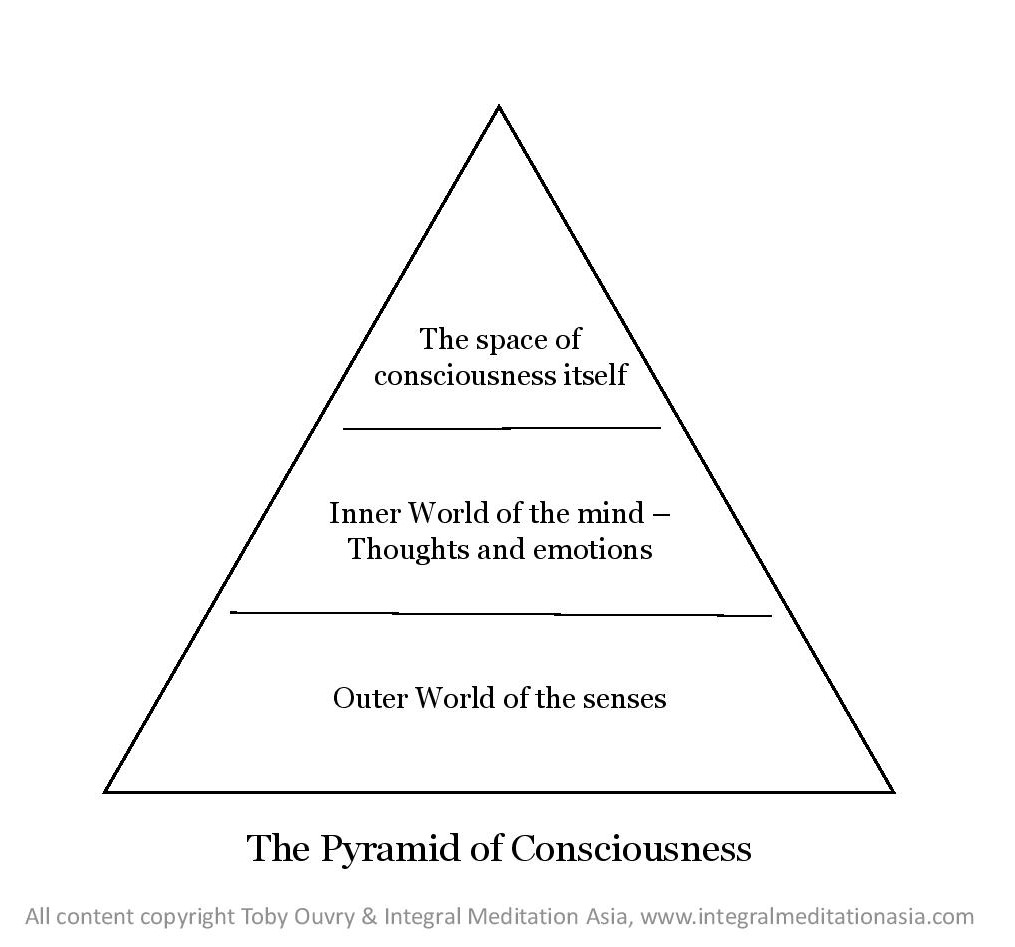
If you think about your consciousness as being like pyramid, with your senses as the broad base, your mind and emotions as the mid-section, and consciousness itself as the top tip (see the article diagram). In this exercise, we are focusing upon stabilizing the ‘base’ of our pyramid by paying attention to the weight of the body. If the base is stable, then everything above it is going to feel basically strong and stable, even when your under pressure.

You don’t need perfect concentration!
Even if as you are focusing on the weight of your body you are only able to concentrate 10-20% of your attention on it, then that is still 10-20% more stability and centre than you have when your lost in your thoughts and feelings. What’s more, if you lose focus on the weight of the body, its very easy to find again, as it is such a simple, obvious sensation. When you have a sensory ‘anchor’ for your consciousness, then even if you ‘get lost’ its easy to find centre again!

This week you might like to spend a few minutes each day ‘stabilizing the pyramid of your consciousness’ by paying attention to the weight of your body.

© Toby Ouvry 2018, you are welcome to use or share this article, but please cite Toby as the source and include reference to his website www.tobyouvry.com


Integral Meditation Asia

Online Courses 1:1 Coaching * Books * Live Workshops * Corporate Mindfulness Training *Life-Coaching *  Meditation Technology
Categories
Inner vision Insight Meditation Integral Awareness Life-fullness Meditation and Art meditation and creativity Meditation and Psychology Meditation techniques Mindful Self-Leadership Mindfulness Motivation and scope

Mindful of your moods, emotions and dispositions

Dear  Integral Meditators,

In the the foreground or background of each moment you experience, there is a mood, emotion and ‘atmosphere’. The article below explores how to start working with these mindfully in your life.

In the spirit of moods and atmospheres,

Toby


Engaged Mindfulness book is on a special 10% offer for the next until end Tuesday 11th Dec)

Christmas is coming up, if you are looking for a meaningful, inexpensive present to pass out to friends, why not order a few copies of ‘Engaged Mindfulness’? It’s a short, 45 page primer on integral mindfulness, broken up into short 1-2page sections. Click here to order your copies…


Mindful of your moods, emotions and dispositions

This article focuses on how you can start to work with emotions, moods and dispositions, for the purposes of enjoyment, as well as becoming more effective in your life. Let’s start with a few definitions:
Emotions are temporary energetic reactions to particular events; what someone said to you, something that you hoped for not happening, something unpredictable occurring, an experience of good fortune etc. Although they are temporary, if you start watching them you’ll start to notice that have a particular habitual range emotions that you use in your life. This is rather like an artist who has a love or habit of working with a particular colour range.
Moods are emotions that you tend to spend quite a lot of time in. They become the background ‘atmospheres’ within which you live much of your life. Anxiety or curiousity, lightness or heaviness, resentment or appreciation, optimism or pessimism are all examples. They are like the typical ‘weather’ that you might expect to experience in a country at a particular time of year and season.
Dispositions are what you might think of as the primary moods that we tend to live in. We spend such a lot of time in them that they become pretty much our personality; they form some of the basic ways in which we experience our self as a personality.

Something to notice about emotions, moods and dispositions is that you are pretty much always in one – it’s useful to be aware of and take it into account because they open or close avenues of possibility and action for us in each moment. For example, an attitude of optimism opens up emotions of appreciation, pleasure and lightness, but may make us blind to certain problems that we need to look at realistically. Similarly, an attitude of pessimism closes certain desirable emotional states, but also invites some interesting insights into areas of risk in our life that we might do well to look at.
Simply asking ‘What are the moods and emotions present for me in this situation?’ will make us aware of what is there and how it is affecting us.

Centring in difficult moods and emotions
If you are experiencing a difficult mood or emotion, then, rather than try and shift out of it or get rid of it immediately, it can often be most useful to simply recognize it, and centre yourself, so that it isn’t keeping you off balance. Once you are aware and have centred yourself, you can them make a choice whether you want to try and shift out of the mood/emotion or stay with it and see what it has to offer you in that moment.

Identifying your habitual range of mood and emotion.
If you watch your moods, emotions and dispositions you’ll start to have a sense of the ‘mood options’ that you have available to you. You can start to cultivate particular emotions and moods in particular situations where they will serve you particularly well.
You’ll also notice that you have particularly inspiring moods and emotions within your range that open up avenues of action and possibility that will help you go experience life better in the moment and get you where you want to go. So consciously cultivating these moods is a good idea! For example, I have a little post-it message on the picture above my lap-top right now that says, ‘Everything is possible!’ This reminds me to open to and live in a mood that is particularly meaningful and helpful to me right now.
So, a good mindful question to go with this last section might be ‘What mood or emotion can I cultivate that would serve me best in this situation?

© Toby Ouvry 2018, you are welcome to use or share this article, but please cite Toby as the source and include reference to his website www.tobyouvry.com


Upcoming Courses at Integral Meditation AsiaOngoing on Wednesday’s, 7.30-8.30pm – Wednesday Meditation Classes at Basic Essence with Toby

Ongoing on Tuesday evenings, 7.30-8.30pm – Tuesday Meditation Classes at One Heart with Toby (East coast)

Monday 6.15-7.15 & Wednesday 12.15-1.15 – Integral Meditation classes at Space2B on Stanley Street

Saturday mornings 9-10.15am 1st,15th, 22nd, 29th December – Qi Gong workout and meditation class

Tues & Weds, 4th, 5th December – Monthly Astrological meditation – on ‘Sagittarius – I perceive/understand’

Saturdays December 15th & 22nd – Mindfulness group coaching sessions with Toby

Saturday 15th December, 1-4pm – Integral meditation practice: Optimize your inner calm, strength and energy

Tues & Weds Dec 18/19th, 7.30-8.30pm – Winter Solstice balancing & renewing meditation


Integral Meditation Asia

Online Courses 1:1 Coaching * Books * Live Workshops * Corporate Mindfulness Training *Life-Coaching *  Meditation Technology

Categories
Integral Awareness Integral Meditation Meditation techniques mind body connection Mindfulness One Minute Mindfulness Presence and being present

Access your brain’s ‘zero space’

Dear  Integral Meditators,

Article below four practical ways of clearing and calming your perception using awareness of the body and brain. They’re very simple to use, and once you know what they are, you can use them to good effect anytime!

In the spirit of clear perception,

Toby


Engaged Mindfulness book is on a special 10% offer for the next week (Until end Tuesday 11th Dec)
Christmas is coming up, if you are looking for a meaningful, inexpensive present to pass out to friends, why not order a few copies of ‘Engaged Mindfulness’? It’s a short, 45 page primer on integral mindfulness, broken up into short 1-2page sections. Click here to order your copies…


Four aspects of clear perception (The zero space in your brain)

What I want to outline here are four ways essentially to calm and center. The first three relate to three aspects of our awareness, namely:

  • Our instinctive, or primal intelligence which resides in the brain stem, the oldest ‘reptilian’ part of our brain. This part of our brain is also wired via our nervous system to our belly area, or our ‘guts’. When we say, “I have a gut feeling about this”, this is partly the area of perception we are referring to.
  • Our emotional and ‘mammalian’ intelligence which resides in the mid-section or limbic area of our brain. This in terms of our body relates to our heart or chest space, where we experience many of our human and social emotions.
  • Our cognitive or thinking intelligence, which is primarily located in the pre-frontal cortex area of the brain. In terms of our body, this is our ‘head’ intelligence.

At any given moment we are receiving impulses and information from these three aspects of our body and our brain. So, in terms of our perception of any given situation, it can be good to ask these questions:

  • What are my guts and reptilian brain telling me here?
  • What are my emotions and limbic brain experiencing here?
  • What is my thinking self and pre-frontal cortex experiencing here?

If you do this you’ll start to be able to tease apart these three areas of your perception and make more conscious choices about your experience in the moment.

Relaxing your instincts, emotions and mind
You can also use this three-fold distinction to relax more systematically:

  • To relax your instinctive self: Focus on relaxing the brain stem just inside the base of the skull and at the top of the spine. Then put one hand on your belly and breathe in and out of it, calming the energy there
  • To relax your emotional self: Focus on the mid-brain area and relax that, then put one hand on your heart/sternum area and breathe in an out of your chest, calming the emotions you sense there.
  • To relax your thinking self: Focus on the front of the brain, and around the temples and forehead. Relax the pre-fontal cortex, then the head area in general.

The zero space inside you head
There is a tiny physical cavity, or space inside your brain. It is in the middle of the brain, just maybe a centimetre or two toward the back from the literal centre. It is the space at the intersection or meeting point between the left and right hemispheres of your brain, and the brain stem which comes up from underneath. Back in the day, Taoist meditators discovered that, if you placed your attention in this physical spot in your head, then your mind calms very quickly, as there is absolutely nothing going on in that space. It’s like a ‘zero space’ of no thought. The Taoist call this space ‘the cavity of original spirit’. So, if you rest your attention there, you can enter a space of no-thought very quickly!
I use these four areas in combination. I first relax my instincts, emotions and thoughts, then I go into the ‘Cavity of original spirit’ for a while. It’s another meditation technique that can also be very useful when you can’t fall asleep at night. A space of ‘no-thought’ is pretty damn relaxing even if you aren’t literally asleep!

© Toby Ouvry 2018, you are welcome to use or share this article, but please cite Toby as the source and include reference to his website www.tobyouvry.com


Upcoming Courses at Integral Meditation AsiaOngoing on Wednesday’s, 7.30-8.30pm – Wednesday Meditation Classes at Basic Essence with Toby

Ongoing on Tuesday evenings, 7.30-8.30pm – Tuesday Meditation Classes at One Heart with Toby (East coast)

Monday 6.15-7.15 & Wednesday 12.15-1.15 – Integral Meditation classes at Space2B on Stanley Street

Saturday mornings 9-10.15am 1st,15th, 22nd, 29th December – Qi Gong workout and meditation class

Tues & Weds, 4th, 5th December – Monthly Astrological meditation – on ‘Sagittarius – I perceive/understand’

Saturdays December 15th & 22nd – Mindfulness group coaching sessions with Toby

Saturday 8th December, 9.30am-12.30pm – Psychic & Psychological Self-defence half day workshop

Saturday 15th December, 1-4pm – Integral meditation practice: Optimize your inner calm, strength and energy

Tues & Weds Dec 18/19th, 7.30-8.30pm – Winter Solstice balancing & renewing meditation


Integral Meditation Asia

Online Courses 1:1 Coaching * Books * Live Workshops * Corporate Mindfulness Training *Life-Coaching *  Meditation Technology

Categories
Insight Meditation Integral Awareness Life-fullness Meditation and Psychology Mindful Resilience Mindful Self-Leadership Mindfulness Presence and being present spiritual intelligence

Discovering your mindful compassion – Seven ways

Dear  Integral Meditators,

This weeks article looks at compassion, and how you can go about developing a living, experiential connection to it through mindfulness. The integral TuesdayWednesday  and Space2B classes will be on compassion for the rest of the month…
On Saturday the 17th morning there is the The Six Qi Healing sounds: Qi gong For Self-Healing and Inner Balance Workshop. Then in the afternoon 4.30-6pm the Mindfulness group coaching,

In the spirit of compassion,

Toby


Special offer: 10% off on Life-Fullness Life coaching sign ups from now until Wednesday 21st NovemberThe Life-Fullness Integral Coaching Program (LICP) is an integral form of 1:1 coaching with Toby that you can sign up for periods of six-months or three-months at a time. It is mindfulness oriented personal coaching that focuses upon the development of three R’s:

  • Re-generate your creative self and curiosity in life
  • Re-connect to deeper levels of motivation and meaning within yourself, your relationships and your career
  • Re-awakening to a sense of your own inner confidence, energy and personal power

Click here for full details of the Life-fulness program


Discovering your mindful compassion – Seven ways

Compassion can be deeply transformative. Learning to feel, see and act from compassion can have a huge practical impact on our potential for self-healing, finding purpose in our life, and acting with creative benevolence. Below are a few pointers designed to help you connect to your own present compassion and grow its presence in your life.

Your own present experience of compassion –  It’s nice to begin by reflecting. What does compassion mean to you? Can you recall times when you have experienced it? What did it feel like when you were compassionate? What tends to stimulate it? What is your experience of receiving compassion, not just giving it? Pop these questions to yourself and see where they lead you…Make compassion personal to you, a conscious part of your story.
A definition of compassion – One useful definition of compassion is that it is a state of mind that observes suffering with empathy and wishes where possible to alleviate that pain.  A pre-requisite of compassion is that we care about the person (ourself, others) that we are observing. Love, warmth, caring are the basis for compassion.
Compassion begins with awareness – At the root of compassion is awareness. If you want to have compassion for yourself, you need to be able to sit with your own pain, suffering and discomfort. You must be able to look at it, acknowledge it and accept it. This in itself is a powerful act of compassion. Similarly, awareness of other people’s pain is the beginning of compassion for them. You may have had the experience of being in pain yourself, and then a friend really seeing and acknowledging your pain, extending their support to you. Even if they couldn’t do anything about it, just knowing they understand and they care is a real supporting force for us. Acknowledging the pain of ourself and others with care builds a powerful basis for compassion.
Creating reciprocal loops of compassion – Like love, we need to develop the capacity to give and receive compassion between ourself and others. When we are in pain we need to be able to open to and receive the support of others. When we see others in pain we can give compassion. The idea is to create a wealth of compassion in our life. If we give too much without receiving, we burn out. If we receive without giving, we can become a burden on others.
Practising open and closed compassion – Sometimes we can practice compassion unconditionally, in a completely empathetic, open state. But this is not always appropriate. We need to also know how to ‘close’ our energy system and be more objective with our compassion sometimes. There is definitely such a thing as objective compassion, where we are extending concern to others without drowning in their pain and maintaining a clear boundary around what is ‘theirs’ and what is ‘mine’ to deal with.
Avoiding the saviour complex – Don’t be the person that gets weird kicks from ‘saving’ other people, the world doesn’t need you. Save yourself from your own delusions first, and then with compassion empower others.
Lightness and playfulness are the friend of compassion – In the presence of pain it can be tempting to get all heavy about it. Without dismissing or avoiding the real suffering that is there, it is a positive skill to bring humour and lightness to pain. Explore what ‘playful compassion’ feels like.

A beginning – Sitting quietly, become aware of an aspect of your own pain or suffering, on whatever level (physical, emotional etc). Breathing smoothly and deeply (65-70% of lung capacity), spend a few minutes extending compassion to yourself as you breathe in, and relaxing into the pain as you breathe out. Release what pain you can, but don’t try and force yourself to release the pain before you are ready. Just hold the space and breathe with compassion.

© Toby Ouvry 2018, you are welcome to use or share this article, but please cite Toby as the source and include reference to his website www.tobyouvry.com


Upcoming Courses at Integral Meditation AsiaOngoing on Wednesday’s, 7.30-8.30pm – Wednesday Meditation Classes at Basic Essence with Toby

Ongoing on Tuesday evenings, 7.30-8.30pm – Tuesday Meditation Classes at One Heart with Toby (East coast)

Monday 6.15-7.15 & Wednesday 12.15-1.15 – Integral Meditation classes at Space2B on Stanley Street

Saturday mornings 9-10.15am 1st,15th, 22nd, 29th December – Qi Gong workout and meditation class

Saturdays November 17th & 24th, 4.30-6pm – Mindfulness group coaching sessions with Toby

Saturday 17th November 9.30am-1pm – The Six Qi Healing sounds: Qi gong For Self-Healing and Inner Balance Workshop

Saturday 24th November 9.30am-12.30pm – Finding simplicity in the complexity – Meditation from the perspective of Zen

DECEMBER
Saturday 1st December 11am-12.30pm
 –  Get Your Meditation Practice Started Now – The Shortest and Most Time Effective Meditation Workshop Ever

Saturday 15th December, 1-4pm – Integral meditation practice: Optimize your inner calm, strength and energy


Integral Meditation Asia

Online Courses 1:1 Coaching * Books * Live Workshops * Corporate Mindfulness Training *Life-Coaching *  Meditation Technology

Categories
A Mind of Ease Inner vision Integral Meditation Meditation techniques mind body connection Mindful Resilience Mindfulness One Minute Mindfulness Presence and being present

Nine different forms of mindful centring

Dear  Integral Meditators,

The world  you inhabit and experience is very different when you view it from your inner centre. This weeks article looks at nine different ways in which you can practice mindful centring. Different ways of enjoying your life more in an empowered way by standing in the middle of it.
If you are a complete beginner to meditation, then I’ll be doing a 90minute ‘Get your practice started Now!‘ session this Saturday afternoon, which is an ideal starting point!

In the spirit of the centre,

Toby


Nine different forms of mindful centring

Mindfulness is by its nature a centring activity, so on one level you might say that any form of mindfulness done well is a form of centring practice. What I’ve done below is to compile a list of practices that help you find your centre in different ways. You can then try them out and see which one or combination works best for you. You’ll see I’ve also linked the sections to further articles that explain the technique in some detail.

Body, senses, breathing – Whenever you bring your attention mindfully to any of these three, then by implication you start to bring yourself back to your center, both in terms of physical location, and the present moment. A few moments being aware of your breathing, or one of your senses, or the weight of your body are all ways of establishing a very basic experience of centre.

Curiosity and questioning – From a position of light observational curiosity, try asking a simple question such as ‘How am I feeling today?’, or ‘What do I notice about my surroundings right now?’ Questioning with curiosity focuses attention and encourages your mind toward a point of centre and focus.

Awareness of your non-centre – If you are feeling off-centre and it’s difficult to settle, then using observation and curiosity ask yourself ‘What is preventing me from feeling centred and present?’ Observing your resistance to the present and your centre will, paradoxically, help you find your centre!

The hub of the wheel – Imagine all the motion and commotion; physical, emotional, mental, in your life as being like the circular motion of a wheel. Imagine yourself at the hub of the wheel. All the energy-in-motion is just the spinning of the wheel around you, you are safe, still and centred in the hub.

The eye of the storm – This is like the hub of the wheel, but a different image and metaphor. All the commotion is like a swirling storm around you. You are in the eye of the storm, a still point of calm and ease right in the centre!

Your vertical core – Imagine a line of light going down from the crown of your head to your perineum (point between the middle of your legs). This is your physical body’s vertical centre, or core. Sitting or standing, rock your body from side to side, and then from front to back whilst focusing on your vertical core. Then take a few breaths centring on your vertical centre, connecting to the feeling of balance that comes from it.

Centres along your vertical core – Once you have your vertical core, you can then centre at specific levels of it. For example, you can centre on it at the level of the belly(lower dan-tien), or the heart, or in the head, in the centre of the brain area. With practice you can learn to centre yourself more and more effectively using these particular physical points in the body.

Grounding – Focus attention on the soles of your feet, imagine yourself with heavy boots, or growing roots from your feet, really connecting to the earth. This can be a nice one to do as you walk. You can also practice feeling centring, grounding energy rising up from the earth as a way of connecting to your centre.

Non-doing – Centring through non-doing means to practice for short periods of time doing nothing, or no-thing on the physical and mental level. This helps us to gently settle and centre our mind in our own primary awareness, in the moment.

So, there you go, nine different ways of finding your mindful centre. Enjoy!

© Toby Ouvry 2018, you are welcome to use or share this article, but please cite Toby as the source and include reference to his website www.tobyouvry.com


Upcoming Courses at Integral Meditation AsiaOngoing on Wednesday’s, 7.30-8.30pm – Wednesday Meditation Classes at Basic Essence with Toby

Ongoing on Tuesday evenings, 7.30-8.30pm – Tuesday Meditation Classes at One Heart with Toby (East coast)

Monday 6.15-7.15 & Wednesday 12.15-1.15 – Integral Meditation classes at Space2B on Stanley Street

Saturday mornings 9-10.15: November 3rd,10th – Qi Gong workout and meditation class

Saturday 27th October, 9:30am – 12:30pm – Meditations for creating a mind of ease, relaxed concentration and positive intention 

Saturday 27th October, 4-5.30pm – Get Your Meditation Practice Started Now – The Shortest and Most Time Effective Meditation Workshop Ever

Tues & Wednesday 30 & 31 October, 7.30-8.30pm – Samhain Meditation – Acknowledging the gifts and wounds of our ancestors

Tues 6th & Weds 7th November – Deepavali meditation – Connecting to your inner-light

Saturday 17th November 9.30am-1pm – The Six Qi Healing sounds: Qi gong For Self-Healing and Inner Balance Workshop

Saturday 24th November 9.30am-12.30pm – Finding simplicity in the complexity – Meditation from the perspective of Zen


Integral Meditation Asia

Online Courses 1:1 Coaching * Books * Live Workshops * Corporate Mindfulness Training *Life-Coaching *  Meditation Technology

Categories
creative imagery Enlightened Flow Inner vision Insight Meditation meditation and creativity Meditation and Psychology Mindful Resilience Mindfulness Stress Transformation

Baseballs or confetti?

Dear Integral Meditators,

If you were to learn to deal with your suffering in life, what might start to happen to your access to rapture and joy? The article below explores this question in a practical way…

In the spirit of baseballs and confetti,

Toby

​Baseballs of confetti? 
The truth of suffering
One of the big gifts of my time as a Buddhist monk and studying Buddhism was its orientation around looking squarely at pain and suffering. Of course, Buddhas first noble noble truth is the ‘truth of suffering’; in our life it is absolutely certain that we will meet various forms of pain. The brief summary of Buddhas seven unavoidable sufferings would be: birth, ageing, sickness, death, parting from what we like, encountering things we don’t like, and uncertainty. So, the basic ‘mindful injunction’ here is ‘be ready’ because in multiple ways small and great you are going to suffer. The good news is that, if you are ready for the pain, then you can reduce the amount of pain you experience, and you can also use it to become wiser, happier and more capable in your life. Put another way, your suffering becomes useful to you.What are you expecting, a baseball or confetti?
Whether our suffering is useful to us or not depends alot upon our expectation. If you are standing there expecting life to throw confetti at you, then when a ‘baseball’ of suffering gets thrown your way, then you are going to be completely unprepared, and the likelihood is that it’s going to hit you flush in the face, and cause a lot of pain. If your ‘ready’ for the suffering, or ‘expecting the baseball to come at you’ then when it does, you can basically ‘catch’ it, without it really doing to much damage. For example:

  • If I am wrestling with uncertainties in important areas of my life, if I have a sense that this is a ‘normal’ part of everyone’s life which I expect then I’ll be ‘ready’ to have to deal with it.
  • If I expect my body to give rise to a certain amount of pain, to age and so forth, then chances are I’ll be able to work with pain when it occurs and relax more gracefully into the ageing process (and perhaps as a result staying ‘beautiful’ longer?)
  • If when I engage in a romantic relationship I expect to have my emotional triggers and vulnerabilities pressed, then there is a much better chance I’ll be able to work with them, and preserve the beauty of the love in the relationship for longer, perhaps indefinitely….

The bottom line here is, if you are ready for it, then the capacity of suffering to cause painis much reduced, and the reduction comes in large part from your expectations…

The truth of rapture
Another truth that I think is equally important to grasp, but that isn’t explicitly in Buddhas four truths (but may be implicit?), is what I call the truth of rapture. This truth is really that life contains within it inherent forms of rapture, beauty and bliss. This rapture is available to all of us, but it exists amongst the suffering, messiness, uncertainty and difficulties of our life. The big payoff of opening to the truth of suffering well and courageously is that you them start to open up spaces in your life that contain wonder, beauty and amazement. Sometimes these experiences are quiet and unobtrusive, and sometimes they come to us in waves, loudly and in technicolour. If you take care of your suffering well then there is more and more room for genuine and sustainable rapture. For example:

  • If you are prepared to meet the ‘pain’ of intimacy in a romantic relationship and deal with it mindfully, then the stage is set for a long term and sustainable experience of rapture
  • If you are prepared to accept and deal with the pain of working hard to build a business well and with integrity, then the stage is set for the long-term pleasure and joy of having done so. You can enjoy the joy of both the process and the result!
  • If you are not pre-occupied with, trying to avoid or being consumed by your suffering, then you can find quiet moments of rapture during the day, in the beauty of a view, the presence of a loved one, the passing of time and so forth…

When you know how to catch the baseballs of suffering that come your way, you may find life spontaneously and as if by accident starts to throw a lot of confetti your way!

Related article: Practical Rapture (On rapture, beauty and mindfulness)

© Toby Ouvry 2018, you are welcome to use or share this article, but please cite Toby as the source and include reference to his website www.tobyouvry.com

Categories
Energy Meditation Integral Meditation Integrating Ego, Soul and Spirit Meditating on the Self Meditation techniques mind body connection Mindfulness Presence and being present Primal Spirituality spiritual intelligence

The body within the body (infinitely small, infinitely big)

Dear  Integral Meditators,

In your body, according to the great meditation traditions, there is another body, which when discovered is a wonder. The article below explains a simple(ish) technique to discover it for yourself!
for those in Singapore: The Qi gong meditation/workout this Saturday 8th is currently FULL, but the one on the 29th still has places.
Details of this weeks evening classes can be found here.

In the spirit of deep body awareness,

Toby


The body within the body (infinitely small, infinitely big)

The body within the body’ is an originally Zen term that I use to refer to a particular technique that enables access to a deep state of formless meditation, using the body and the senses as a starting point. It’s a useful technique to know because as well as being very simple, if you get good at it combines:

  • A simple technique that you can use to calm and center yourself with in daily life
  • Enabling access to a deep and expanded state of awareness that is often only experienced after years of meditation practice

The technique: 
Begin with the body – Start by focusing your attention upon the sensation of your physical body. You can focus on the sensation of the body in general, or you can take one area of the body, such as the rising and falling of your belly as you breathe, or the weight of your body on the chair/cushion. Either way, use the sensory experience of the body as your object of focus.
Let the mind still – As you focus on the body in this way, you will find that naturally, over time your mind and thoughts start to slow down, resulting in greater and greater periods of time where your mind is merely an open spacious experience of awareness, with no thoughts in it. You keep your physical body as the anchor for your attention and let the mind still gradually in its own time. No need to push things.
Let the body dissolve – After a while you’ll find that your sense of your physical body will start to dissolve away, and you’ll be left with what feels like a huge ‘white’ open space, which appears more and more directly to your awareness. This is the ‘body within the body’, or the formless, timeless ‘body of consciousness’.
Rest in the ‘body within the body’ – This is your principle object of meditation and attention for the session. It’s quite a radically different experience from our normal everyday state of mind and is characterized by not just a mental experience of stillness, but also a sense of inhabiting a ‘body’ that is itself infinitely still, spacious and consisting of consciousness, rather than any kind of physical form.
Come back to your physical body – Finally, when you have finished the time you intended to spend meditating, really come back solidly to your physical body and awareness of your outer environment. Concretely ground yourself in your sense of physicality and everyday physical surroundings. This last stage is very important!

A personal story
This method can also be practiced using external objects of the senses as your point of focus. I had my first experience of this type of ‘body within the body’ meditation 100% by accident as a 12-13 year old. I was sitting underneath a row of polar trees at school, enjoying looking at them and the breeze running through the leaves. Relatively suddenly I had the sense of the trees and my own physical body ‘expanding’ to become as if infinitely large, and then dissolving away to leave an open empty space (the body of consciousness) that felt at the same time both infinitely large, and infinitely small. This stayed with me as ‘peak’ experience that I dipped in an out of for several weeks, before disappearing. Later when I took up meditation in my twenties I had similar experiences that I was then able to identify as useful and meaningful as a part of the meditation journey.

© Toby Ouvry 2018, you are welcome to use or share this article, but please cite Toby as the source and include reference to his website www.tobyouvry.com


Upcoming Courses at Integral Meditation AsiaOngoing on Wednesday’s, 7.30-8.30pm – Wednesday Meditation Classes at Basic Essence with Toby

Ongoing on Tuesday evenings, 7.30-8.30pm – Tuesday Meditation Classes at One Heart with Toby (East coast)

Begins 14/15th September – Effortless effort – Insight meditation for self-healing and transformation – a five week course

Monday 6.15-7.15 & Wednesday 12.15-1.15 – Integral Meditation classes at Space2B on Stanley Street

Saturday 8th September & 29th September 9-10.15am – Qi Gong workout and meditation class

Tues 18th & Weds 18th September, 7.30-8.30pm – Autumn equinox balancing & renewing meditation

Saturday 22nd September, 10.30am-5pm – Shamanic Mandala Meditation and Art Workshop

Saturday 29th September, 2-5pm – OneHeart Open Day ‘Activating your journey of healing and empowerment’.


Integral Meditation Asia

Online Courses 1:1 Coaching * Books * Live Workshops * Corporate Mindfulness Training *Life-Coaching *  Meditation Technology