Categories
A Mind of Ease Energy Meditation Life-fullness Meditation techniques mind body connection Mindful Breathing Mindful Resilience Mindfulness Presence and being present Stress Transformation

Sinking your centre of gravity

W
“If you observe your body during the day, you may notice is that, if there are a number of things that trigger your stress levels in succession, then your centre of gravity rises higher. If you consciously lower your centre of gravity, this can help build greater resilience to that stress.”
U
Dear Integral Meditators,

This weeks article explores somatic awareness and how it can help you deal better with stress.  Enjoy!

In the spirit of  balance,

Toby


Bringing your centre of gravity down

If you observe your body during the day, you may notice is that, if there are a number of things that trigger your stress levels in succession, then your centre of gravity rises higher.
For example, if during breakfast you are reminded of a project at work that is stuck, that thought causes your centre to rise a bit from your lower belly up into your stomach.
Then your partner reminds you that you haven’t started to organise for the party on the weekend, so your centre rises up into your chest. This is accompanied by shallower breathing, from the mid and upper lungs, you are no longer using the lower lung.
Then you go to work and 3-4 people are trying to get your attention. You can’t settle into a task, and even more stress is triggered. By now your stress levels are forcing your energy into your upper chest and shoulders. Your shoulders rise towards your ears, you are breathing from the top of your lungs, and your getting brain cramp behind your eyes as you try and ‘think’ your way out of all the uncomfortable feelings you are having!

Sinking your centre of gravity
One simple way to reduce your stress level then is to simply notice when your centre of gravity rises in your body, and spend a few moments bringing it down. here is one simple method that you can use:

  • Notice the height of your centre of gravity in your torso. For example, it may be in your upper chest or clavicles. Place your hand/palm on that level, and breathe, being aware of it.
  • Then place your hand mid-way between your current centre of gravity, and your lower belly area. As you breathe the next few breaths, ‘sink’ your centre of gravity down to this level, taking slightly deeper breaths than usual.
  •  Now place your hand over your lower belly area, just beneath the belly button. Over the next few breaths sink your centre of gravity down from your mid-level down into the belly. This makes your centre of gravity low, with your upper body relaxed. Feel your torso becoming ‘broad’ at the base (hips and belly) and ’narrow’ at the top (head and shoulders), like a mountain or pyramid.

Keeping your centre of gravity low in your body like this helps to release stress as it arises, and decompress stress that has been building up over time. Try doing the exercise three times a day, for just a minute each time, and observe the effect that it has on you.


Article content © Toby Ouvry & Integral Meditation Asia 2019.


Upcoming classes and workshops

Ongoing on Wednesday’s, 7.30-8.30pm (Restarts 21st August) – Wednesday Meditation for stress transformation and positive energy with Toby (Bukit Timah)

Ongoing on Tuesday evenings (Restarts 13th August), 7.30-8.30pm – Tuesday Meditation for stress transformation and positive energy with Toby  (East Coast)

Tuesday 12.30-1.30 – Integral Meditation classes at Space2B on Stanley Street

Saturday November 16th, 11.30am-1pm – Get your meditation pratice started now – The shortest and most time effective meditation workshop ever

Saturday November 23rd, 10am-1pm – Qi Gong for Improving your Health and Energy Levels and for Self-Healing

Re-Starts Monday November 4th, 6-7.30pm – The Men’s Group – The path of conscious manhood

Tues  10th & Weds 11th December –  Monthly Full Moon Meditation & Manifestation Session


Integral Meditation Asia

Online Courses 1:1 Coaching * Books * Live Workshops * Corporate Mindfulness Training *Life-Coaching *  Meditation Technology

Categories
Energy Meditation Enlightened love and loving Integral Meditation Meditation techniques Mindful Breathing Mindful Resilience Mindfulness Presence and being present

Mindfully working with your physical heart

W
“The principle healing agent with mindfulness is always conscious awareness itself. But there are other emotional and mental healing agents that naturally start to flow in as a result of the primary act of conscious attention.”
a

Dear Integral Meditators,This weeks article focuses on the physical heart as your object of mindful attention. Enjoy!

In the spirit of heart,

Toby


Meditating with your physical heart

Mindfulness and meditation have a capacity to help the health of your physical heart, and other parts of your body. These are complementary to other strategies that we have around diet, exercise, medication and so forth. The principle healing agent with mindfulness is always conscious awareness itself. But there are other emotional and mental healing agents that naturally start to flow in as a result of the primary act of conscious attention. With this in mind here are some simple ways to get started. They can be practiced together as a sequence, or individually, as you prefer:

  1. Becoming aware of the physical heat and heartbeat: Here you simply focus your attention in the area of the chest where your physical heart is located, and sense onto it, seeing what you notice. After a while you will have a sense of your heart as an object on your chest, and you will feel the heart-beat. You can also place your hand over the chest over your heart, and use that to sense the heart-beat. Just commune with your heart gently through mindful attention.
  2. Breathing with the flow of blood: With this practice, focus on your heart and heartbeat. Sense the network of arteries and veins thru-out your body. Sense the flow of blood thru your entire body. As you breathe out, be aware of the blood flowing out into your body through your arteries. As you breathe in be aware of the blood flowing back to your heart through the veins. Relax into this process for as long as you wish.
  3. Working with the emotional qualities of the physical heart: As you focus on your physical heart, be aware of any emotions present within the heart. As you breathe in soften and open your heart, allowing yourself to feel them, as you breathe out relax into the emotions present, letting them be released or enjoyed, as feels appropriate to you.
  4. Working with ‘heart qualities’: as a variation on exercise 3, you can select particular ‘heart qualities’ that you want to bring into your heart, for example care, courage, love or compassion. As you breathe in feel the energy of the emotional quality gathering and building in your physical heart, as you breathe out feel it spreading out from your heart into the rest of your body. Build a strong sense of the presence of that emotion in your heart, and feel it gently pumping and flowing our into the rest of your body. Feel a strong connection between your physical body and the energy of this emotion.

When you do these, perhaps it will be the first time that you have ever spent so much time paying attention directly to your physical heart. It can be a very powerful experience, and the beginning of a long, healthy and fulfilling collaboration between you and your physical heart!

Article content © Toby Ouvry & Integral Meditation Asia 2019.


Upcoming classes and workshops

Ongoing on Wednesday’s, 7.30-8.30pm (Restarts 21st August) – Wednesday Meditation for stress transformation and positive energy with Toby (Bukit Timah)

Ongoing on Tuesday evenings (Restarts 13th August), 7.30-8.30pm – Tuesday Meditation for stress transformation and positive energy with Toby  (East Coast)

Tuesday 12.30-1.30 – Integral Meditation classes at Space2B on Stanley Street

Saturday mornings 9-10.15am, June 15th, 29th – Qi Gong workout and meditation class

Starts Sunday November 3rd – A six week mindfulness course for adults with ADHD

Re-Starts Monday November 4th, 6-7.30pm – The Men’s Group – The path of conscious manhood


Integral Meditation Asia

Online Courses 1:1 Coaching * Books * Live Workshops * Corporate Mindfulness Training *Life-Coaching *  Meditation Technology

Categories
Awareness and insight Concentration Inner vision Insight Meditation Integral Awareness meditation and creativity Meditation techniques Mindful Breathing Mindful Self-Leadership Motivation and scope Primal Spirituality spiritual intelligence

Still water that moves – Meditation for greater creativity

W
After we learn to still our mind, we then move onto another stage in meditation where we experience a heightened state of creativity. It becomes like “Still water that moves, and moving water that is still”.
Dear Integral Meditators,

This weeks article explores how to access deeper creativity through meditation, and explains a simple technique that you can start practicing with. The Tuesday and Wednesday evening classes will be on this subject, so if you want to practice, do come down! Schedule of sessions is beneath the article.In the spirit of deeper creativity,

Toby


Still water that moves – Meditation for greater creativity

One of my favourite expressions from Ajahn Chah is where he refers to the achievement of a state in meditation where our mind becomes like “Still water that moves, and moving water that is still”. Part of what this means is that, after we learn to still our mind, we then move onto another stage in meditation where we experience a heightened state of creativity. In this state our mind is still, and yet on a subtle level we experience flashes of creative inspiration from our intuitive consciousness. Our mind moves in a creative way, whilst at the same time being still and quiet. This is a paradoxical state of mind, as normally we think of our mind as either still or moving. This deeper state involves both.
Below is a simple meditation that you can use as a way of moving into stillness, and then going beyond it to a state of heightened creativity.

  1. Centring and focusing – Imagine a flame of light about 6-8cms high right in the centre of your chest, at the level of your heart. As you breathe in, breathe your attention into that flame in the centre of your body, as you breathe out, relax your body-mind from that centre. Build relaxed concentration in this way.
  2. Decompressing tension – As you continue to breathe, you will notice different emotions, tensions and thoughts from the day coming up. Simply acknowledge these and keep focused by using the flame at your heart. It may take a while for your body-mind to settle, be patient.
  3. Moving into stillness – Gradually move into stillness, get accustomed to the feeling of it.
  4. Inviting creativity – After a while you may notice that, within the stillness there are deeper, intuitive and creative movements in your mind. These movements are different from the normal distractions or discursive thoughts. Pay attention to them and what they might be showing you. If you like you can take a particular topic and let your intuitive mind explore it.

This is a really simple way of opening a door in your consciousness to your own deeper creativity and inspiration. It also works perfectly well as a meditation to calm your body, mind and heart.
Enjoy exploring!


Upcoming classes and workshops

Ongoing on Wednesday’s, 7.30-8.30pm – Wednesday Meditation for stress transformation and positive energy with Toby (Bukit Timah)

Ongoing on Tuesday evenings, 7.30-8.30pm – Tuesday Meditation for stress transformation and positive energy with Toby  (East Coast)

Wednesday 12.30-1.30 – Integral Meditation classes at Space2B on Stanley Street

Saturday mornings 9-10.15am, June 15th, 29th – Qi Gong workout and meditation class


Integral Meditation Asia

Online Courses 1:1 Coaching * Books * Live Workshops * Corporate Mindfulness Training *Life-Coaching *  Meditation Technology

Categories
creative imagery Energy Meditation Integral Awareness Life-fullness mind body connection Mindful Breathing Mindful Resilience Mindfulness One Minute Mindfulness Presence and being present Qi gong

Meditation for cultivating vitality – Three practices

Below are three simple ways in which you can build vital energy in your body through meditation. They can be practised individually or in combination. They have the general meditation benefit of calming and focusing the body-mind, with the addition of specifically promoting the build-up and flow of life-force through the body.

Method 1 – Relaxing into tension:
Rather than fighting and seeking to get rid of tension, discomfort or fatigue in your body, make a point of moving towards it and relaxing into it. Try and locate the principal areas of tension in your body. Once you have identified them, take some time to work with each one in turn. Take a few breaths where as you inhale you allow yourself to feel the tension in that part of the body. Then, as you exhale relax into it and release. The principle here is that, if you focus attention on the area of the body where energy is blocked and work on releasing it, that will allow new energy and vitality to flow into that area of the body. Let your body relax so that vital energy can flow easily to areas where it is needed.

Method 2 – Breathing into your belly
In both the Zen and Qi gong traditions of meditation, there is a lot of emphasis upon breathing into the belly area, where the core of your body’s life-force (see my article on the Dan-tiens in qi gong) is said to be located. Initially, simply placing the palm of one hand on your belly, just beneath the belly button, and focusing on the rising and falling of the abdomen is a good way to start. Then once you have basic familiarity, you can visualize a ball of light about the size of a tennis ball sitting within the centre of the lower belly area. As you breathe in, see the ball glowing gently with vitality and life-force. As you breathe out see the light and energy from the ball expanding out into the rest of your body, filling it with energy. If you do this consistently, you will find that you have a real, tangible feeling of this energy building and expanding as you do the exercise.

Method 2 – Sitting like a pyramid
If you want to bring a sense of solidity and grounded-ness into your belly breathing, imagine your body as being like a pyramid as you sit and do the belly breathing. Imagine your hips and belly are like the broad base of the pyramid, with your chest and head tapering up to a point, so your hips and belly are super stable and broad. As you breathe in and out of the belly, release tension from your upper body downwards into the belly and hips, building the feeling of strength and stability.

Adding a smile
A final simple method you can combine with any of the above methods; add a gentle half smile into the mix:

  • As you release tension from the parts of your body, smile to them gently and warmly
  • As you breathe in and out of the belly, imagine the energy is warm and smiling, positively radiating out from the belly into the rest of the body.

Wishing you enjoyment with your experience of mindful vitality!

Related articles: 
Mindful Centring – three sitting positions
Breathing from your belly

Article and picture © Toby Ouvry 2019, you are welcome to use or share this article, but please cite Toby as the source and include reference to his website www.tobyouvry.com 


All Courses at Integral Meditation Asia for February

Ongoing on Wednesday’s, 7.30-8.30pm – Wednesday Meditation Classes at Basic Essence with Toby

Ongoing on Tuesday evenings, 7.30-8.30pm – Tuesday Meditation Classes at One Heart with Toby (East coast)

Monday 6.15-7.15 & Wednesday 12.15-1.15 – Integral Meditation classes at Space2B on Stanley Street

Saturday mornings 9-10.15am, 16th & 23rd February – Qi Gong workout and meditation class

Saturday 23rd February 11-12.30pm –   Get your meditation practice started now- The shortest and most time effective meditation workshop ever

Saturday 23rd February, 3.30-5.30pm – Developing Your Self-Confidence Through Mindfulness Workshop


Integral Meditation Asia

Online Courses 1:1 Coaching * Books * Live Workshops * Corporate Mindfulness Training *Life-Coaching *  Meditation Technology

Categories
Concentration Energy Meditation Integral Meditation mind body connection Mindful Breathing Mindfulness One Minute Mindfulness Presence and being present Uncategorized

Free Form Breathing – Allowing your body intelligence to decide

Dear  Integral Meditators,

This weeks article is a short, simple and profound breathing meditation technique for getting in touch with your body’s natural intelligence and wisdom. I do it a lot, and when I teach it people give very good feedback on the immediate effects they notice!
Reminder of the next two classes, this Tuesday and Wednesday’s Chinese New year meditation, and the Aquarius meditation on developing your self-knowledge on the 12/13th February.

In the spirit of our body-wisdom,

Toby


Free Form Breathing – Allowing your body intelligence to decide

One very simple technique that can be used both as a meditation in itself, or in order to prepare for other meditation practices is as follows:
Simply ask your body how it wants to breathe in order to find its point of balance, relaxation and calm. Then simply allow your bodies consciousness to guide the pace, depth and manner of your breathing for a few minutes.

In this exercise rather than imposing a technique or form upon your breathing and body, you allow your body consciousness to guide you in the breathing pattern IT needs to do most in order to find centered-ness, relaxation and calm. It may decide that it needs to breathe in short bursts with an emphasis on the outbreath, it may guide you toward long, evenly spaced breathing or whatever (you may be a little surprised!). The point is that you are allowing your body consciousness to do it, rather than dictating to our body what the rhythm should be.
Once you have done this for a while you’ll find that your mind and body are calmer and more centered, and you can go onto engage in whatever activity you then wish with a greater sense of poise and presence of mind.

© Toby Ouvry 2019, you are welcome to use or share this article, but please cite Toby as the source and include reference to his website www.tobyouvry.com 


Upcoming Courses at Integral Meditation AsiaOngoing on Wednesday’s, 7.30-8.30pm – Wednesday Meditation Classes at Basic Essence with Toby

Ongoing on Tuesday evenings, 7.30-8.30pm – Tuesday Meditation Classes at One Heart with Toby (East coast)

Monday 6.15-7.15 & Wednesday 12.15-1.15 – Integral Meditation classes at Space2B on Stanley Street

January 29/30th, 7.30-8.30pm – Lunar new year meditation 2019: Being benevolent and big-hearted in the year of the Pig

Saturday mornings 9-10.15am, 16th & 23rd February  – Qi Gong workout and meditation class

Saturdays February 9th & 23rd, 4-5.30pm , 4-5.30pm – Mindfulness group coaching sessions with Toby

Tues & Weds February 12/13th – Monthly astrological meditation – Aquarius: Developing your inner knowing and self-knowledge

Saturday 9th February, 9.30am-12.30pm  – Going from overwhelmed to overwell meditation workshop

Saturday 23rd February 11-12.30pm – Get your meditation practice started now- The shortest and most time effective meditation workshop ever

MARCH

Saturday 16th March, 9.30am-12.30pm – Meditation for self healing and creating high levels of energy


Integral Meditation Asia

Online Courses 1:1 Coaching * Books * Live Workshops * Corporate Mindfulness Training *Life-Coaching *  Meditation Technology

Categories
Awareness and insight Concentration creative imagery Integral Meditation meditation and creativity Meditation techniques Mindful Breathing Mindful Resilience Mindfulness Presence and being present

Stabilizing your pyramid of consciousness

Dear  Integral Meditators,

What is the simplest, stabl-est and most basic way to stabilize your mind and attention? The article below explores one answer to this in a practical way.

In the stability,

Toby


Stabilizing your pyramid of
consciousness

Within your field of awareness, you have three basic areas; your senses, your feelings and your thoughts. Of these, which do you imagine is the most stable and reliable? Which of these three moves slowest and is the most predictable? If you watch for a while, you will see clearly from experience that the answer to this is your senses. The mind and emotions can move and change very quickly and unpredictably. Your physical awareness and senses however are much slower moving. For example, if you bring your attention to the sensation of your physical body over a one minute period, you’ll see that it remains fairly constant, even as your mind moves here and there, and your moods shift.

Anchoring your attention to your senses
In mindfulness terms then, if you want to establish basic stability in this moment, the obvious place to go is to your physical body and senses. You can use them as an anchor for your attention. If you think about your attention as like a boat, and your thoughts and feelings as being like the waves, wind and other moving conditions around the boat. Your body and senses then become like the anchor that keeps the boat in one place. You don’t even need to try too hard still your mind and feelings. Just keep coming back to the anchor of your body, and you’ll find this gives you the basic ‘weight’ and stability for a sense of calm to start to come into your mind.

The weight of your body
I find it particularly useful to focus on the weight and solidity of my body. In particular the sensation of the weight where my body is on contact with the floor or surface where it is sitting or standing. So, if you are standing, that would be the soles of your feet, or if you are sitting it’s the back of your legs and butt that is on contact with the seat. If you like you can focus on the weight of your body as you inhale and then feel the tension in your upper body flowing down into the floor through that contact point as you exhale.

Your pyramid of consciousness 
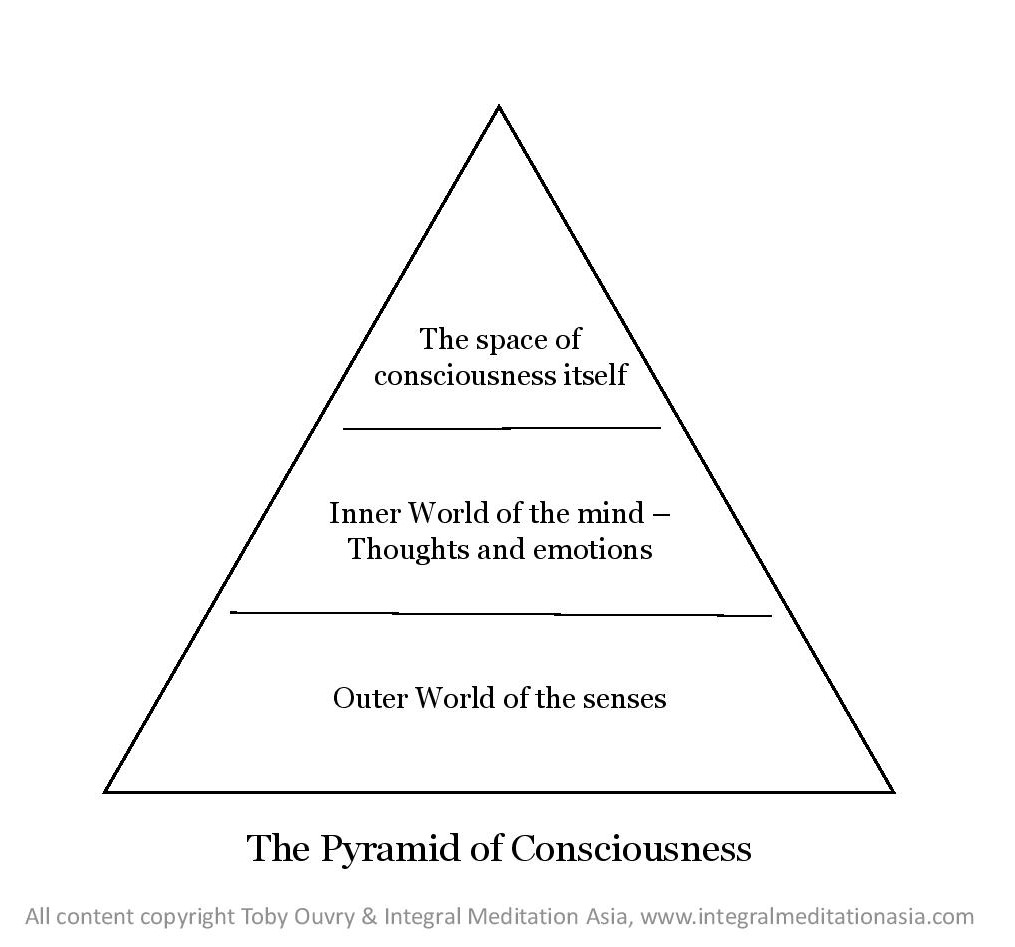
If you think about your consciousness as being like pyramid, with your senses as the broad base, your mind and emotions as the mid-section, and consciousness itself as the top tip (see the article diagram). In this exercise, we are focusing upon stabilizing the ‘base’ of our pyramid by paying attention to the weight of the body. If the base is stable, then everything above it is going to feel basically strong and stable, even when your under pressure.

You don’t need perfect concentration!
Even if as you are focusing on the weight of your body you are only able to concentrate 10-20% of your attention on it, then that is still 10-20% more stability and centre than you have when your lost in your thoughts and feelings. What’s more, if you lose focus on the weight of the body, its very easy to find again, as it is such a simple, obvious sensation. When you have a sensory ‘anchor’ for your consciousness, then even if you ‘get lost’ its easy to find centre again!

This week you might like to spend a few minutes each day ‘stabilizing the pyramid of your consciousness’ by paying attention to the weight of your body.

© Toby Ouvry 2018, you are welcome to use or share this article, but please cite Toby as the source and include reference to his website www.tobyouvry.com


Integral Meditation Asia

Online Courses 1:1 Coaching * Books * Live Workshops * Corporate Mindfulness Training *Life-Coaching *  Meditation Technology

Categories
Concentration Energy Meditation Life-fullness Meditation techniques Mindful Breathing Presence and being present Qi gong

Learning to conserve, build and circulate your energy

Dear  Integral Meditators,

How can mindfulness improve your energy levels and energy efficiency? The article below looks at this question in general, but also specifically from a qi gong perspective.
Two classes related to this topic, firstly the Qi gong workout and meditation class this Saturday morning. Secondly this week sees the beginning of a new series:  Five stages of integral meditation practice, from beginners to advanced. A five module course the first class of which will be in how to create an integrated, energetically strong body-mind.

In the spirit of energy,

Toby


Learning to conserve, build and circulate your energy (not waste it though dissipation and distraction)

One of the basic principles of Qi gong is that, through our awareness of energy we are trying to learn not to needlessly dissipate or “throw off” our mental, emotional and physical qi. Instead we learn to keep it within our energy field and circulate it within our mind-body continuum. Here are some practical ways in which we waste our qi and life force habitually:

  • Continuous physical fidgeting and habitual muscle tension (often due to lack of awareness of how our busy mind is causing our body to feel uneasy all the time)
  • Discomfort with feeling deep emotion (positive or negative), due to a habitual aversion to the vulnerability that deep emotion makes us feel. In general, deep emotion carries with it large amounts of qi that we can learn to circulate in our energy system. Repressing emotion, or becoming addicted to it/acting compulsively on it, causes us to lose our ability to use its qi in an effective way
  • Doing our physical actions, using much more muscle power than is necessary. For example typing at a computer with our facial muscles locked in an unconscious frown.
  • Compulsive and excessive (mindless or meaningless) speech
  • Compulsive and excessive thinking or worrying

In all the above ways and many more, we dissipate our qi on a daily basis. So, one of the best ways to start practising Qi gong is simply to make it a daily habit and discipline to be aware of how you are using your qi on a moment to moment basis. Ask yourself questions like:

  • “In the last hour, how effectively have I been using my life-force?”
  • “How much physical energy do I really need to walk from one place to another, how can I make my walking more energetically efficient?”
  • “Is the amount of thought that I am giving this problem really ergonomically effective?” (ie: the amount of good results relative to energy spent on the issue)

Here is a simple, 6 minute exercise that you can do to help develop awareness of your qi, and start to build it in your mind and body, rather than dissipate it needlessly. If you do this and nothing else as a Qi gong practice it will help you raise your energy levels:

For first two minutes:
Sit in a comfortable position. Visualize an energy field around your body, the shape of an egg, extending roughly 10-20cms from the surface of your body. Simply sit still, and focus on the physical stillness of your body. Notice the temptations to fidget and don’t follow them. Try to keep all of your energy in the present moment, and within the boundaries of your energy field. Use your breathing, your still body, and the edge of your energy field as your basic points of focus

For minutes 3-4:
Use the core body breathing technique to breathe energy into the core of your body and out to the edge of your energy field. As the qi moves in and out of the core of your body, retain it in your energy field so that you can feel it building and increasing.

For minutes 5-6:
Relax and breathe naturally, your body and energy field will now feel energized. Practice keeping mentally and physically still, whilst at the same time feeling full of energy and life-force.

This final state is the one that we are aiming to make the base line of our daily life and awareness as Qi gong practitioners particularly, but also as any type of meditation and mindfulness practitioner really: Simultaneously relaxed and energized.

© Toby Ouvry 2018, you are welcome to use or share this article, but please cite Toby as the source and include reference to his website www.tobyouvry.com


Upcoming Courses at Integral Meditation AsiaOngoing on Wednesday’s, 7.30-8.30pm – Wednesday Meditation Classes at Basic Essence with Toby

Ongoing on Tuesday evenings, 7.30-8.30pm – Tuesday Meditation Classes at One Heart with Toby (East coast)

Monday 6.15-7.15 & Wednesday 12.15-1.15 – Integral Meditation classes at Space2B on Stanley Street

September: Saturday 29th , October: Sat 6th/20th , Fri 5th/26th– Qi Gong workout and meditation class

Begins September 26th/27th – Five stages of integral meditation practice, from beginners to advanced. A five module course

Saturday 29th September, 2-5pm – OneHeart Open Day ‘Activating your journey of healing and empowerment’.

October Events:

Saturday 6th October 1-4pm – Mindful Resilience: Sustaining your effectiveness, happiness and clarity under pressure

Saturday 20th October 10.30am-5.30pm – Integral Meditation for Intermediate and Advanced Meditators

Saturday 27th October, 9:30am – 12:30pm – Meditations for creating a mind of ease, relaxed concentration and positive intention 

Saturday 27th October, 4-5.30pm – Get Your Meditation Practice Started Now – The Shortest and Most Time Effective Meditation Workshop Ever

Tues & Wednesday 30 & 31 October, 7.30-8.30pm – Samhain Meditation – Acknowledging the gifts and wounds of our ancestors


Integral Meditation Asia

Online Courses 1:1 Coaching * Books * Live Workshops * Corporate Mindfulness Training *Life-Coaching *  Meditation Technology

Categories
Energy Meditation Meditation techniques Mindful Breathing Qi gong

Qi Gong 101: Mindfully increasing & harmonizing your subtle energy 

Dear  Integral Meditators,

Qi gong is a way of working mindfully with the subtle energy in your body. This week’s article reflects upon two fundamental questions: What is Qi Gong? And what are the different elements of qi gong practice? I have placed the answers in six parts or divisions. You’ll see links embedded in the article that will take you to some simple practices from my Qi gong blog.

In the spirit of energy,

Toby


If you enjoy the article, then do check out my QG coaching and healing page. On the coaching page I share a little about my own personal journey with qi gong meditation!


Qi Gong 101: Mindfully increasing & harmonizing your subtle energy 

What is Qi Gong? Here are six different ways of answering this question, that together give an overview of the different aspects of qi gong practice.

1) Qi Gong is developing awareness of and circulating ‘qi’ or subtle energy.
All qi gong practices really focus around this basic point. They are all methods to improve the amount (quantity) of qi flowing through our body and mind, thus giving us more energy. Secondly, they improve the harmony and balance (quality) of the qi/energy flow. What is commonly referred to as ‘qi’ in qi gong is the subtle magnetic or bio-electrical energy that flows through the energy meridians in our body. The qi in our body is a part of a vast field of bio-electrical energy that pervades and infuses planet Earth. Other equivalent words for qi are vital energy, prajna, etheric force and “ki” (as in the Japanese word “re-ki” or “universal energy”).

What does Qi Gong practice consist of?

2) Standing
Qi gong practices teach us how to increase and harmonize the flow of energy through our body by adopting certain special standing positions. If you think about the sky and stars above you as being the positive pole of an electrical circuit and the Earth beneath you as being the negative pole, then your body is like the conductor of electrical energy between these two poles. Qi gong standing postures show how to tap into the energy of the universe simply by standing in an optimal manner.

3) Breathing
Qi gong practice teaches basic breathing techniques to develop and enhance the flow of qi around our bodies. At any given time, if you observe your breathing, you will find that it reflects the way in which your body and mind are feeling at that time. Qi gong breathing techniques focus on giving our breathing patterns eight fundamental qualities; Silent and fine, slow and deep, long and soft, continuous and even.

4) Smiling
This is such a fundamental part of qi gong that I tend to draw it out as an individual element. The expression on our face has a fundamental effect on the energy in our mind and body. By practicing a technique called the “inner smile” we can harness this form of qi or energy for many positive purposes in our life.

5) Movement
Qi gong promotes special types of gentle physical movement to help promote the flow of qi through the body. There is also a mechanical (in the positive sense of the word) aspect of qi gong movement that focuses on putting the joints of our body through their full range of movement on a regular basis. “A used door hinge never rusts” as the saying goes. Qi gong movement help us to exercise our joints and basic muscle groups in a way that helps to maintain them in a healthy, optimal state.

6) Practical philosophy
Qi gong is based around a great wealth of practical wisdom from the (mostly) Taoist tradition of health, primal psychology and spirituality. This provides a context and way of life that surrounds, infuses and informs the Qi gong practices outlined in points 1-5 above.

© Toby Ouvry 2018, you are welcome to use or share this article, but please cite Toby as the source and include reference to his website www.tobyouvry.com


Integral Meditation Asia

Online Courses 1:1 Coaching * Books * Live Workshops * Corporate Mindfulness Training *Life-Coaching *  Meditation Technology

Categories
Integral Meditation Meditation techniques mind body connection Mindful Breathing Qi gong

Incremental Breathing – Relaxing and energizing at will

Dear  Integral Meditators,

How can you use your breathing consciously to both energize and relax yourself at will? The article below offers a simple, easy to practice technique.
For those in Singapore, a reminder that the weekly evening meditation classes start again this week, full details here. This Saturday we also have a new  Qi gong meditation workout and meditation, as well as the monthly meditation for beginners workshop.

In the breathing and feeling alive,

Toby


Incremental Breathing – Relaxing and energizing at will

Incremental breathing is a way of using the breath to both energize and or relax our mind and body. Taking a few of these breaths at regular times during our day can really make a difference to the quality of our life, as well as making us more aware and empowered regarding how we can influence the energies of our mind, body and nervous system for the better using such an easy technique. Incremental breathing can be practiced on the inhalation when we want to energize our body, and on the exhalation when we want to calm and relax our body.
Practicing either of these two forms of breathing will be enhanced if we first bring our torso’s center of gravity down low into the belly and breathe with the whole lung. I explain these two points fully in my article on Belly breathing.

Incremental breathing on the inhalation.
As you breathe in, divide your inhalation into three even lengths or ‘sips’ as follows:
Breathe into about 25% lung capacity, pause*, breathe in to about 50% of lung capacity, pause, breathe into about 75% of lung capacity, pause. By this time your lungs are comfortably full. Then, breathe a long, slow exhalation. Repeat 3-9 times.
(*the pause here should be short, a half second or one second max).
Once you have become used to the above technique, as you are inhaling incrementally, feel all the cells of your body becoming more and more energized as you inhale, so by the time you reach the top of your inbreath, your whole body feels full of Qi /energy).

Incremental breathing on the exhalation.
First take a long, measured inbreath to about 75% of your lung capacity, so that your lungs are comfortably full. Then, as you breathe out, divide your exhalation into three even lengths:
Breathe out to about 50% of lung capacity, pause, breathe out to about 25% of lung capacity, pause, empty remaining air from lungs, pause. Repeat 3-9 times.
Once you have become used to the basic process of incremental breathing on the outbreath, as you breathe out incrementally, feel your whole body becoming progressively more and more relaxed.

Once you have practised them individually, you can combine these two techniques together, so that you are breathing in incrementally to energize your body and mind, and then breathing out incrementally to relax your body and mind. The result is a very pleasant combined experience of energy and relaxation that we can take into and use in our life.

For the insomniacs among you, this type of breathing, particularly breathing incrementally on the exhalation can be good to combine with the ”Hands on the belly to relax the brain”technique in the article I published in July. Enjoy your breathing!

© Toby Ouvry 2018, you are welcome to use or share this article, but please cite Toby as the source and include reference to his website www.tobyouvry.com


Upcoming Courses at Integral Meditation AsiaOngoing on Wednesday’s, 7.30-8.30pm – Wednesday Meditation Classes at Basic Essence with Toby

Ongoing on Tuesday evenings, 7.30-8.30pm – Tuesday Meditation Classes at One Heart with Toby (East coast)

Begins 14/15th September – Effortless effort – Insight meditation for self-healing and transformation – a five week course

Monday 6.15-7.15 & Wednesday 12.15-1.15 – Integral Meditation classes at Space2B on Stanley Street

Saturday 11th August, 9-10.15am – Qi Gong workout and meditation class

Saturday 11th August, 11am-12.30pm – Get Your Meditation Practice Started Now – The Shortest and Most Time Effective Meditation Workshop Ever

Saturday 18th August, 9.30-1pm – Meditations for Developing the Language of Your Shadow Self Workshop


Integral Meditation Asia

Online Courses 1:1 Coaching * Books * Live Workshops * Corporate Mindfulness Training *Life-Coaching *  Meditation Technology

Categories
Energy Meditation Meditation techniques Mindful Breathing Mindfulness Qi gong Stress Transformation

Hands on the belly to relax the brain (a short cut to sleeping at night?)

Dear  Integral Meditators,

Greetings from Berlin where I’m traveling right now! Before I left for the holidays, I facilitated a Qi gong workshop, which then led me to start having a look at some old qi gong meditation articles that I had written out a decade or so ago. The method below is one that you can use to help you fall asleep at night, and to relax your nervous system whenever you want to dial down and get out of your thinking mind for a while for a while. Enjoy!

In the spirit of conscious relaxation,

Toby


Hands on the belly to relax the brain (a short cut to sleeping at night?)

This is a very simple technique that I use often in order to calm and reduce conceptual activity and center myself fully in my body. I use it most frequently when my mind is whizzing when I lie down to go to sleep at night, or if I want to take a quick nap during the day and want to move into a state of relaxed non-conceptuality relatively fast. It can be done sitting, standing or lying down:
Simply place your hands one on top of the other on your belly, just beneath your belly button. Close your eyes, relax the brain and simply focus on the feeling of warmth that the resting hands create on the lower belly. If you like you can imagine that the lower belly area is like a magnet, and that energy from the brain is gently being attracted down into the torso by the pull of this magnet. However, to be honest I find that this is not necessary, the natural sensation of the hand on the belly does the work for you, without you having to do a lot else!
Related articlesBasic Qi Gong Belly Breathing
Meditation Technique For Brain Relaxation, Non-Conceptuality and Falling Asleep at Night.

© Toby Ouvry 2018, you are welcome to use or share this article, but please cite Toby as the source and include reference to his website www.tobyouvry.com


Upcoming Courses at Integral Meditation AsiaOngoing on Wednesday’s, 7.30-8.30pm – Wednesday Meditation Classes at Basic Essence with Toby

Ongoing on Tuesday evenings, 7.30-8.30pm – Tuesday Meditation Classes at One Heart with Toby (East coast)

August program coming soon!


Integral Meditation Asia

Online Courses 1:1 Coaching * Books * Live Workshops * Corporate Mindfulness Training *Life-Coaching *  Meditation Technology