Categories
A Mind of Ease Inner vision Integral Awareness Life-fullness Meditation and Psychology Meditation techniques Mindful Resilience Mindfulness Presence and being present Primal Spirituality Stress Transformation

Mindfully Re-Contextualizing Our Biological Fear

“Recognition of safety in the present provides a new basic context for our mind & biological fear, where the underlying feeling is one of relaxation & ease, not paranoia”
Dear Integral Meditators, 

This weeks article looks at biological fear, and how we can work to mindfully re-direct its functioning in our mind so that it is working for us rather than against us in our life.

If you enjoy the article, we will be doing a meditation on ‘The art of non-emergency – Making friends with fear’ in both the Wednesday & Saturday classes this week, you would be welcome to attend, either online or in-person. 

In the spirit of ease,
 
Toby


Re-Contextualizing Our Biological Fear
 
Our biological fear is that part of our body and brains’ programming that essentially works to ensure our survival. It is extremely ancient and the strategy that it has is based around is paranoia. Its reasoning is that, the more paranoid you are about potential threats to your wellbeing, the more likely you are to survive. For most of human kinds history this has worked very well, as up until quite recently there have always been genuine threats to physical survival, such as wild animals and head-hunters who, if you were not alert really could end your life prematurely.
However, in our present time, where our immediate physical surroundings are relatively safe. As often as not our paranoid survival-based programming often gets in the way of our happiness, and capacity to relax and enjoy our daily existence. It:
 

  • unconsciously prevents us from appreciating the good things that we have
  • exaggerates threats to our safety and wellbeing
  • focuses on all the negatives in our life
  • keeps us highly stressed
  • makes us feel like we are living in a dog-eat-dog world, and generally living in fear of what could go wrong in the future.

 
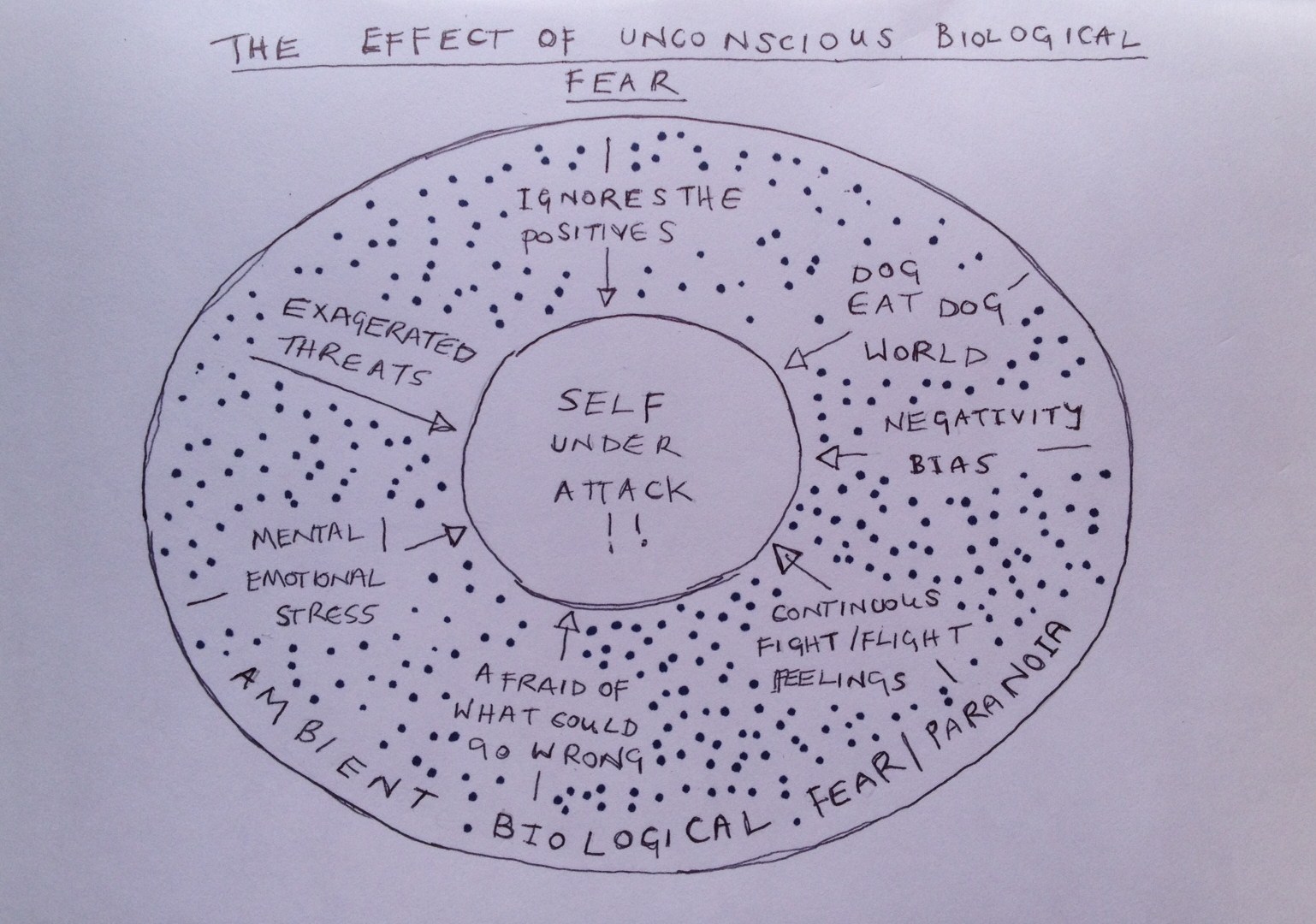
As a result, we often feel like we are under some form of physical or psychological attack, even when right at that particular time we are under no immediate threat. I’ve represented this situation in the diagram below. The big circle is the ambient biological fear pervading our mind, and making us feel as if we are under attack all the time, thus unnecessarily adding to rather than subtracting from the real and present challenges that we actually do have in our life.
So what is the solution to this? It is basically a two-fold move that we need to make:

  • Recognize that we have this biological fear ticking away in the background, and make sure that we are not letting it run the way we approach and experience our life.
  • Regularly learn to recognize and rest our awareness in the relative physical and psychological safety of the present moment.

 
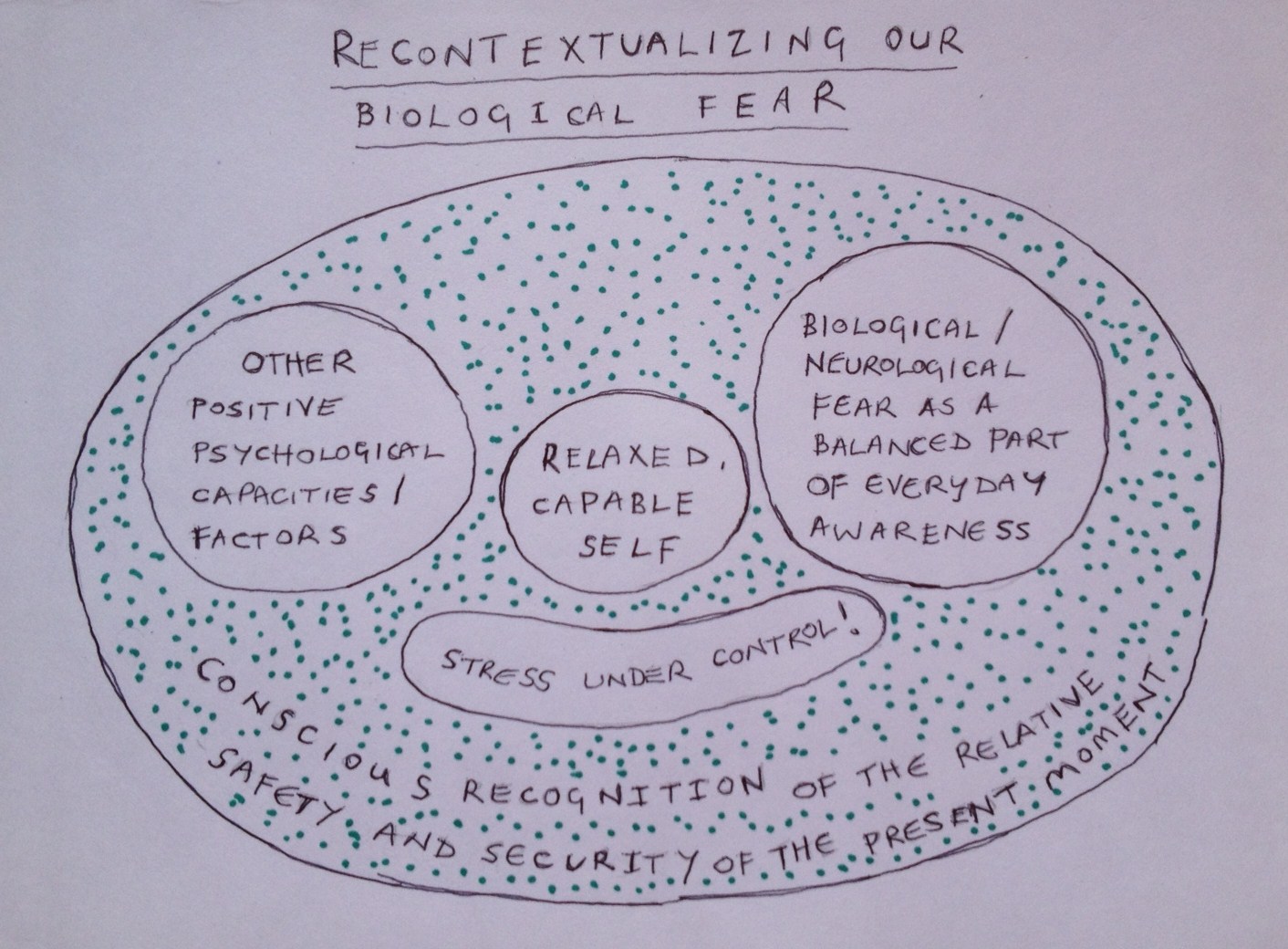
This recognition of safety in the present moment then provides a new basic context for our mind and life, where the underlying feeling is one of relaxation and ease. Within this new context the other biological and psychological aspects of our experience (including our biological fear) can function appropriately and in their proper place. I’ve represented this in the diagram below, where you can see the recognition of safety in the present as a big circle of awareness that provides a context for the rest of our moment-to-moment experience. In this new arrangement our biological fear remains in our mind, able to perform its function of detecting threats to our wellbeing and safety, but doing so without inhibiting and blocking other mental and emotional factors in our mind that cause us happiness and wellbeing.
Recommended one-minute mindfulness for the week:

Spend one minute, three times a day sitting quietly, following your breathing and recognizing that, right at this moment there are no immediate threats to your physical or psychological safety. Rest at ease in this experience and try and take it as much as possible into the rest of your day.
 
Related articles: The art of non-emergency
How to mindfully thrive with today’s stress (safety & fear)


© Toby Ouvry 2026, you are welcome to use or share this article, but please cite Toby as the source and include reference to his website www.tobyouvry.com 


Follow Toby on: LinkedIn, YouTube, Instagram

Integral Meditation Asia

Live workshops & online Courses * 1:1 Coaching * Books * Corporate Mindfulness Training *Life-Coaching *  Meditation Technology
Categories
Awareness and insight creative imagery Inner vision Integral Awareness Life-fullness Meditation and Psychology Mindfulness Presence and being present spiritual intelligence

Four types of mindful coaching & self-coaching conversation

“The journey of coaching is often from a life of “functional meaning” directed by the ego to a life of deeper meaning & orientation around the souls wish to creatively express goodness, beauty & truth”

Dear Integral Meditators, 

This week’s article is a slight edit of a 2012 article that I wrote, after I had been coaching as a professional for around ten years. fourteen years later in 2026, it still holds water for me. I still use the four questions both for coaching others and for self-coaching.

Enjoy & a very happy Deepavali to those celebrating!

In the spirit of enquiry,

Toby

Find out more about Toby’s Life-coaching, executive coaching, self-knowledge program & shadow coaching


Four types of mindful coaching & self-coaching conversation
 
When I am in a coaching session with someone, although on one level there is only one conversation going on, on another level there are four basic aspects or dimensions that I try and pay mindful attention to within the conversation. Each one gives me some information about where the client is coming from and what they might need in terms of guidance and input. It is also a model that I use in my own self-care and self-reflection when looking at what is happening within me.
 
The Conscious Self – This is the daily functional self or “persona” of the client. The information that they give me on this levels is basically that which their conscious mind understands to be true with regard to the problem or challenge that they are facing. Generally this information will come through directly and explicitly in the conversation that is being had.
 
The Shadow Self – This is the aspect of the daily self or ego that is hidden to the client as it has been repressed into his/her unconscious mind, and thus is invisible to her. Sometimes I might do an exercise specifically designed to investigate their shadow, but as often as not I’ll get to know the persons shadow implicitly through the nuance of what is said, and the language that is used (or left out) in the conversation, their body language and their response to certain emotional triggers.
 
The Soul – You might think of the soul as the higher or deeper self of the client, and it is from this dimension of their being that they often feel the impulse toward establishing deeper meaning and direction in their life, and toward the expression of the principles of goodness, beauty and truth. Quite often the coaching journey that I take with people is, in an essential way the journey from a life of “functional meaning” directed by the ego to a life of deeper meaning and orientation based around the souls wish to creatively express goodness, beauty and truth.
 
The Spirit – On one level you might think of the spiritual dimension of the coaching conversation as being that which is concerned with helping the client connect to a sense of silence, presence and peace within themselves that helps them negotiate the challenges of their life with less negative stress and a greater sense of creativity and freedom. The spiritual level of the conversation involves the connection to a sense of the deepest levels of both peace and creativity within the client, and helping these to start playing a tangible part in both the conversation as we are having it, as well as in their life as a whole.
 
Four mindful and integral self-coaching questions:
 
Based around the above model, here are four self-coaching questions that you might like to ask yourself when presented with a challenge or opportunity in your life:

  1. What is my conscious understanding of the problem or challenge as I understand it?
  2. What hidden emotions, psychological discomfort and agendas do I sense within me lying beneath my conscious perception?
  3. What is my soul asking of me in this situation in terms of the expression of meaning, goodness, beauty and truth? What opportunities does my soul see here?
  4. Viewed from the perspective of stillness and peace what is my free-est and most creative response to what is happening?

 
Related articles: The dynamic of personal evolution
Fulfillment of the Ego, Fulfillment of the Soul, Fulfillment of Spirit
Balancing the Development of Your Ego and Spirit


© Toby Ouvry 2026, you are welcome to use or share this article, but please cite Toby as the source and include reference to his website www.tobyouvry.com 


Follow Toby on: LinkedIn, YouTube, Instagram

Integral Meditation Asia

Live workshops & online Courses * 1:1 Coaching * Books * Corporate Mindfulness Training *Life-Coaching *  Meditation Technology

Categories
Awareness and insight Inner vision Integral Awareness Integrating Ego, Soul and Spirit Life-fullness Mindful Resilience Stress Transformation Using the Energy of Negative Emotions

 Distinguishing attachment, positive-attachment, non-attachment & dissociation

‘Positive attachment is learning to link, connect & care in ways that are balanced, appropriate, coming from an inner place of fullness rather than emptiness or lack’

Dear Integral Meditators, 

This week’s article looks at some distinctions around attachment & non-attachment. There is a reall opportunity for joy & fullness when we get these distinctions right, & often a high price to be paid when we get them wrong…

If you enjoy the article you would be welcome to come along for this week’s Wednesday & Saturday classes, where we will bbe taking attachments & desires as the subject of meditation!

In the spirit of balanced linking,

Toby


Article: Distinguishing attachment, positive-attachment, non-attachment & dissociation: Finding the middle way to enjoying your life fully
 
Non-attachment is a major part of any path of inner growth
All the great spiritual traditions teach it in one form or another. As the Buddha said (many times in one way or another) “All suffering comes from attachment”.
Often, the way to overcome attachment we are told is to practice non-attachment. Being told this, it is very easy for us to misunderstand, and go to the extreme of dissociation (dis-association); completely cutting ourselves off from our enjoyments, emotions, passion, and enthusiasm.
As a result of falling into dissociation, we can lose our authentic connection to life, relationships and spiritual path.
By non-attachment, in the healthy sense of the word, we simply mean the ability to maintain some degree of objectivity with regard to someone or something that we are engaging with.  
 
So, really non-attachment is a path that steers between the extremes and illusions of both imbalanced attachment and dissociation.
 
One further issue with dissociation is that it leads to a repression of our attachments and desires. Rather than working with them appropriately, we simply push them into our unconscious or subconscious minds, where they continue to seek out their agendas without our being fully aware of them. This in turn leads to a whole host of other secondary challenges and issues.
 
Let’s define our terms:

  • Imbalanced attachment is a state of mind that has become so absorbed into or addicted to an activity, person or object that it cannot be happy without that “thing”.
  • Dissociation is when we completely cut ourself off emotionally, personally, mentally from a person, object or enjoyment in the false belief that non-attachment means being completely above and beyond any kind of human connection, if we are enjoying ourself it must be wrong, and cannot be ‘spiritual’!

 
Genuine non-attachment is the key
A person who has balanced non-attachment is someone who is able to fully enjoy and engage in their relationships, work, leisure activities and so on without being totally reliant upon those things for his or her inner happiness and sense of wellbeing.
 
So, with non-attachment it is not just a matter of cutting ourself off from attachments, it is also avoiding the extreme of dissociation. In order to be happy, we need to feel committed to life, we need to be passionate, we need to care, we need to get emotional, we need to be able to positively direct our desires toward constructive goals.
Many well intentioned and aspiring mediators and “spiritual” people live a life of inner conflict because they think they are practicing non-attachment, when in fact they are practicing dissociation which, put bluntly, very often causes misery in the long term.
If you know the difference between attachment, non-attachment and dissociation, you can begin treading the happy, vibrant, engaged path of non-attachment in your daily life. It is a comfortable, radiant middle way that enriches us all the way up and all the way down; physically, emotionally, mentally, spiritually.
 
One further way of thinking about this middle path of engaged non-attachment, is as a path of ‘positive attachment’. By this I mean a path where we learn to relate and attach to people, places and things in such a way they the attachment is warm, balanced, caring, appreciative. When you ‘attach’ something to something else, you ‘link’ or ‘connect’ it. Positive attachment is learning to link, connect and care in ways that are balanced, appropriate, coming from an inner place of fullness rather than emptiness or ‘lack’.
 
 
Related articles: Going from clinging on to enjoying (Attachment to appreciation)
The middle way
 

© Toby Ouvry 2026, you are welcome to use or share this article, but please cite Toby as the source and include reference to his website www.tobyouvry.com 


Follow Toby on: LinkedIn, YouTube, Instagram

Integral Meditation Asia

Live workshops & online Courses * 1:1 Coaching * Books * Corporate Mindfulness Training *Life-Coaching *  Meditation Technology